
Revelations from co-authoring Brigadier Musa Usman’s biography
Theophilus Abbah (co-author)
Every time Hajiya Ramatu Ohioma Ali (now late) spoke or called me, her voice carried a brutal force of authority I could not resist. So, it was in 2020, when her name flashed on my sleek Samsung handset. In an undisguised commanding tone, she declared: “You’re part of a project to write the biography of Brigadier Musa Usman.”
The name meant nothing to me; it did not stir any memory. “Who’s he?” I asked.
“Theo,” Ramatu reprimanded sharply. “Don’t tell me you’ve never heard that name. Brigadier Musa Usman was my uncle. He was governor of the North-Eastern State. You and Mahmud Jega will write his biography.”
Her words fell on me like shadows. I had never heard of Brigadier Musa Usman until then, nor could I recall any Nigerian state called “North-Eastern State.” My earliest memory of northern states dated back to the early 1980s, when, as primary school pupils, we memorized the nineteen northern states and their capitals. “North-Eastern State” was not among them.
I would later learn that Brigadier Musa Usman had died in 1991. Why, then, would Ramatu drag me into a task that felt like pressing water from stone? She had previously enlisted me to ghostwrite an autobiography—a project that succeeded because the subject granted extensive interviews, provided documentary evidence, and connected us with corroborating witnesses for frank interviews. But this new assignment was different. We would not hear from the horse’s mouth. We were being asked to walk through a dark tunnel and somehow produce a meaningful biography.
Hajiya Jummai Musa Usman, opened the gate to the hidden past with the details she shared in a foundational conversation.
At our first meeting, held at the residence of Senator Abdulrahman Abubakar, Mahmud Jega arrived with a detailed outline of the book’s chapters. I must confess: I was bewildered. How had he generated what seemed to be the contents of each chapter? Of course, Jega was renowned for his elephantine memory. At editorial meetings at Daily Trust, he routinely alluded to past social, political, and economic events—often to the astonishment, if not dismay, of other board members. From historical examples, he would predict future consequences of current debates. How could one man always have something insightful to say about everything?
From the chapterization Jega presented, it was clear he was prepared for the long haul of writing the biography. I, on the other hand, felt myself retreating into my shell, already contemplating withdrawal. The small chops served as refreshment that afternoon changed its taste from smoothness to bitterness in my mouth when Jega announced that he had assigned the first three chapters to me to write.
How could I write about Brigadier Musa Usman’s childhood without the privilege of interviewing him? When I was an undergraduate, Creative Writing was my best and most favourite course. My short stories had appeared in the Sunday New Nigerian and in an anthology, and since the early 1990s I had begun to describe myself as a writer. I knew how to sustain suspense, deploy rhetorical devices, initiate conflict, describe characters and scenes, and weave narratives around themes. My novel Lost in the Wind fictionalizes a real tragic incident. But biography is not fiction. It demands cold facts and evidence. Even narrative non-fiction requires factual raw material to succeed.
So how could Jega expect me to write the opening chapters of a book whose foundations were still shrouded in mist?
But the mist began to lift, revealing a clearer historical narrative as we conducted interview after interview. Brigadier Musa Usman’s widow, now the family’s matriarch, Hajiya Jummai Musa Usman, opened the gate to the hidden past with the details she shared in a foundational conversation. Her recollections traced her husband’s childhood, education, military career, and the imprint he left as military governor. For context, she pointed us toward published autobiographies of Musa Usman’s contemporaries—works that illuminated the background to policies, projects, and decisions that laid the foundation for the future of the North-East.
Further interviews with siblings, cousins, uncles, and extended family members produced a torrent of tributaries, a flood of details that overflowed the boundaries of my expectations. Journalism then came to the rescue—history written in haste, yet invaluable. From the archives of the New Nigerian newspaper, we unearthed stories and interviews that transported us into the lived experiences of Brigadier Musa Usman. As the dominant publication from the 1960s through the military era, the New Nigerian chronicled events involving Musa Usman and the North-Eastern State. Supplementary resources from the Borno State History and Culture Bureau in Maiduguri further enriched our trove: newspapers, journals, government documents—all bearing evidence of the late governor’s imprint.
Soon, multiple Ghana-must-go sacks filled with documents arrived, and with them the arduous task of synthesizing and categorizing material into thematic areas. The project consumed months, as we cross-checked documents against oral testimonies and memoirs referencing Musa Usman’s era. The work was tedious, at times frustrating. As the author of Ecclesiastes observed, “Much study wearies the body.”
Read Also: Service & Impact of Brigadier Musa Usman: A Book Revıew
The most difficult challenge was reconstructing Musa Usman’s role during the Nigerian Civil War. Accounts of his attitude and actions were scarce. Yet one truth emerged: though the North seethed with anger over the misadventure of the “Five Majors,” and though the butchery of Igbos was tragically fashionable, Brigadier Musa Usman refused to partake in the shedding of innocent blood. To prevent the madness from infecting the Nigeria Air Force Command under his leadership in Kaduna, he disarmed his officers, ensuring none succumbed to the demon of bloodshed spreading from city to city. In him, we saw a pacifist soldier—clear-headed, principled, steering the Air Force away from reckless adventures.
Drafting the book was like passing through a grinding mill. Yet the bitter process awakened in me a desire to know more about my own environment. While cross-checking Musa Usman’s background, I discovered that his father, Usman Kakagida, had lived in Ankpa military barracks and served as a recruiter for the British Army’s West African Frontier Force in the 1940s. I hail from Ankpa Local Government Area, yet I had been ignorant of any military barracks there. Many elders of my father’s generation had fought in the “Hitler War”—some returned, others were ‘eaten’ by it. I had often wondered how the British reached my remote village to recruit fighters for the Second World War. This research revealed the depth of colonial presence in Ankpa: powerful resident officers overseeing tax collection, and a military recruitment field within the barracks. We had heard of “the barracks,” but not of its role in the global conflict.
Most of the landmark projects in today’s North-East trace their origins to Brigadier Musa Usman’s nine-year leadership.
The work unveiled unsettling truths about Nigeria. At just 27, Musa Usman bore the political, economic, and social burdens of the North-East—now divided into six states. The weight was surreal. Compared with today, when 40-year-old governors flaunt their youthfulness, one must ask: how mature were these men when they joined the army? How did Musa Usman manage such a diverse society without a degree in Political Science or Political Economy? What curricula at the Nigerian Military Academy and the Royal Military Academy in Sandhurst forged such strong-willed, dynamic leaders—men who steered Nigeria through coups and a three-year civil war? What prepared them to navigate the treacherous politics left by the British and the corrupt contraption of the First Republic, stabilizing Nigeria and ushering in the economic boom of the 1970s? What was the magic? These questions demand a new inquiry into the political leadership of that era—and the lessons modern politicians might yet draw from them.
The climax of my learning experience in researching and co-authoring the 363-page biography with Mahmud Jega was the revelation of a hero whose memory might have been erased from Nigeria’s political consciousness—were it not for the initiative to write his posthumous story. Most of the landmark projects in today’s North-East trace their origins to Brigadier Musa Usman’s nine-year leadership, from 1967 to 1975.
Dr Theophilus Abbah
The enduring glory of Gombe State remains Ashaka Cement, established under his watch. Taraba State still points to the Mambilla Project as its defining institution. In the 1970s, Musa Usman invited experts from Kenya to unlock the Plateau’s economic potential—tea cultivation and energy production. The University of Maiduguri, revered across the North-East, owes its existence to his vision; generations of public servants, political leaders, and business magnates proudly call themselves graduates of “Unimaid.” Bauchi State’s jewel, Yankari Game Reserve, was revived from slumber by his intervention.
Towns like Yola, Bauchi, Damaturu, Gombe, and Jalingo—once provincial headquarters starved of amenities—were transformed. Today they stand as state capitals, modernized by roads and institutions Musa Usman deliberately planted to inject progress into rural landscapes. His vision of balanced development ensured that dusty towns became centers of governance and growth.
This reflection may read like another chapter of his biography, yet for me, the experience of writing the book was more transformative than any other work I have undertaken—save for my doctoral thesis. The lesson is clear: much is possible in Nigeria if our leaders set their minds to it.
Age is no barrier. Musa Usman, in his youth, carried the weight of governance with remarkable impact. Tribal differences are no barrier. His father was Kanuri, his mother Igala; his wife had an Igbo father and a Fulani mother. None of these identities distracted him from the pursuit of good governance. Education is no barrier. Without a doctorate in Political Science, he left behind legacies that demand serious scholarly inquiry. Even insecurity is no barrier. Foreseeing the dangers of insurgency, Musa Usman established the Lake Chad Commission to police porous borders and forestall incursions by foreign fighters.
Read Also: Two words defined the life of Brigadier Musa Usman, says Senator (General) Ike Nwachukwu
I am persuaded that Nigeria harbors many more unsung heroes and heroines like Brigadier Musa Usman. Perhaps it is time to tell their stories. Perhaps their experiences hold the keys to Nigeria’s development and prosperity.
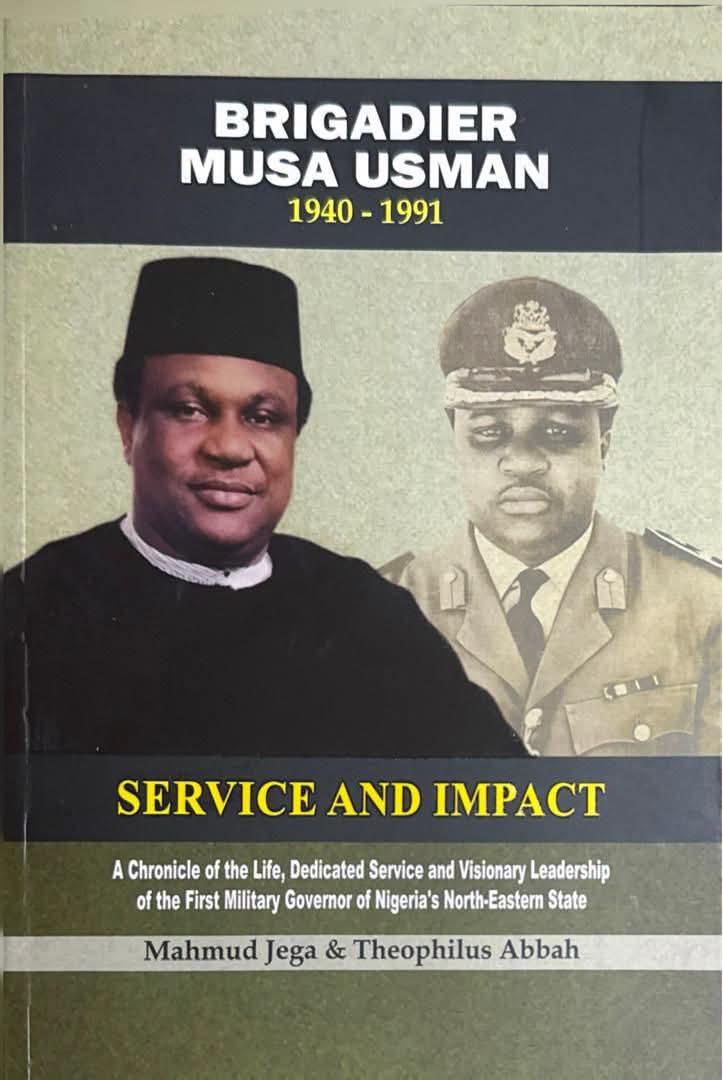
On Monday, September 14, 2026, Nigerians from diverse backgrounds gathered. State governors, led by the dynamic Professor Babagana Zulum of Borno State, joined dedicated ministers in Bola Ahmed Tinubu’s government. Traditional rulers, seasoned retired military generals, influential architects of Nigeria’s security framework, experienced retired public servants, and vibrant groups from all parts of the country also converged. They assembled at the spacious Nigerian Air Force (NAF) Conference Centre in Kado, Abuja, for the grand public presentation of the book Brigadier Musa Usman (1940–1991): Service & Impact, written by Mahmud Jega and me.
The 1,000-seat capacity hall was completely full, and many eager attendees stood patiently in the crowded aisles to watch the almost solemn proceedings. Vice-President Kashim Shettima, once a governor of Borno State, was the distinguished Guest of Honour. He was ably represented by his Special Adviser (Political), the articulate Dr. Aliyu Modibbo.
Yes, Nigerians can now proudly read and deeply learn from the story of one of their nearly forgotten national heroes, the late, courageous Brigadier Musa Usman.
Read Also:‘Why the family commissioned this book of Brigadier Musa Usman’
Author

Sign up for The Insight Newsletter
Get in-depth, research and data-based interpretative reports from around Nigeria.


