
UniAbuja Shuts Gates as Day Three Protest Against Wike’s Alleged Land Grab Leaves Students Stranded
By Emmanuel Kwada
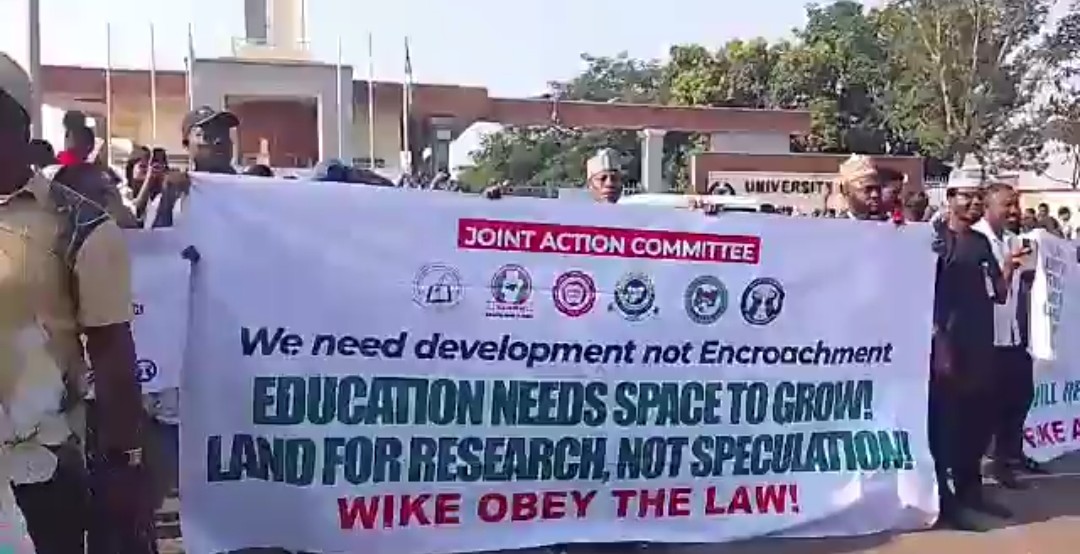
Students of the University of Abuja were left stranded on Wednesday as the institution’s gates remained shut amid the ongoing protest against the alleged reallocation of part of the university’s land by the Minister of the Federal Capital Territory, Nyesom Wike.
The development, which disrupted movement in and out of the institution, came as the protest entered its third day, with students, lecturers, non-academic staff and alumni demanding a reversal of the decision. However, the Federal Capital Territory Administration (FCTA) has dismissed the protest as misplaced, insisting that Wike only implemented a recommendation and approval made by the previous administration.
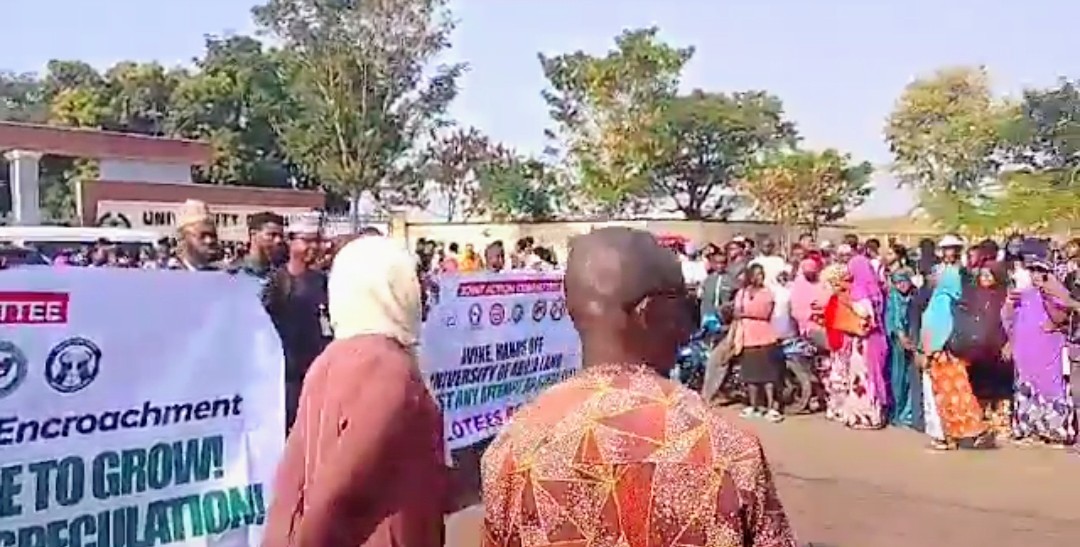
A video circulating on social media, shared by Henry Tyohemba, showed the university gates locked, leaving students unable to gain access to the campus.
The protest began on Monday, November 16, following growing opposition to the reduction of the university’s land from 11,824.04 hectares to 4,685 hectares.
Members of the Academic Staff Union of Universities (ASUU), Senior Staff Association of Nigerian Universities (SSANU), Non-Academic Staff Union of Educational and Associated Institutions (NASU), alongside students under the Students’ Union Government (SUG) and alumni, took part in the demonstration.
Carrying placards and chanting solidarity songs, the protesters called for the reversal of the alleged land reallocation and urged President Bola Tinubu to intervene in the dispute.
The Students’ Union Government had earlier announced a three-day protest scheduled to run from November 16 to 18. The continued shutdown of the gates has, however, raised concerns about the impact of the dispute on students’ academic activities and access to essential services within the university.
FCTA Defends Wike, Says Previous Administration Approved Land Reduction
In a statement issued on Monday, November 16, the FCTA described the protest by the university’s Joint Action Committee (JAC) as misplaced, arguing that Wike merely acted on a recommendation made by a joint committee established by the FCTA and the university in 2016.
The protesters called for the reversal of the alleged land reallocation and urged President Bola Tinubu to intervene in the dispute.
The statement, signed by the FCT Minister’s Senior Special Assistant on Public Communications and Social Media, Lere Olayinka, said the committee was inaugurated on November 10, 2016, by the then FCT Minister to examine the university’s land size, alleged encroachment by indigenous settlers, developments around its Gwagwalada Mini Campus and the issuance of land titles.
According to the FCTA, five of the committee’s 12 members were representatives of the University of Abuja, including Professors Otaki Alanana and A. Mallam, Mohamed Kassim, A.E. Ripite and Sadiq O. Shuaibu.
The administration said the committee concluded that the university’s main campus land, measuring more than 11,000 hectares, was far beyond the 100 hectares recommended by the National Universities Commission (NUC).
It further claimed that the committee recommended that the university be allocated 100 hectares in line with the NUC’s recommendation, and that its report was approved by the immediate past FCT Minister, Mohammed Musa Bello.
However, the FCTA said Wike went beyond the 100 hectares recommended by the committee by approving 4,519.80 hectares for the university, which it argued could accommodate more than 80,000 buildings on 500-square-metre plots.
The administration also alleged that the university had allocated portions of its land to individuals and corporate organisations, including the Economic and Financial Crimes Commission (EFCC), which it said received 100 hectares without recourse to the FCTA.
Questioning the basis of the protest, Olayinka challenged the unions, student leaders and alumni to explain why they were opposing a recommendation that, according to the administration, had involved representatives of the university and received approval under the previous FCT leadership.
The statement also questioned the need for the university to retain more than 11,000 hectares, asking what major expansion had taken place in its 38 years of existence to justify the land size.
The FCTA maintained that the land reduction would not affect workers’ salaries or students’ academic activities, insisting that the government was entitled to review the size of land allocated to an institution it owns.
The controversy has brought renewed attention to the importance of protecting public educational institutions’ land and ensuring that decisions affecting their future are handled transparently.
Established in 1988, the University of Abuja has grown into one of Nigeria’s major federal universities. Its land provides space not only for existing academic and administrative facilities but also for future expansion, including hostels, research centres, lecture halls and other infrastructure.
While the FCTA maintains that the land reduction was based on an earlier committee recommendation and was intended to address land-use concerns, protesters fear that the decision could undermine the institution’s long-term development and limit its capacity to accommodate future growth.
The dispute has therefore placed the university community and the FCT Administration on opposing sides, with the protesters demanding a reversal of the decision and the administration defending the process that led to it.
As the protest enters its third day, students remain among those most affected by the disruption, with many facing uncertainty over access to the campus and possible interruptions to academic activities.
The unfolding situation has heightened calls for dialogue between the FCTA and the university community, as stakeholders seek a resolution that addresses the land dispute without further disrupting teaching, learning and other university activities.
Author

Sign up for The Insight Newsletter
Get in-depth, research and data-based interpretative reports from around Nigeria.


