
Nigeria Secures $5bn Africa Energy Bank Headquarters as Continent Moves to Close $200bn Funding Gap
By Emmanuel Kwada
Nigeria has secured a major position in Africa’s energy financing landscape with the formal establishment of the $5bn Africa Energy Bank in Abuja, a new pan-African financial institution expected to mobilise funding for oil, gas and other strategic energy projects across the continent.
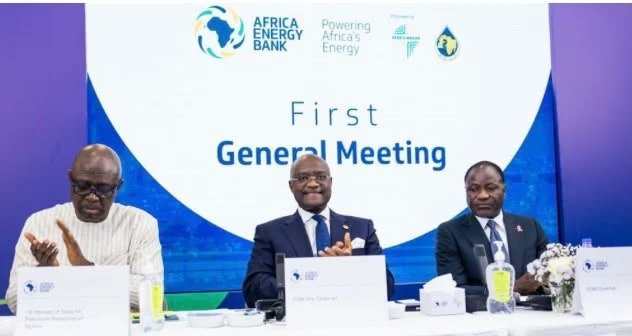
The bank, established through a partnership between the African Export-Import Bank (Afreximbank) and the African Petroleum Producers’ Organisation (APPO), was formally announced at its inaugural general meeting held in Abuja on Saturday, October 31, 2026.
The bank will finance projects across the energy value chain, including petroleum exploration, production, transportation, processing, refining and distribution.
With an authorised capital of $5bn, the institution is designed to address growing financing challenges in Africa’s petroleum industry, particularly as traditional international lenders increasingly withdraw funding from fossil fuel projects.
According to a joint statement by Afreximbank and APPO, the bank will finance projects across the energy value chain, including petroleum exploration, production, transportation, processing, refining and distribution.
The initiative comes against the backdrop of an estimated $200bn energy investment requirement across Africa, highlighting the enormous financial gap facing the continent’s energy development ambitions.
The promoters explained that the new institution would provide an alternative financing platform to support African energy projects and strengthen the continent’s capacity to develop its natural resources.
“Traditional providers of short- and long-term financing to Africa’s energy sector are withdrawing funding from fossil fuels, even as oil and gas remain vital to the continent’s energy systems,” the statement noted.
The bank is also expected to promote local refining capacity, reduce Africa’s dependence on imported petroleum products and encourage energy trade among African countries.
Beyond the petroleum industry, its mandate will cover investments in energy generation and transmission infrastructure, which are considered essential to industrialisation, economic expansion and the growing electricity demands of emerging technologies, including artificial intelligence.
The institutions further stated that the bank would promote stronger African participation in the continent’s energy industry, ensuring that investment decisions and development priorities reflect Africa’s economic realities.
At the inaugural general meeting, participating institutions approved the appointment of Helmy Ghazi as the bank’s first president and constituted its maiden Board of Directors, comprising representatives from the public and private sectors and policy institutions across Africa.
The meeting attracted key African energy stakeholders, including Nigeria’s Minister of State for Petroleum Resources (Oil), Senator Heineken Lokpobiri; Afreximbank President and Chairman of its Board of Directors, Dr George Elombi; and Côte d’Ivoire’s Minister of Mines, Petroleum and Energy, Mamadou Sangafowa-Coulibaly.
The Africa Energy Bank is expected to operate as an independent, supranational pan-African financial institution, attracting investments from African governments, national oil companies, financial institutions and private investors.
For Nigeria, hosting the institution represents an important opportunity to strengthen its influence in continental energy financing, attract investments and support the development of regional energy infrastructure.
However, with Africa’s estimated energy investment needs standing at $200bn, the bank’s $5bn authorised capital represents only an initial contribution towards the broader financing challenge.
Its long-term impact will therefore depend on its ability to attract additional capital, develop bankable projects and ensure that funding translates into tangible improvements in energy production, refining capacity, electricity supply and economic opportunities across Africa.
Afreximbank, one of the continent’s leading multilateral financial institutions, reported total assets and contingencies exceeding $54.1bn as of September 2026, with shareholder funds of $9bn.
APPO, established in Lagos in 1987, promotes cooperation among African petroleum-producing countries through policy coordination, technical collaboration and knowledge sharing.
The establishment of the Africa Energy Bank marks a significant step in Africa’s efforts to develop independent financing mechanisms for its energy sector while navigating changing global investment priorities.
Author

Sign up for The Insight Newsletter
Get in-depth, research and data-based interpretative reports from around Nigeria.


