
Five Black Governors Emerge in US as Nigeria’s Women Remain on the Margins
By Emmanuel Kwada
The United States has recorded a historic breakthrough in its political landscape, with five Black politicians elected or re-elected as state governors in the 2026 midterm elections, a development that has renewed conversations about political inclusion and representation, particularly in countries where certain groups remain marginalised.
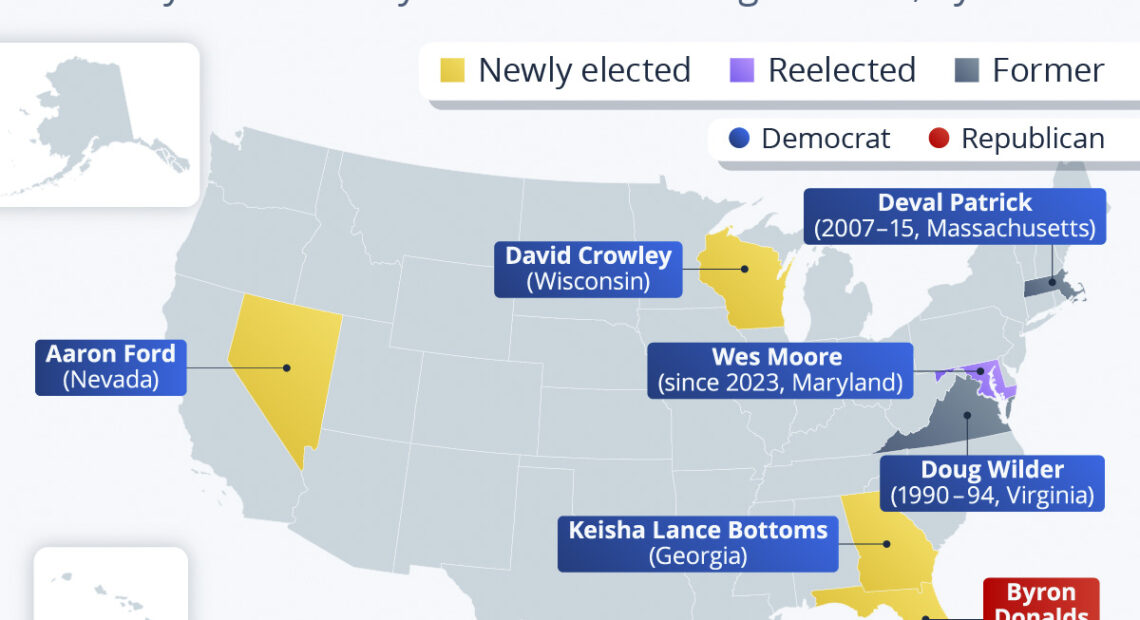
According to a report by Statista, published on November 9, 2026, five Black governors will assume or continue their terms from January 2027, marking the first time in American history that the country will have five Black governors serving simultaneously.
The development offers an opportunity to examine Nigeria’s own record of political inclusion.
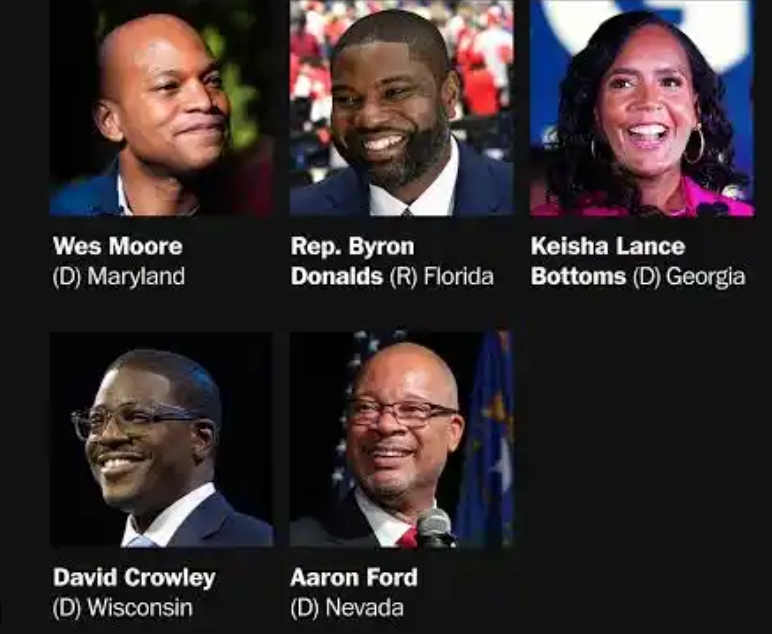
The five include four Democrats and one Republican, reflecting growing representation across the country’s political parties.
Among them is Maryland Governor Wes Moore, who secured re-election, while Aaron Ford emerged victorious in Nevada, David Crowley in Wisconsin and Keisha Lance Bottoms in Georgia. Republican Byron Donalds also won in Florida.
The development is particularly significant for women in politics, as Keisha Lance Bottoms is set to become the first Black woman to serve as governor of a US state and the first Democratic governor of Georgia in 24 years.
Bottoms, 56, previously served as mayor of Atlanta and also worked as a judge, prosecutor and senior adviser in the administration of former President Joe Biden.
The historic outcome represents a major milestone in America’s political representation, especially considering that only three Black Americans had previously been elected governor of a state, with none serving simultaneously.
Online
Douglas Wilder became the first Black American elected governor when he won Virginia’s governorship in 1989. Deval Patrick later served as governor of Massachusetts, while David Paterson became governor of New York in 2008 after his predecessor resigned.
Beyond the American political milestone, the development offers an opportunity to examine Nigeria’s own record of political inclusion, particularly the persistent struggle of women to secure elective offices since the country’s return to democratic rule in 1999.
While the American development demonstrates how political representation can evolve, Nigeria’s experience since the restoration of democracy in 1999 presents a contrasting picture, particularly for women seeking elective offices.
Despite women constituting nearly half of Nigeria’s population and playing significant roles in political mobilisation, voting and community development, their presence in elected political positions remains remarkably low.
Women have never occupied more than nine of the 109 seats in the Nigerian Senate or more than 26 of the 360 seats in the House of Representatives at any point since 1999.
Data published by The Public Interest in October 2026 show that women have never occupied more than nine of the 109 seats in the Nigerian Senate or more than 26 of the 360 seats in the House of Representatives at any point since 1999.
The figures reveal that women secured only three Senate seats and 12 House of Representatives seats in 1999.
Their representation increased to nine senators and 25 members of the House of Representatives in 2007, marking the highest combined representation recorded during the period.
However, the progress was not sustained.
In the 2023 general elections, only four women emerged as senators, while 15 secured seats in the House of Representatives, leaving women with a small fraction of the 469 seats in the National Assembly.
The situation is equally concerning at the state level, where women remain significantly underrepresented in the Houses of Assembly.
According to figures from the Federal Ministry of Information and National Orientation, only 48 women were elected into the 36 State Houses of Assembly in 2023, representing approximately 4.7 per cent of the available seats.
Several states also have no female representation in their respective legislatures, further highlighting the imbalance in political participation.
Political observers and gender advocacy organisations have identified several obstacles limiting women’s chances of winning elective positions in Nigeria.
These include the high cost of election campaigns, political godfatherism, party structures dominated by men, cultural and religious restrictions, gender discrimination, political violence and limited access to campaign financing.
Women often face difficulties securing party tickets, even before the general election, as political party primaries and internal decision-making structures remain largely controlled by influential male politicians.
A 2023 analysis by the Carnegie Endowment for International Peace also identified financial limitations, cultural expectations and political marginalisation as significant barriers to women’s electoral success in Nigeria.
The situation has fuelled calls for political parties to create more opportunities for women, while advocates continue to push for reforms that would improve their access to elective positions.
With Nigeria approaching another general election cycle in 2027, the question of women’s political representation is once again attracting attention.
The proposed special seats legislation for women has also become part of the national conversation, with advocates arguing that additional legislative seats could help address the longstanding imbalance in political representation.
For Nigeria, the American development provides an opportunity to reflect on how political parties, electoral institutions and society can create a more inclusive political environment.
The issue is not simply about having more women in government but ensuring that women have a fair opportunity to compete, win elections and participate in decisions affecting the country.
While the United States prepares to make history with five Black governors serving simultaneously, Nigeria continues to grapple with a political system in which women remain a small minority among elected representatives.
After more than two decades of uninterrupted democracy, the persistent question remains: when will Nigerian women have a fairer share of the country’s political leadership?
Read Also: Prof. Amupitan Lists 5 Reasons Nigerians Should Trust INEC Ahead of 2027 Elections
Author

Sign up for The Insight Newsletter
Get in-depth, research and data-based interpretative reports from around Nigeria.


