
Nigeria Leads Africa With $2.6 Trillion Real Estate Market as Continent Outpaces Global Growth
Nigeria’s 28 Million-Unit Housing Deficit Emerges as a Major Driver of Property Investment, While Africa’s $17.6 Trillion Market Grows Nearly Twice as Fast as the Global Average
Key Points:
- Nigeria leads Africa with $2.6 trillion real estate market, ahead of Egypt and South Africa.
- Africa’s property market growing at 5.58%, nearly double global 2.69% growth rate.
- Nigeria’s 28 million housing deficit creates huge demand for affordable, mid-market homes.
- Diaspora remittances, youth, urbanization and infrastructure drive demand across African cities.
- Nigeria offers 8% rental yields, but faces inflation, FX risks, weak mortgages.
By Emmanuel Kwada
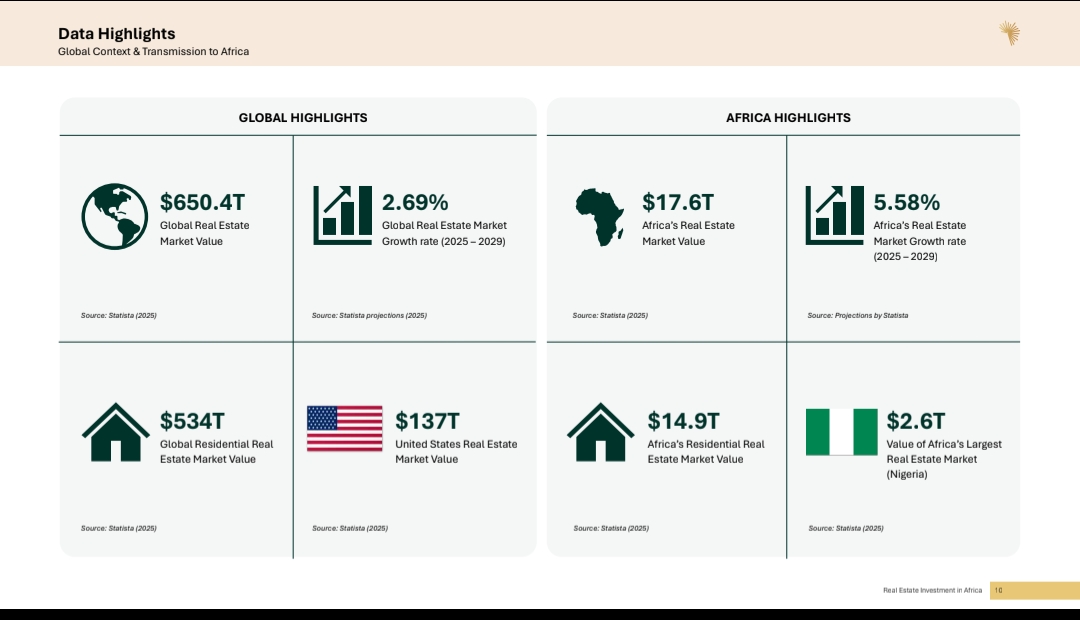
Nigeria has emerged as Africa’s largest real estate market, with an estimated property market value of $2.6 trillion, as the continent’s broader real estate sector enters a period of rapid expansion driven by population growth, urbanisation, housing shortages, infrastructure development and rising consumer demand.
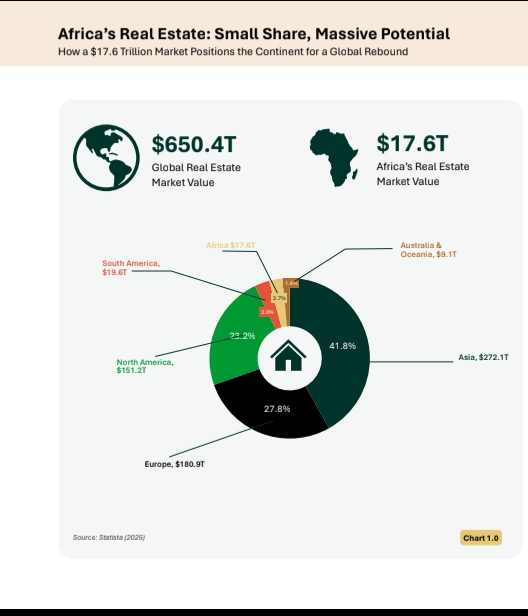
According to the July 2026 LEAF (Real Estate Investment in Africa) Report, Africa’s real estate market is valued at approximately $17.6 trillion, representing about 2.7 per cent of the estimated $650.4 trillion global real estate market.
Source: LEAF
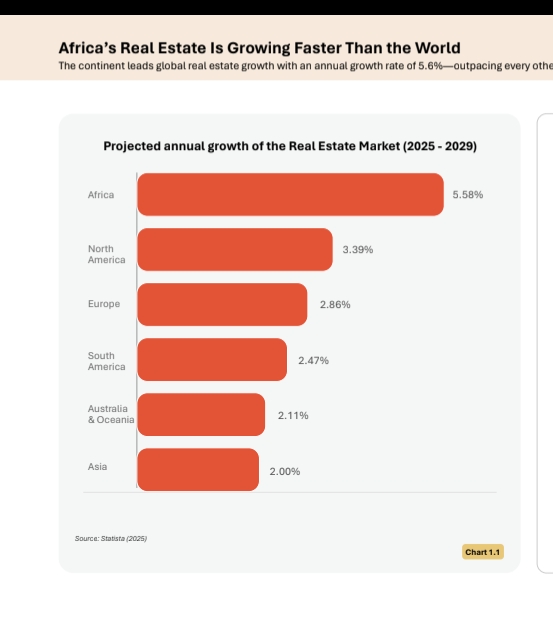
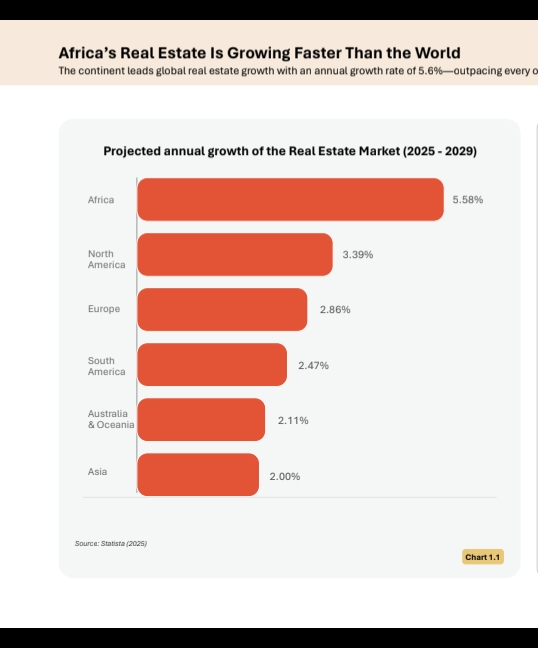
More significantly, the report projects that Africa’s property market will grow at a 5.58 per cent compound annual growth rate (CAGR) between 2025 and 2029, almost twice the global projected growth rate of 2.69 per cent.
The figures place Africa ahead of North America, projected at 3.39 per cent, Europe at 2.86 per cent, South America at 2.47 per cent, Australia and Oceania at 2.11 per cent, and Asia at 2 per cent.
For Nigeria, the report identifies the country’s enormous housing deficit as one of the strongest structural forces behind the market’s expansion.
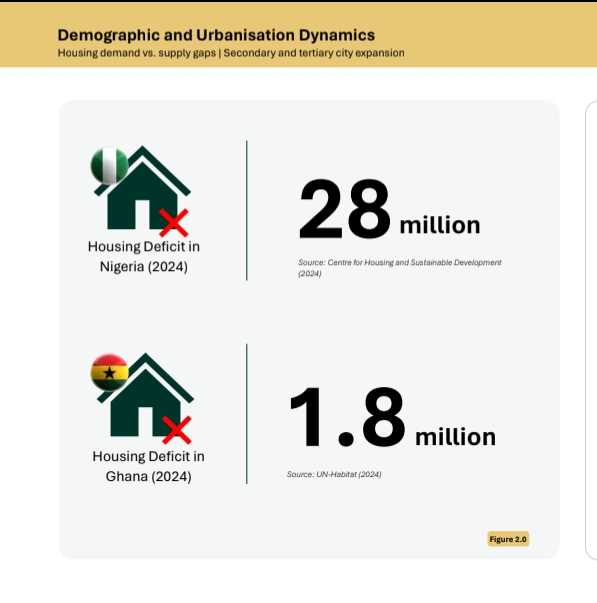
Nigeria’s housing shortage is estimated at more than 28 million units, creating a vast unmet demand for residential properties, particularly affordable and middle-income housing.
Nigeria Leads African Property Market
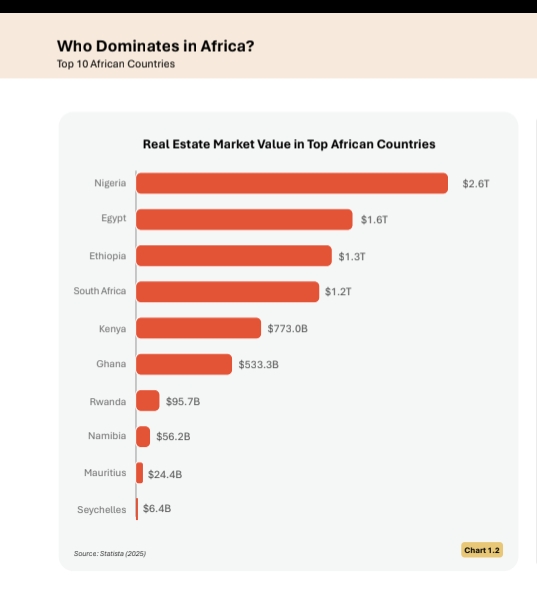
Nigeria’s estimated $2.6 trillion real estate market places it ahead of Egypt, valued at about $1.6 trillion; Ethiopia, $1.3 trillion; and South Africa, approximately $1.2 trillion.
Kenya follows with an estimated $773 billion market, while Ghana is valued at about $533.3 billion.
Other markets highlighted by the report include Rwanda at $95.7 billion, Namibia at $56.2 billion, Mauritius at $24.4 billion and Seychelles at approximately $6.4 billion.
Africa is still urbanising rapidly, while formal housing supply remains far below the needs of its growing population.
The report notes that residential property accounts for the overwhelming share of real estate value in most African countries, typically representing between 70 and 90 per cent of the market.
Africa’s residential real estate market alone is estimated at approximately $14.9 trillion.
The scale of the residential market reflects a fundamental reality: Africa is still urbanising rapidly, while formal housing supply remains far below the needs of its growing population.
Housing Deficit Creates Investment Opportunity
Nigeria’s housing deficit is arguably one of the clearest indicators of the opportunity available to developers and investors.
The LEAF analysis puts Nigeria’s housing shortfall at more than 28 million units, compared with approximately 1.8 million units in Ghana and about two million units in Kenya.
The report argues that the shortage is particularly severe in the affordable and mid-market segments, where millions of households require decent accommodation but cannot afford luxury developments.
This creates a potentially attractive environment for developers capable of delivering housing at scale and at prices compatible with the purchasing power of Nigeria’s expanding workforce.
Source: LEAF
The opportunity, however, is not simply about constructing more houses.
It increasingly involves delivering homes close to transport corridors, schools, healthcare facilities, commercial centres and other essential services.
The emerging consumer is also demanding gated communities, serviced apartments, mixed-use developments, energy-efficient buildings, better finishes and professional property management.
Africa’s Demographics Are Reshaping Property Demand
Demographics remain at the heart of Africa’s real estate story.
The continent has a median age of approximately 19.3 years, making it the youngest major region in the world.
Its working-age population increased from about 557.6 million in 2008 to approximately 866.3 million in 2024.
At the same time, Africa’s urban population is expanding rapidly.
Urbanisation currently stands at roughly 44 to 45 per cent and is projected to exceed 60 per cent by 2050. The continent’s urban population is expected to approach 1.5 billion people by then.
As incomes rise, housing preferences are changing.
That transformation is creating enormous demand for housing, offices, retail centres, warehouses, transportation infrastructure, hotels, student accommodation and other urban assets.
For property investors, the implication is straightforward: millions of people are moving into cities while the formal supply of quality real estate remains inadequate.
Middle Class Expands, Consumer Expectations Change
The report also identifies the expansion of Africa’s consumer class as another important source of property demand.
Africa’s middle-class population is projected to rise from approximately 355 million in 2010 to 500 million by 2030, and potentially reach 1.1 billion by 2060.
As incomes rise, housing preferences are changing.
For many consumers, property is no longer viewed solely as shelter. Location, security, accessibility, convenience, design, energy efficiency and access to amenities are becoming increasingly important considerations.
This is particularly evident in major urban centres such as Lagos, Abuja, Nairobi, Accra and Johannesburg.
The changing preferences are also encouraging growth in alternative housing models, including build-to-rent, co-living, serviced apartments, short-let accommodation and rent-to-own arrangements.
Diaspora Money Becomes a Property Market Force
Another major factor supporting Africa’s property market is the growing flow of remittances from Africans living abroad.
Source: LEAF
The report estimates that remittance inflows into Africa reached approximately $96.4 billion in 2024, compared with about $10 billion in 2000.
Egypt received approximately $22.7 billion in 2024, followed by Nigeria with $19.8 billion and Morocco with $12 billion.
Kenya received about $4.8 billion, while Ghana recorded approximately $4.6 billion.
Nigeria’s position is particularly significant because diaspora remittances have become an important source of foreign exchange and household investment.
A significant proportion of diaspora funds is channelled into land acquisition, residential construction, home purchases and second homes.
In some segments of Lagos’ property market, diaspora buyers have reportedly accounted for a substantial share of transactions, particularly in luxury housing and short-let properties.
The report describes diaspora investment as both a source of liquidity and a potential source of volatility, particularly where exchange-rate movements influence property prices and rental values.
Infrastructure Is Creating New Property Hotspots
Infrastructure development is another powerful force transforming Africa’s property landscape.
Roads, railways, airports, power infrastructure and new economic centres can fundamentally alter the value of surrounding land.
In Nigeria, the Lekki–Epe corridor has become a major example of how transport infrastructure and large-scale economic development can shift property demand.
Source: LEAF
Similar dynamics are visible around Kenya’s Konza Technopolis, expansion corridors in Accra and planned satellite developments around Kigali.
The Africa Infrastructure Development Index cited in the report increased from approximately 8.61 in 2003 to 25.7 in 2024.
As connectivity improves, previously peripheral areas can become commercially viable and attract housing, logistics facilities, retail centres and industrial developments.
Nigeria Among Africa’s Fastest-Growing Markets
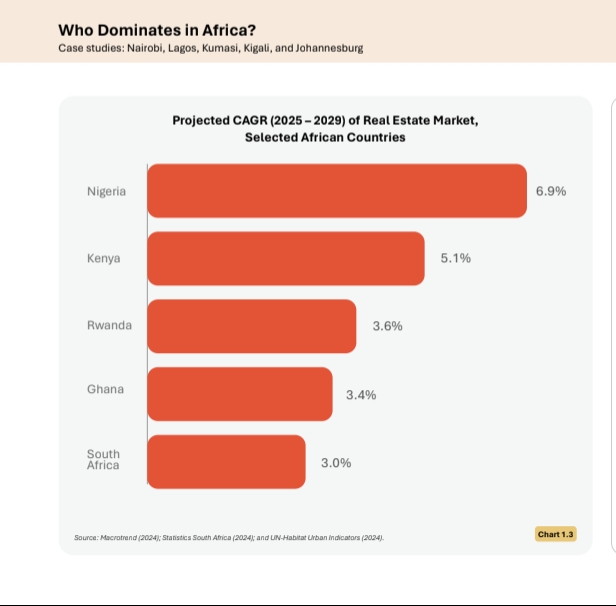
The report projects Nigeria’s real estate market to record a 6.9 per cent CAGR between 2025 and 2029, ahead of Kenya at 5.1 per cent, Rwanda at 3.6 per cent, Ghana at 3.4 per cent and South Africa at 3 per cent.
The combination of growth and investment attractiveness also places Nigeria among the continent’s most promising markets.
In an investment comparison cited by the report, Nigeria scores 4 out of 5 for growth speed and 5 out of 5 for investment appeal.
Nigeria scores 4 out of 5 for growth speed and 5 out of 5 for investment appeal.
Kenya scores 4 and 4 respectively, while Rwanda scores 4 for growth speed and 3 for investment appeal.
Ghana records 3 and 3, while South Africa scores 2 for growth speed but 4 for investment appeal, reflecting the maturity and relative stability of its property market.
Rental Yields Remain Attractive
The opportunity is also reflected in rental returns.
Data cited in the report puts South Africa’s gross rental yield at approximately 10 per cent, Zimbabwe at 9.2 per cent, Cameroon at 9.1 per cent and Nigeria at about 8 per cent.
Kenya records about 5.4 per cent, Morocco 5.2 per cent, Egypt 5 per cent and Ghana approximately 4 per cent.
Nigeria’s relatively high rental yield is supported by rapid urbanisation, limited housing supply and strong demand in major cities.
Source: LEAF
However, high nominal yields should not automatically be interpreted as high real returns. Currency depreciation, inflation, maintenance expenses, vacancy rates, taxation and property management costs can significantly affect an investor’s final return.
Construction Industry Adds Billions to African Economies
The property boom is also feeding directly into Africa’s construction industry.
The report estimates construction industry output at approximately $97.7 billion in South Africa, $55.7 billion in Nigeria, $23.9 billion in Ghana, $20 billion in Kenya and $2.9 billion in Rwanda.
Together, construction activity in the five markets exceeds $200 billion.
Beyond property values, construction is a major employment generator, creating opportunities for architects, engineers, artisans, labourers, suppliers, manufacturers, financiers, estate managers and other professionals.
The expansion therefore has implications beyond the property sector, supporting broader economic activity.
E-Commerce Is Creating Demand for Logistics Real Estate
Africa’s rapidly expanding digital economy is opening another property frontier: logistics.
Source: LEAF
The number of e-commerce users on the continent is projected to rise from about 138.9 million in 2017 to approximately 519.8 million in 2025, according to the figures cited by the report.
That growth is creating demand for warehouses, distribution centres and strategically located logistics facilities.
Modern warehouse occupancy averages about 83 per cent across Africa, with South Africa at approximately 96 per cent, Egypt at 95 per cent, Nigeria at 85 per cent and Kenya at 83 per cent.
For investors, the logistics sector offers an opportunity to benefit from the expansion of online commerce without relying exclusively on residential property.
Data Centres Emerging as a New Property Frontier
Digital infrastructure is also creating demand for specialised real estate.
Africa currently has only about 450 megawatts of live data-centre capacity, according to the report.
South Africa accounts for approximately 320MW, Nigeria 86MW and Kenya about 20MW.
Student accommodation is another segment attracting attention.
With digital services, cloud computing, artificial intelligence and internet usage expanding, the continent requires significant additional capacity.
The shortage creates opportunities for investors who can provide suitable land, power, connectivity and secure infrastructure for data-centre development.
Student Housing and Serviced Apartments Gain Momentum
Student accommodation is another segment attracting attention.
Purpose-built student accommodation in Lagos is reported to record occupancy rates of between 88 and 96 per cent, while comparable accommodation in Johannesburg can reach about 98 per cent occupancy.
The underlying demand is driven by Africa’s young population and expanding tertiary education systems.
Source: LEAF
Similarly, the serviced-apartment market is expanding as business travellers, expatriates, tourists and increasingly mobile professionals seek flexible alternatives to conventional hotels and long-term leases.
But the Boom Comes With Serious Risks
Despite the impressive growth projections, the LEAF report cautions against treating Africa’s property market as a risk-free investment opportunity.
Inflation remains a major challenge.
The report puts average African inflation at approximately 18.7 per cent in 2024, although it projects a moderation towards 13.8 per cent in 2025.
Construction costs have also increased, while currency depreciation has significantly affected the cost of imported building materials and equipment.
Nigeria is particularly exposed to foreign-exchange risks because substantial portions of construction inputs are imported.
The naira’s sharp depreciation has simultaneously increased construction costs and altered the dollar value of Nigerian property and rental income.
Mortgage Access Remains a Major Constraint
One of the biggest obstacles to converting Africa’s housing demand into effective purchasing power is weak mortgage penetration.
Mortgage lending remains below 5 per cent of GDP in many African economies.
Kenya’s mortgage market, for example, is estimated at approximately 1.86 per cent of GDP.
Mortgage lending remains below 5 per cent of GDP in many African economies.
This means that millions of households may need housing but lack access to long-term financing capable of turning demand into actual home ownership.
Consequently, the growth of affordable housing will depend partly on innovative financing models, including mortgage guarantees, housing funds, rent-to-own schemes, shared-equity arrangements and micro-mortgage products.
Warning Signs of Property Overheating
The report also identifies several warning signs that investors should monitor.
Extreme price-to-income ratios are evident in some African markets. Ethiopia reportedly records a ratio of 47.1, while Cameroon records approximately 46.6.
The report’s overheating indicators include price-to-income ratios above 15, vacancy rates exceeding 15 per cent and foreign-exchange-adjusted rental increases of more than 50 per cent year-on-year.
High-end developments are particularly vulnerable to oversupply.
In some cities, luxury estates and commercial developments have been constructed faster than genuine purchasing power can absorb them, producing partially occupied developments often described as “ghost estates.”
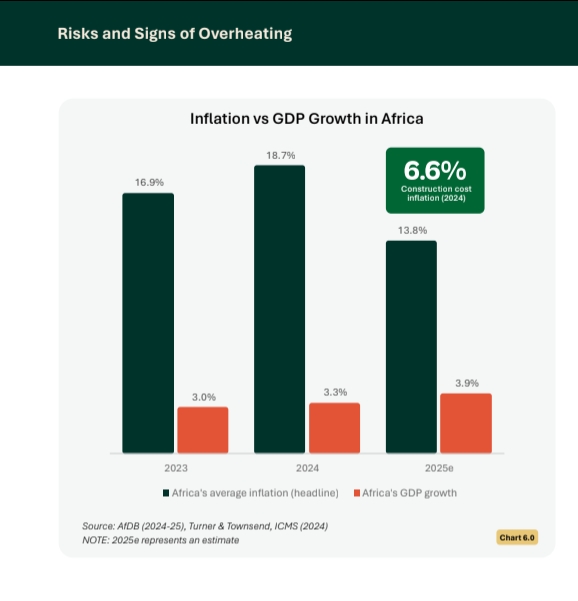
Source: LEAF
Lagos, for instance, faces a complicated picture in which demand remains strong but currency-adjusted property and rental prices have risen sharply.
Land and Title Issues Remain Critical
Property investors must also contend with title verification, land disputes, bureaucratic delays, permitting challenges and inconsistent regulatory frameworks.
The risks are particularly important in frontier and rapidly expanding markets where land speculation can push prices far ahead of underlying economic fundamentals.
A successful investment therefore requires more than identifying a rapidly appreciating location.
Investors must verify ownership, conduct proper due diligence, understand planning regulations and assess infrastructure availability before committing capital.
Smart Cities and Green Buildings Point to the Future
The next phase of Africa’s property market is expected to be shaped increasingly by technology, sustainability and urban planning.
Green buildings also offer opportunities to reduce energy costs, improve resilience and increase long-term asset values.
The LEAF report identifies three converging forces: PropTech, Real Estate Investment Trusts (REITs), and smart and green development.
More than 20 major smart-city projects are reportedly planned across Africa, while the continent’s smart-city market is projected to grow at approximately 12 per cent annually between 2025 and 2029.
Projects such as Konza Technopolis in Kenya, the Lekki corridor in Nigeria and Kigali Innovation City illustrate the direction of development.
Green buildings also offer opportunities to reduce energy costs, improve resilience and increase long-term asset values.
Real Estate Investment Trusts are also expanding the options available to investors who cannot afford to purchase entire properties.
South Africa has Africa’s most developed listed property market, with REIT market capitalisation estimated at approximately $8.5 billion.
Nigeria’s REIT market is valued at about $600 million, while Kenya’s is approximately $300 million.
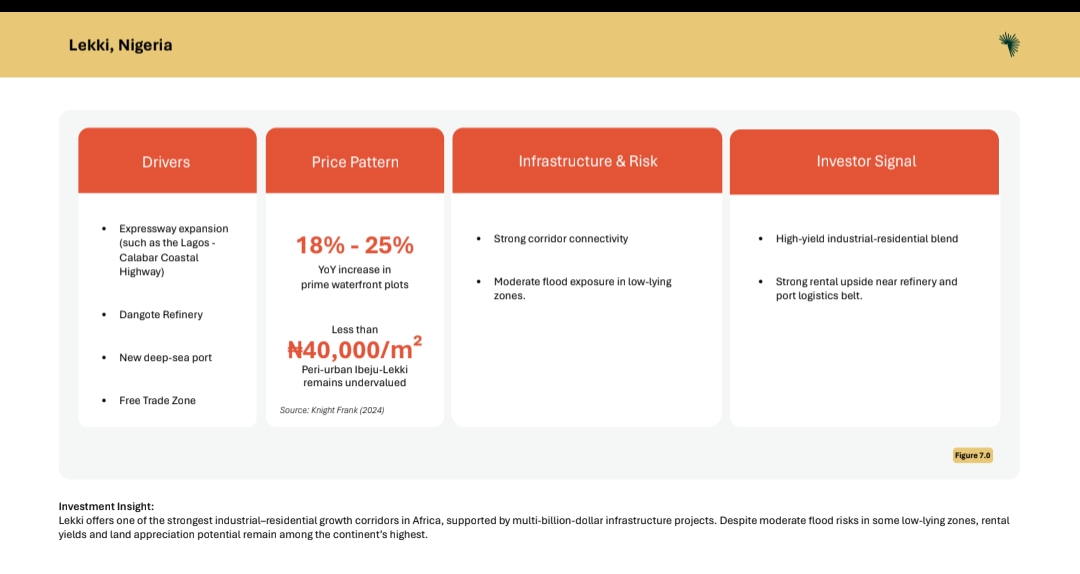
Source: LEAF
The expansion of REITs could provide smaller investors with access to income-generating commercial and residential assets while improving liquidity in the property market.
Technology is increasingly transforming the real estate value chain.
Digital property listings, automated valuation systems, online mortgage platforms, electronic documentation, smart contracts and digital property management can reduce transaction costs and improve transparency.
African PropTech funding cited in the report increased from $10.7 million in 2022 to $16.2 million in 2023 and reached approximately $75 million in the first half of 2025.
The growth suggests that technology companies are increasingly becoming part of Africa’s property ecosystem.
Africa’s real estate story is ultimately a story of supply and demand.
The continent is young, rapidly urbanising and increasingly connected. Millions of new households will require homes, while businesses will need offices, warehouses, shops, hotels, data centres and industrial facilities.
Nigeria sits at the centre of that opportunity because of its enormous population, large cities, substantial housing deficit and significant diaspora capital.
But the same characteristics that create opportunity can create risk.
Investors who focus exclusively on land appreciation or luxury developments may face significant exposure if prices move ahead of incomes.
The more durable opportunity, according to the report’s overall analysis, lies in segments where genuine demand is difficult to satisfy: affordable and mid-market housing, student accommodation, build-to-rent, logistics, data-centre infrastructure and well-designed mixed-use developments.
The strongest markets are likely to be those where population growth, rising incomes, infrastructure investment and effective public policy reinforce one another.
Lagos, Nairobi, Accra and Kigali stand out in that respect, while Nigeria’s broader market offers one of the continent’s largest pools of unmet housing demand.
The message from the numbers is therefore not simply that African property is booming.
It is that Africa is entering a new phase of urban development—and the quality, affordability and sustainability of the real estate built during this period could determine whether the continent’s projected $17.6 trillion property base becomes a foundation for inclusive economic growth or another cycle of speculative expansion.
For Nigeria, the $2.6 trillion market valuation and more than 28 million-unit housing deficit underline both sides of the equation: an extraordinary investment opportunity and an equally extraordinary national housing challenge.
How effectively policymakers, developers and investors bridge that gap may determine the real winners of Africa’s next real estate cycle.
Source: LEAF, Real Estate Investment in Africa Report, July 2026, drawing on data and analysis attributed to World Bank, African Development Bank, Knight Frank, Numbeo, national statistical agencies and other cited sources.
Read Also: Why Debt Hurts Africa More: The High Cost of Borrowing and the Continent’s Development Dilemma
Author

Sign up for The Insight Newsletter
Get in-depth, research and data-based interpretative reports from around Nigeria.