Osun 2026: How Party Agents, BVAS and Larger Electorate Made Vote-Buying, Rigging Harder — AEO

Key points:
- Strong rivalry between parties with agents on ground made large-scale rigging harder to carry out undetected.
- Registered voters, accreditation, and turnout all rose sharply from 2022, making retail vote-buying less effective.
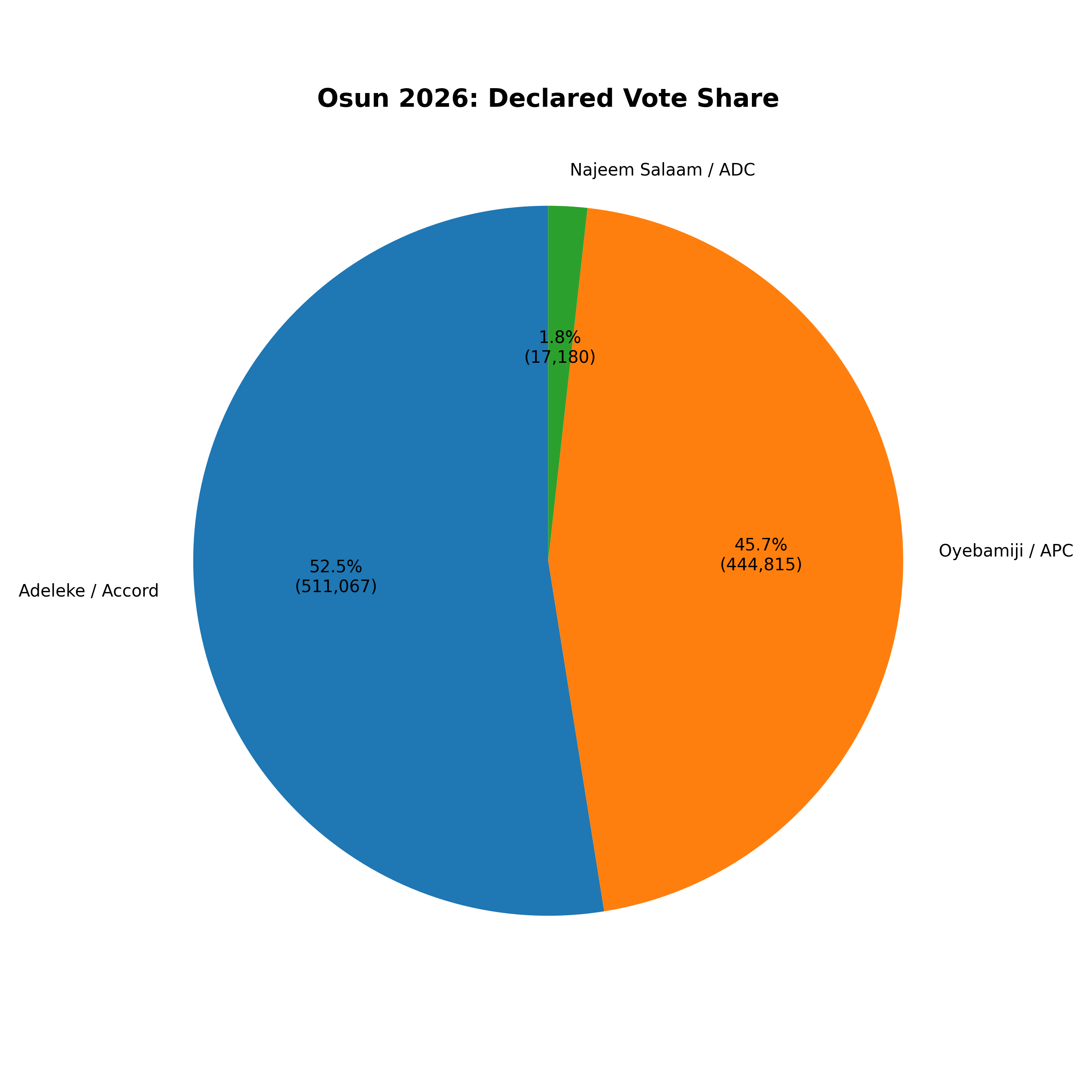
- Both parties gained votes, but Adeleke’s margin doubled to 66,252.
- BVAS and IReV boosted transparency, but delays and system gaps persist.
- AEO will audit to verify if digital records match declared results.
By Emmanuel Kwada
The 2026 Osun State governorship election presented a more difficult environment for large-scale electoral manipulation, as intense competition between political parties, a significantly expanded electorate and the growing use of digital election technologies combined to strengthen the safeguards around the voting process, the Athena Election Observatory (AEO) has said.

The top three candidates in the 2026 Osun State governorship election
In its preliminary assessment of the election, released on Monday, August 17, 2026, the observatory said the presence of well-organised party agents across polling units made it substantially harder for electoral manipulation to take place on a large scale without being detected.
The AEO, an independent electoral integrity initiative established by the Athena Centre for Policy and Leadership, said the competitive nature of the contest itself became an important layer of protection for the election.
“Organised political competition is itself an important safeguard for electoral integrity,” the observatory said, explaining that parties with agents deployed across polling units, knowledge of electoral procedures and independent mechanisms for tracking results were better positioned to detect irregularities.
Sources: AEO and INEC
According to the assessment, the situation created a more demanding operating environment for anyone seeking to manipulate the process because competing political interests were closely watching events at polling units and could independently document and compare results.
Larger Electorate Changes the Equation
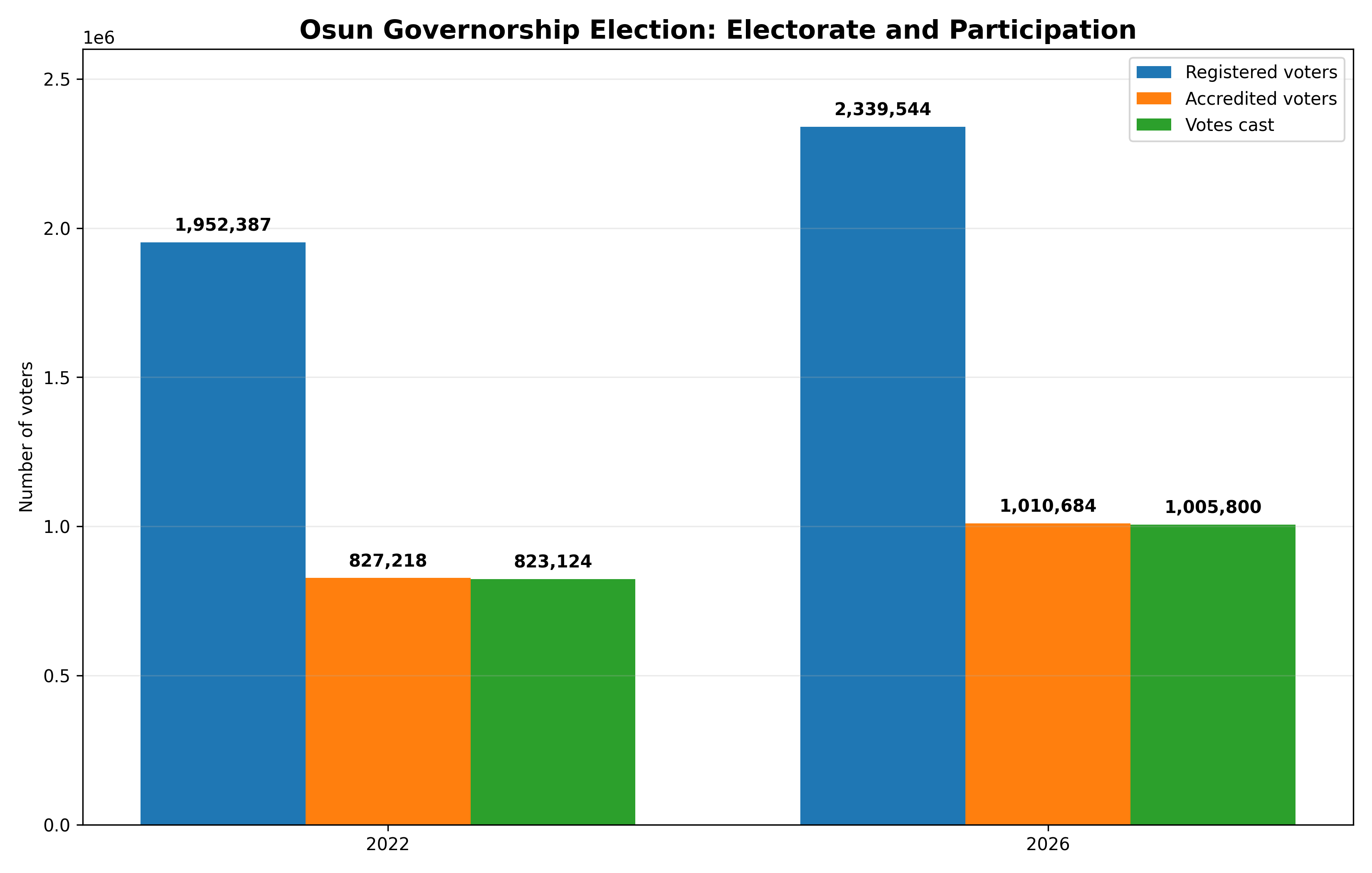
The AEO also drew attention to the substantial growth in the number of registered and participating voters between the 2022 and 2026 elections, arguing that the expansion made retail vote-buying a less effective instrument of electoral manipulation.
The number of registered voters increased from 1,952,387 in 2022 to 2,339,544 in 2026, representing a rise of 387,157 voters, or 19.8 per cent.
Accredited voters also increased from 827,218 to 1,010,684, while total votes cast rose from 823,124 in 2022 to 1,005,800 in 2026, an increase of 182,676 votes or 22.2 per cent.
Sources: AEO and INEC
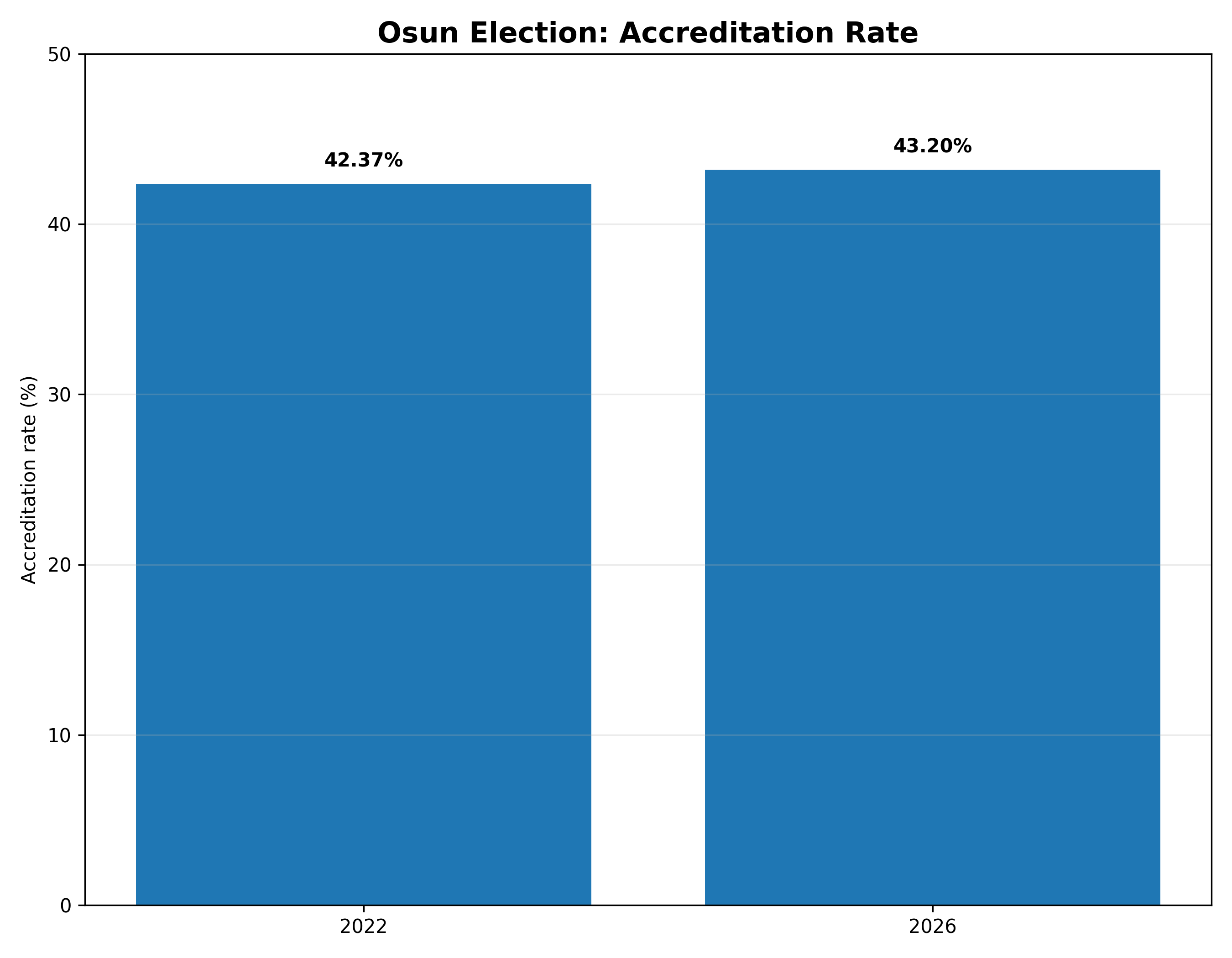
Despite the growth, the accreditation rate remained relatively stable, moving from 42.37 per cent in 2022 to 43.20 per cent in 2026.
The observatory said the figures point to a substantially larger electorate participating in a fiercely contested election.
For AEO, the significance goes beyond the numbers. A larger and more competitively mobilised electorate increases the scale and cost required to influence voting behaviour through individual-level inducement, while making it more difficult for such efforts to determine the overall outcome.
Both Adeleke, APC Candidate Increased Their Votes
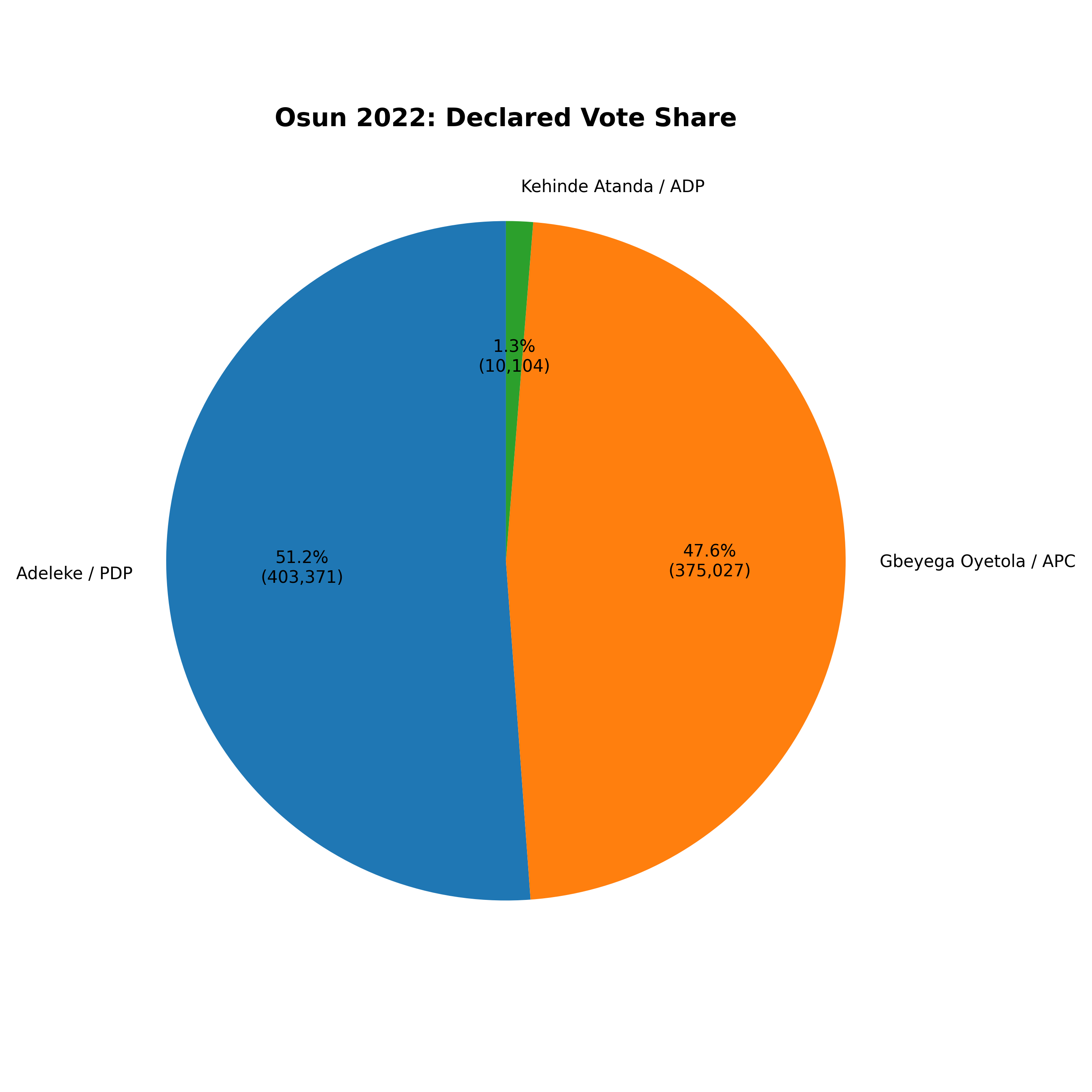
The election also recorded significant increases in the votes secured by the two leading candidates, according to the Independent National Electoral Commission’s declared results cited by AEO.
Sources: AEO and INEC
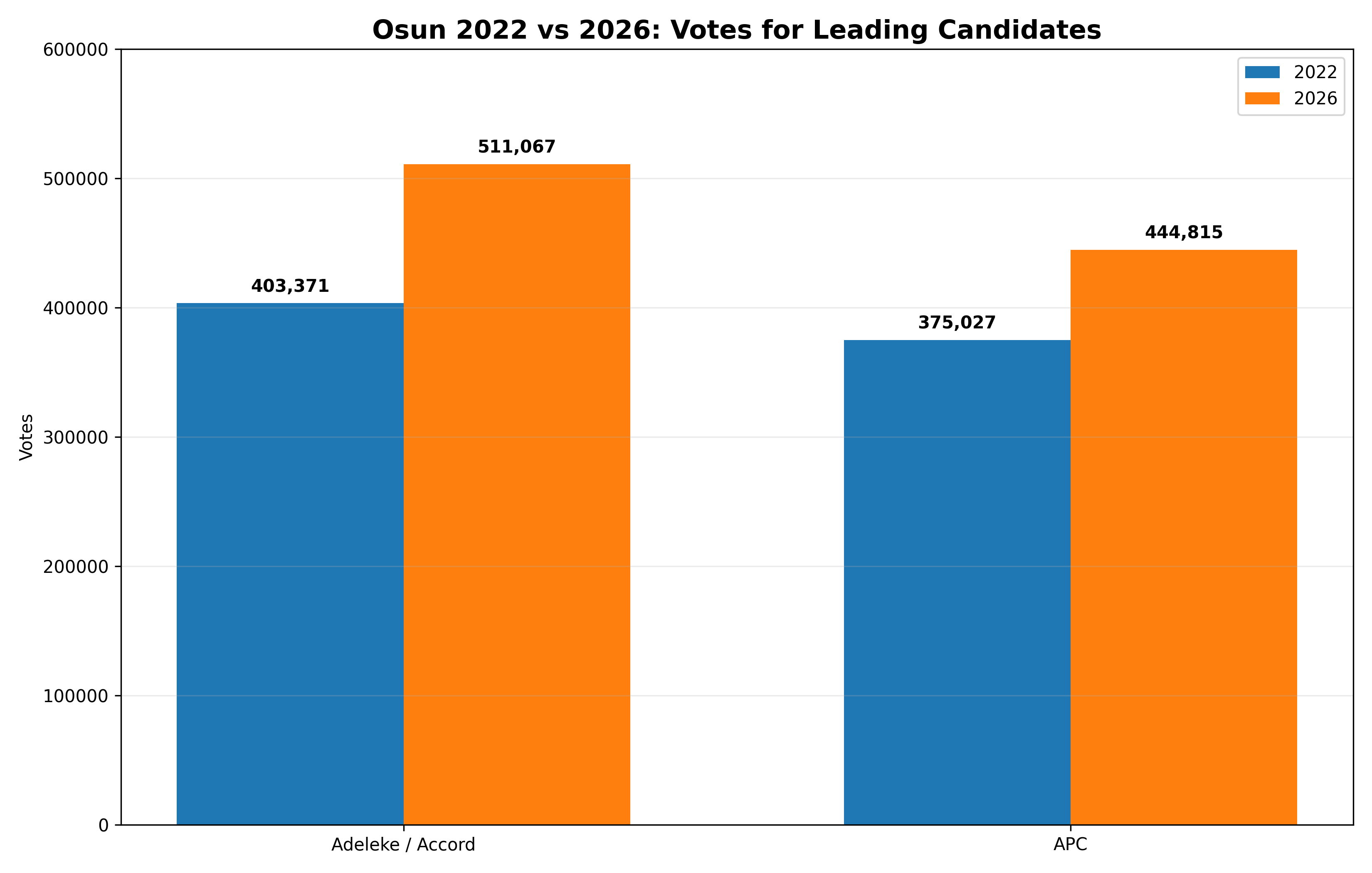
Governor Ademola Adeleke, who contested on the platform of the Accord Party in 2026, increased his vote tally from 403,371 in 2022 to 511,067 in 2026.
The APC candidate, Munirudeen O. Oyebamiji, also substantially increased the party’s votes, moving from 375,027 recorded by the APC in 2022 to 444,815 in 2026.
The figures, the observatory noted, demonstrate that both major political camps were able to mobilise significantly more voters than they did four years earlier.
However, Adeleke’s declared winning margin increased considerably.
His margin over the APC candidate stood at 28,344 votes in 2022 but rose to 66,252 votes in 2026, representing an increase of 37,908 votes, or approximately 133.7 per cent.
Sources: AEO and INEC
The AEO said the wider margin produced a clearer separation between the two leading candidates despite the heightened competitiveness of the election.
BVAS, IReV Strengthen Electoral Audit Trail
Beyond political competition and voter mobilisation, the observatory identified technology as another important development in the 2026 election.
It specifically highlighted the use of the Bimodal Voter Accreditation System (BVAS), the Independent National Electoral Commission’s Result Viewing (IReV) platform and structured digital result capture.
According to AEO, these systems are helping create a more traceable electoral record by linking voter accreditation and polling-unit results to digital records that can subsequently be examined and reconciled.
The observatory, however, cautioned against treating technological deployment as a complete solution to electoral malpractice.
Sources: AEO and INEC
It identified delays in uploading results, uncertainties around transmission timelines, system resilience and the need for stronger reconciliation between different digital records as areas requiring further improvement.
The assessment therefore strikes a balance between recognising technological progress and demanding greater institutional transparency.
While BVAS and IReV can strengthen the audit trail, AEO said the ultimate test is whether the information contained in the various electoral records can be consistently reconciled with the results declared by INEC.
AEO Begins Post-Election Audit
For the observatory, the conclusion of voting and declaration of a winner does not mark the end of its work.
Sources: AEO and INEC
Instead, AEO said it would move into a more detailed post-election audit designed to determine whether the complete electoral record supports the declared outcome.
The planned exercise will include examination of polling-unit datasets, BVAS accreditation records, Forms EC8B-E and successive levels of result collation, with particular attention to whether the different records correspond.
The observatory said its objective was not to challenge the winner declared by INEC or determine who ought to have won the election.
Rather, it wants to establish whether the entire chain of electoral records is sufficiently resilient, transparent and accurate to withstand independent scrutiny.
Read Also: Osun Decides 2026: Adeleke Wins Second Term, Takes 19 LGAs with 511,067 Votes
“We are not asking who should have won. Voters have voted, and INEC has exercised its statutory responsibility to declare the winner,” the AEO said.
“We are asking a different question: How resilient, transparent, and accurate is the structural chain of collation when subjected to total digital and declared results?”
Competition Alone Is Not Enough
The AEO’s assessment nevertheless carries an important caveat: a competitive election and technological safeguards can reduce opportunities for manipulation, but they do not eliminate the need for continuous scrutiny.
How resilient, transparent, and accurate is the structural chain of collation when subjected to total digital and declared results?
The observatory’s findings suggest that the combination of vigilant party agents, increased voter participation and digital verification mechanisms created multiple layers through which irregularities could potentially be detected.
Its post-election audit will determine whether those safeguards worked consistently from the polling unit through the collation process.
The 2026 Osun election, therefore, offers more than a comparison of votes between two election cycles. It provides an opportunity to assess whether Nigeria’s evolving electoral architecture is becoming harder to manipulate and easier to independently verify.
The AEO said the real measure of electoral integrity would ultimately depend on whether the records generated at every stage of the process tell the same story as the result declared by INEC.
The Athena Election Observatory is an independent electoral integrity initiative of the Athena Centre for Policy and Leadership, an Abuja-based think tank founded by former Nigerian Aviation Minister Osita Chidoka.
Read Also: 13 Months After Coalition Launch, ADC Falters in Five Major Elections With Zero Wins
Author

Sign up for The Insight Newsletter
Get in-depth, research and data-based interpretative reports from around Nigeria.