
Intelligence: 10 risks in disqualifying Atiku from 2027 presidential elections

Theophilus Abbah
Justice Peter Lifu’s recent judgment nullifying the African Democratic Congress (ADC) leadership led by David Mark and invalidating the process that produced Atiku Abubakar as the party’s presidential candidate for the 2027 election has drawn comparisons with one of the most dramatic episodes in Nigeria’s democratic history.
The ruling, which voided the ADC’s leadership structure and all decisions flowing from it, including Atiku’s nomination, has placed the former vice president’s presidential ambition under judicial uncertainty. For many observers, the development is reminiscent of 2007 when Atiku faced a similar political and legal storm.
At the time, while serving as vice president, he was accused of corruption following the findings of an administrative panel and proceedings involving the Code of Conduct process.
Any development that keeps Atiku off the 2027 ballot could cast a long shadow over the credibility, acceptance, and legitimacy of the election itself.
The allegations were subsequently used by the Independent National Electoral Commission (INEC) as a basis to exclude him from the list of candidates for the presidential election.
However, Atiku challenged the decision in court, arguing that INEC lacked the constitutional authority to disqualify a candidate nominated by a political party. In a landmark ruling delivered only days before the election, the Supreme Court of Nigeria held that INEC had no power to disqualify candidates on its own and restored Atiku’s eligibility to contest the poll.
The current controversy therefore appears, at least in political terms, like a replay of history: a major legal challenge emerging ahead of a presidential election cycle and threatening to keep Atiku off the ballot. While the circumstances are different, the unfolding events portend a similar risk, raising concerns that prolonged litigation and conflicting judicial decisions could once again leave the fate of a leading opposition candidate to be determined by the appellate courts at the eleventh hour.
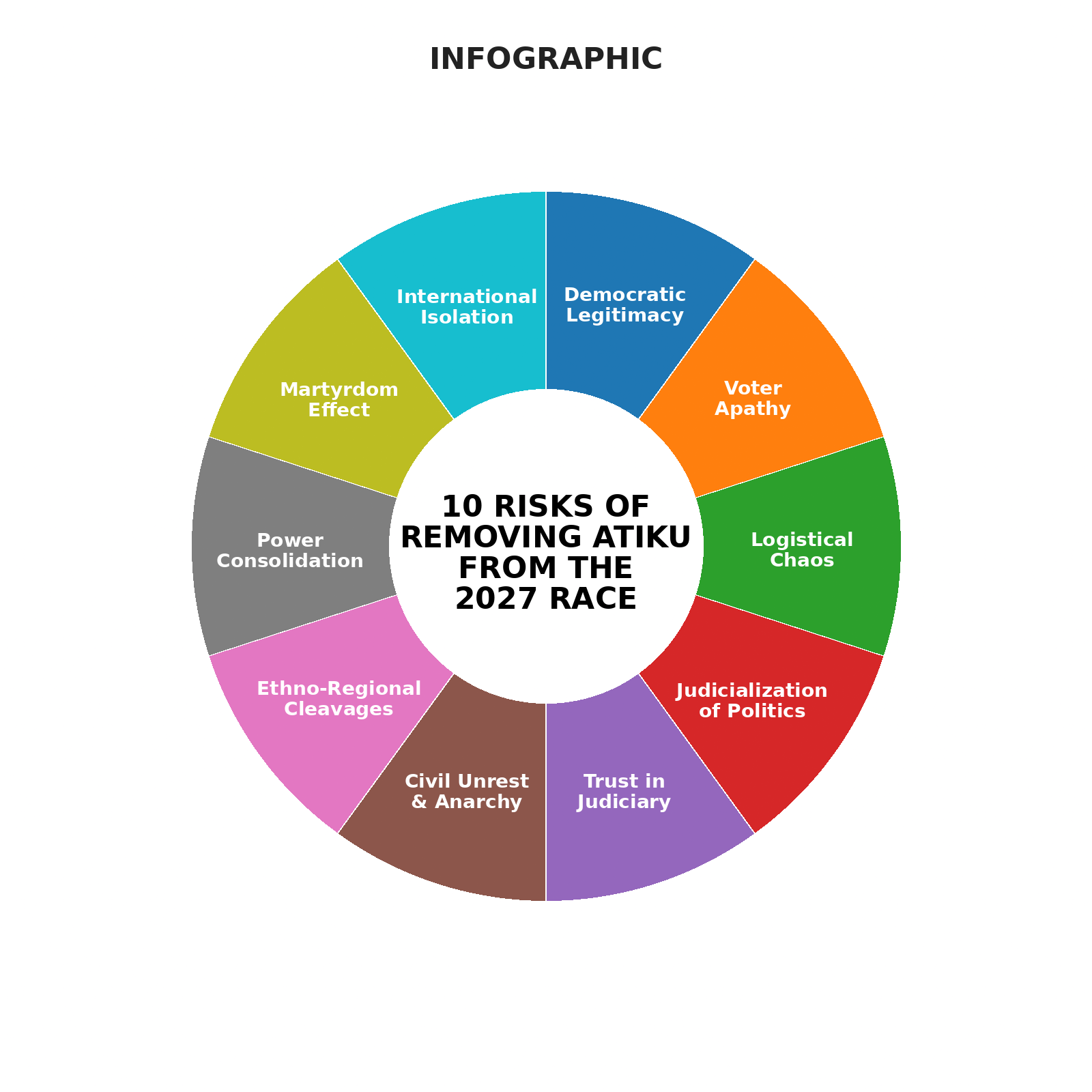
Damaging Nigeria’s Democratic legitimacy
Any move that prevents Atiku Abubakar or the ADC from participating in the 2027 election risks inflicting serious damage on the democratic legitimacy of the electoral process.
A presidential election derives credibility not merely from voting day procedures but from the inclusion of major political contenders and the availability of genuine choices for voters. If a leading opposition figure is excluded many Nigerians could perceive the election as a one-horse race rather than a truly competitive contest.
Similar concerns arose in Venezuela in 2024 when opposition leader María Corina Machado, who had overwhelmingly won her coalition’s primary, was barred from contesting the presidential election, a decision that drew condemnation from the opposition and several countries and contributed to widespread criticism of the electoral process. The lesson is that excluding major opposition candidates can undermine public confidence in election outcomes.
Consequently, any development that keeps Atiku off the 2027 ballot could cast a long shadow over the credibility, acceptance, and legitimacy of the election itself.
Voter apathy could deepen:
Excluding Atiku Abubakar or any other major opposition candidate from the 2027 presidential election could further deepen the voter apathy that the Independent National Electoral Commission (INEC) itself has repeatedly identified as a major threat to Nigeria’s democracy.
This week, Prof. Joash Amupitan, Chairman of INEC, again raised concerns about voter apathy ahead of the 2027 polls, warning that declining participation could undermine the electoral process.
The commission has consistently described voter apathy, declining public trust and political cynicism as serious challenges confronting the next general election. In such a climate, excluding a leading opposition figure could reinforce the perception among many voters that the outcome has been predetermined, thereby discouraging participation.
History offers a cautionary example. In Iran’s 2021 presidential election, voter turnout fell to the lowest level in the history of the Islamic Republic after the Guardian Council disqualified many prominent reformist and moderate candidates, leaving voters with limited alternatives.
The 2027 election faces a similar risk. If Atiku is ultimately disqualified, it could deepen public disillusionment, depress turnout and weaken the perceived credibility and inclusiveness of the democratic process.
Logistical Chaos
Beyond the political implications, excluding Atiku Abubakar at this stage could create significant logistical challenges for INEC if the appellate courts eventually overturn the decision. Nigeria has experienced a similar situation before. In 2007, Atiku’s exclusion from the presidential race was reversed by the Supreme Court of Nigeria only shortly before the election, after the court ruled that INEC lacked the power to disqualify him.
That ruling forced electoral authorities to make last-minute adjustments to accommodate his candidacy as the Action Congress presidential flag bearer. If a comparable scenario unfolds ahead of 2027, INEC could face costly and disruptive operational pressures, including reprinting materials and revising election logistics, creating avoidable uncertainty in the electoral process.
Dangerous judicialization of politics
The growing judicialization of politics in Nigeria raises troubling questions about the health of the country’s democracy. Increasingly, major political contests are being decided in courtrooms rather than at the ballot box, creating the impression that the judiciary is being drawn into the process of determining political winners and losers instead of allowing voters to make that choice.
This trend is unhealthy for democratic development and weakens public confidence in both the electoral and judicial systems. Conflicting judgments from courts of coordinate jurisdiction further compound uncertainty and political tension. Nigeria’s history already offers cautionary lessons.
In 2020, the Supreme Court dramatically nullified the election of David Lyon, the governor-elect of Bayelsa State, less than 24 hours before his inauguration, after finding that his running mate was not qualified to contest the election.
The case underscored how judicial interventions can overturn political outcomes at the very last moment. Against this backdrop, many observers argue that persistent efforts to settle political rivalries through litigation rather than electoral competition risk deepening instability, encouraging forum shopping, and eroding the principle that sovereign power ultimately belongs to the electorate.
Erosion of public trust in Judiciary:
Any judicial decision that effectively keeps Atiku Abubakar out of the 2027 presidential race at this stage also risks further eroding public confidence in the judiciary. Nigeria already faces a significant trust deficit in its justice system, with many citizens viewing politically sensitive judgments through a partisan lens rather than as impartial applications of the law.
The resulting perception can be as damaging as the decision itself. Where court rulings appear to determine electoral outcomes before voters have the opportunity to cast their ballots, suspicions of judicial interference are likely to deepen.
Developments capable of narrowing the democratic space could be perceived as an invitation to anarchy.
This is particularly important in light of previous instances in which judgments by Justice Peter Lifu were overturned on appeal, reinforcing public concerns about inconsistency in politically charged cases.
Civil unrest and post-election anarchy:
Another major concern is the potential for civil unrest if a leading opposition figure such as Atiku Abubakar is excluded from the 2027 presidential contest through judicial or administrative actions.
Several political stakeholders have already warned that developments capable of narrowing the democratic space could be perceived as an invitation to anarchy. When a significant segment of the electorate concludes that the political process has unfairly prevented its preferred candidate from participating, the consequences can extend beyond the courtroom into the streets.
The post-election violence in Northern Nigeria in 2011 serves as a sobering reminder of how perceptions of political unfairness can trigger widespread unrest and regional disturbances. While no democracy should yield to threats of violence, policymakers and judicial authorities must remain mindful of the broader implications of decisions that could be viewed as restrictive or exclusionary.
Widening Ethno-Regional Cleavages:
Another danger is that the exclusion of Atiku Abubakar could deepen existing ethno-regional tensions in Nigeria’s already fragile political landscape. As a prominent northern politician challenging incumbent President Bola Ahmed Tinubu from the South, any judicial action that prevents Atiku from contesting may, rightly or wrongly, be interpreted by some groups through a regional lens. Nigeria’s history demonstrates the dangers of such perceptions.
The crisis that followed the annulment of the June 12, 1993 presidential election, widely believed by many Nigerians to have been won by the late M.K.O. Abiola, was fueled in part by a perception that the political aspirations of the Yoruba people had been unjustly denied. While the circumstances are different, perceptions often matter as much as reality in politics.
Democracy depends not only on elections but also on the existence of credible opposition, effective checks and balances, and a level playing field for political competition.
If significant sections of the North come to view Atiku’s exclusion as politically or regionally motivated, it could generate grievances that outlast the election itself and further strain national cohesion.
Asymmetric Consolidation of Power:
Critics argue that any attempt to use the courts to exclude Atiku Abubakar from the 2027 election could be interpreted as a classic example of the asymmetric consolidation of political power, in which institutional mechanisms are deployed to weaken opposition forces and reduce the competitive pressures that are essential to a healthy democracy.
Democracy depends not only on elections but also on the existence of credible opposition, effective checks and balances, and a level playing field for political competition. A comparable debate emerged in Senegal ahead of the 2019 presidential election when two of the country’s most prominent opposition figures, Karim Wade and Khalifa Sall, were barred from the race on legal grounds, a development that significantly increased President Macky Sall’s chances of re-election. Opposition supporters accused the authorities of manipulating the judicial process to sideline popular challengers and create an easier path to victory, while thousands protested and questioned the impartiality of state institutions.
Although the circumstances differ, the Senegal experience illustrates how the exclusion of major opposition figures can fuel allegations of democratic backsliding, weaken confidence in political institutions, and create the perception that electoral outcomes are being shaped by elite power rather than voter choice.
Possible Martyrdom Effect:
An often-overlooked consequence of attempts to exclude a major opposition figure is the so-called “martyrdom effect” in politics. The martyrdom effect occurs when a politician who is perceived to be unfairly targeted, victimized, or persecuted by powerful interests gains increased public sympathy and support as a result.
Rather than weakening such a candidate, efforts to stop them can strengthen their political appeal by creating the impression that they are being denied a fair opportunity to compete.
In the case of Atiku Abubakar, any judicial or administrative attempt to keep him out of the 2027 race could be interpreted by many voters as evidence of political persecution rather than a legitimate legal process. Such perceptions may encourage undecided voters and even some political opponents to rally around him in defense of democratic fairness.
If that sentiment takes hold, the effort to sideline Atiku could backfire politically, transforming him from an ordinary opposition candidate into a symbol of resistance against perceived injustice and thereby boosting his electoral appeal.
International Isolation and Economic Backlash:
Any move that prevents Atiku Abubakar from participating in the 2027 presidential election could also attract negative scrutiny from the international community. Nigeria has already faced criticisms from election observers over aspects of previous electoral processes, and adding allegations of opposition suppression to that record would be unnecessary and potentially damaging.
Any action seen as shrinking democratic space could undermine Nigeria’s international reputation, discourage foreign direct investment.
Democratic credibility is increasingly an important factor in international relations, investor confidence, and diplomatic engagement. If a major opposition candidate is perceived to have been excluded through judicial or administrative means, foreign governments, democracy-monitoring organizations, and international investors may question the openness of Nigeria’s democratic system.
Comparable concerns emerged in Zimbabwe, where the treatment of opposition figures such as Morgan Tsvangirai and later Nelson Chamisa generated sustained international criticism and contributed to the country’s diplomatic and economic isolation. While Nigeria’s circumstances are different, perceptions matter in global politics.
Any action seen as shrinking democratic space could undermine Nigeria’s international reputation, discourage foreign direct investment, and create avoidable concerns about the country’s commitment to competitive democratic governance.
Read Also: How I plan to reset Nigeria, by Seyi Makinde, APM presidential candidate
Author

Sign up for The Insight Newsletter
Get in-depth, research and data-based interpretative reports from around Nigeria.


