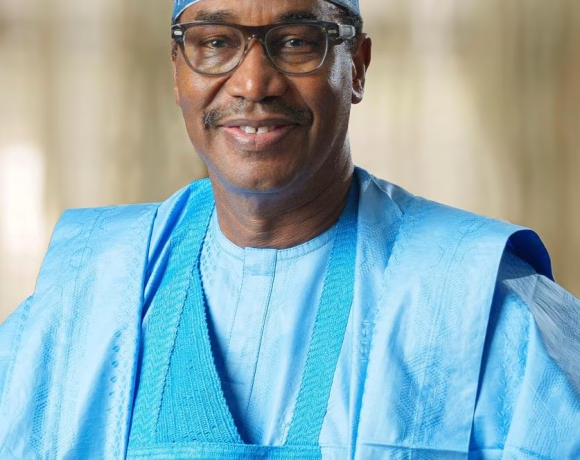
How I plan to reset Nigeria, by Seyi Makinde, APM presidential candidate

A quick review of the party’s 74-page manifesto
By Theophilus Abbah
As a preamble to the presentation of his ‘Reset Nigeria’ manifesto in Abuja on Wednesday, Governor Seyi Mankinde and Presidential candidate of the Allied Peoples Movement (APM) described the mood heralding next year’s election thus: “The 2027 elections is a contest between the All Progressives Congress (APC) and the Nigerian People.”
For the sea of heads, his audience, at the elite Congress Hall of the Transcorp Hilton Hotel in Abuja, the above statement from a contestant in the election may sound odd. Why didn’t Makinde elevate his preparedness to compete in the election by saying the combat for power would be between APM and APC? Why not even say it would be between APC and the 17 other political parties that will field presidential candidates? Why would it be between the APC and the people?
Standing on the podium, in the sparks of stars from decorative lights and the floodlights from cameras, Makinde alluded to the harsh condition of living among the people as a major determinant of the choice voters would make in next year’s polls.
The 2027 elections is a contest between the All Progressives Congress (APC) and the Nigerian People.
He struck the right chords and received huge applause as he carefully and succinctly chose the words to elaborate his thesis: “Government is meant to make life easier for the people… Macroeconomic reforms that inflict harsh living conditions on the people cannot be a genuine reform. Reforms must have a direct impact on the people, creating jobs and improving the income of the people…Nigeria is rich in natural and human resources, but our leaders are plagued by poverty of ideas” to make positive impact on the population.
For 45 minutes the presidential hopeful held the audience spellbound as he took the people through his own Nigerian dream story which may never be applicable to the youths under the current harsh living condition. “Political parties will come and go but the interest of the people must be uppermost…” and promised that, if voted into power in January 2026, he would give account of his stewardship from the first 100 days.
For the party’s Reset Nigeria agenda, it has produced a 74-page manifesto that addresses various sector. The presidential agenda is built around a governance framework designed to create a productive economy, a secure nation, a capable education system, and a more accountable federation.
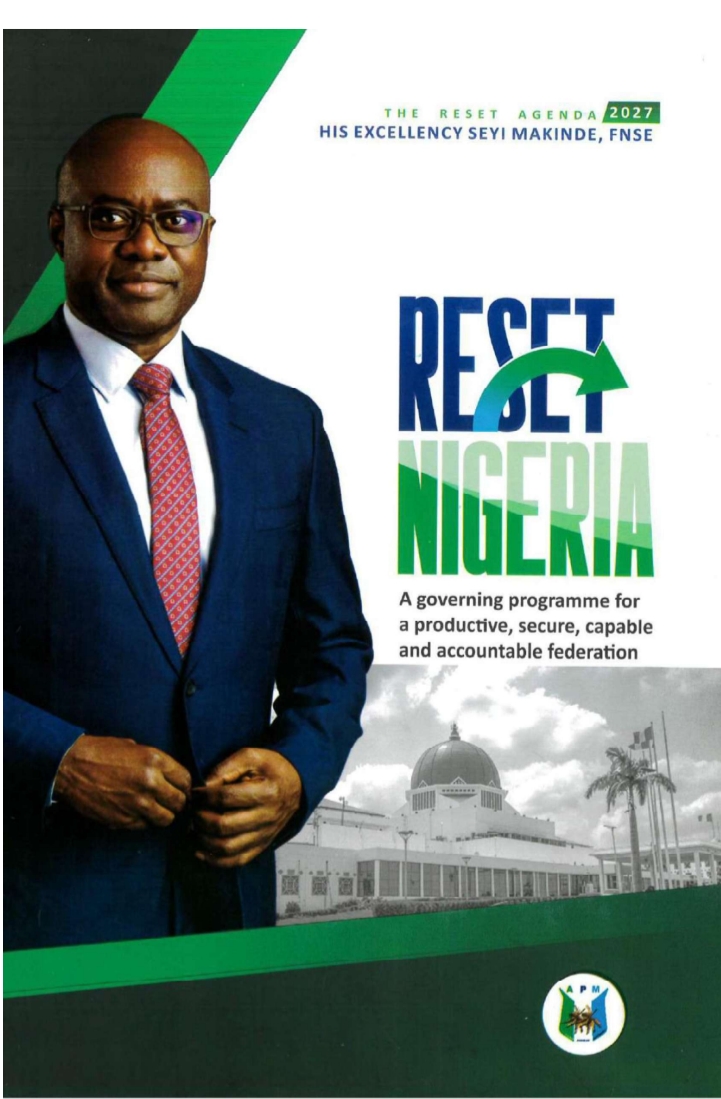
Cover page of Seyi Makinde’s Manifesto
The programme rests on the argument that Nigeria’s challenges are not caused by a lack of policies but by institutional failures, poor coordination, weak accountability, and excessive centralization of power. Below is a sector-by-sector analysis of the agenda.
Economic Sector: Making Growth Work for Ordinary Nigerians
The Economic Reset aims to lower the structural cost of living by addressing factors that increase prices across the economy, including poor infrastructure, insecurity, unreliable energy, storage losses, and regulatory inefficiencies.
Rather than pursuing isolated projects, the agenda proposes strategic economic corridors linking farms, industries, ports, railways, and markets. It also emphasizes agricultural value chains, food security systems, industrial hubs, refinery reforms, electricity market restructuring, and improved conditions for enterprises.
This approach is important because Nigerians are not suffering merely from insufficient production but from inefficiencies that make goods unnecessarily expensive. By reducing transportation costs, improving food distribution, expanding processing capacity, and ensuring more reliable electricity, the plan seeks to reduce inflationary pressures and improve household purchasing power.
The proposal for a Domestic Energy Value Credit is particularly significant because it attempts to ensure that Nigerians directly benefit from the country’s oil wealth through lower domestic energy costs.
Government is meant to make life easier for the people.
The agenda also promotes fiscal discipline, transparency in borrowing, exchange-rate stability, and simplification of government-business interactions through a “Tell Government Once” system. These measures could encourage investment, stimulate industrial growth, create jobs, and improve the competitiveness of Nigerian businesses.
Agriculture and Food Security
Agriculture occupies a central place in the agenda. The plan proposes integrated value chains covering production, storage, transportation, processing, finance, security, and market access for staple foods such as rice, maize, cassava, beans, and tomatoes. It also recommends agricultural security programmes to protect farmers and food transport routes.
This is essential because food inflation remains one of the greatest burdens on Nigerian households. By reducing post-harvest losses, improving storage facilities, protecting farmers from insecurity, and strengthening processing industries, the programme could increase food availability and affordability. The linkage between security and agriculture demonstrates an understanding that food production cannot expand where farmers fear for their lives.
Security Sector: Bringing Security Closer to Communities
The Security Reset is based on decentralization, intelligence-driven operations, and community protection. The agenda supports a framework for state policing, enhanced intelligence sharing, coordinated security responses, and security-economic recovery plans for conflict-affected communities.
The significance of this approach lies in its recognition that Nigeria’s security challenges vary across regions and require localized solutions.
By bringing operational responsibility closer to affected communities and ensuring that intelligence leads to action, the programme seeks to protect lives, secure economic activity, and restore public confidence. Farmers could return to their farms, businesses could operate freely, and investment would become more attractive.
The emphasis on justice, accountability, and protection of civil rights also seeks to improve trust between citizens and security agencies, thereby strengthening democratic governance.

The APM Presidential Candidate, Seyi Makinde, flanked by others during the unveiling of his manifesto.
Education Sector: Creating Capability Rather Than Certificates
The Education Reset focuses on learning outcomes rather than mere enrollment figures. It introduces a National Foundational Learning Guarantee to ensure that children achieve literacy and numeracy standards by Primary Three. It also emphasizes teacher quality, technical education, vocational skills, research, innovation, and stronger links between education and employment.
This vision is crucial because unemployment and underemployment often stem from a mismatch between educational qualifications and labour market needs. The agenda seeks to produce graduates who possess practical skills and demonstrable competencies rather than certificates alone. Technical education, apprenticeships, and industry partnerships could help young Nigerians gain employable skills and establish businesses.
The focus on teacher effectiveness, school safety, and access for disadvantaged groups also addresses long-standing weaknesses in Nigeria’s education system, potentially improving social mobility and reducing inequality.
Healthcare Sector: Accessible and Affordable Care
In healthcare, the agenda seeks to strengthen primary healthcare delivery, expand health insurance coverage, improve maternal and child health outcomes, and ensure that health funding is linked to actual service delivery rather than infrastructure alone.
A stronger safety net can reduce extreme poverty.
This proposal is vital because many Nigerians struggle with high out-of-pocket medical expenses. If implemented successfully, it could improve healthcare access, reduce preventable deaths, and protect households from catastrophic health expenditures. The emphasis on accountability and measurable service standards would also help citizens assess whether government spending is producing tangible health benefits.
Social Protection and Inclusion
The agenda proposes a unified social protection system with transparent eligibility rules, appeal mechanisms, and support for vulnerable populations, including the poor, elderly, displaced persons, and persons with disabilities. It also promotes inclusion in public appointments, procurement, and economic opportunities.
These measures are important because economic growth alone does not guarantee social justice. A stronger safety net can reduce extreme poverty, provide protection during economic shocks, and create more equitable access to opportunities. This could help prevent social exclusion and strengthen national cohesion.
Governance, Federalism and Institutional Reform
Perhaps the most ambitious aspect of the Reset Agenda is its commitment to restructuring governance. The programme advocates functional federalism, greater state participation in resource management, local government reforms, improved public service delivery, transparent procurement, judicial independence, and electoral reforms.
The rationale is that many national challenges persist because decision-making authority is concentrated at the federal level while states bear responsibility for implementation.
This could make governance more responsive, reduce bureaucratic inefficiencies, and strengthen democratic participation.
By aligning authority with accountability, the agenda seeks to create a federation that responds more effectively to local needs. This could make governance more responsive, reduce bureaucratic inefficiencies, and strengthen democratic participation.
Conclusion
The Reset Agenda presented by Seyi Makinde offers a comprehensive blueprint for national transformation based on economic productivity, security, education, healthcare, social protection, and institutional reform.
Its greatest strength is its focus on accountability, measurable outcomes, and the integration of policies across sectors rather than isolated interventions.
The plan argues that prosperity cannot exist without security, education cannot succeed without capability, and governance cannot deliver results without accountability and functional federalism.
If effectively implemented, the agenda could improve living standards, expand opportunities, reduce poverty, strengthen institutions, and create a more inclusive and productive Nigeria.
Author

Sign up for The Insight Newsletter
Get in-depth, research and data-based interpretative reports from around Nigeria.