13 Months After Coalition Launch, ADC Falters in Five Major Elections With Zero Wins
By Emmanuel Kwada
Thirteen months after prominent opposition figures unveiled the African Democratic Congress (ADC) as the political vehicle for a broad coalition against the ruling All Progressives Congress, the party is facing an uncomfortable question: can the momentum generated by its high-profile leaders be translated into actual electoral victories?
The question has become more pressing following the conclusion of the Osun State governorship election, where the ADC finished a distant third, despite having former Osun State Governor and current National Secretary of the party, Rauf Aregbesola, among its most prominent political figures.
Across five major electoral tests since the coalition’s emergence, the ADC and its allied political structure have so far failed to record a victory.
The pattern cuts across federal and state by-elections, the Anambra governorship election, local government and Federal Capital Territory Area Council elections, and now the Osun governorship poll.

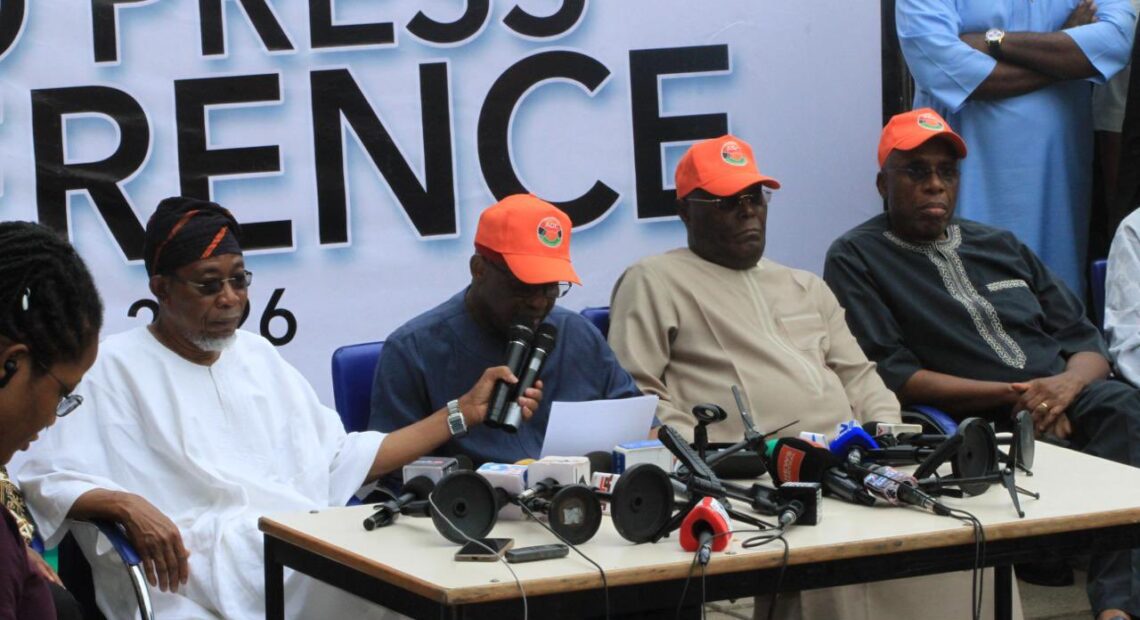
Opposition leaders during the unveiling of the new coalition party, ADC
Rather than the sweeping electoral breakthrough anticipated by supporters of the coalition, the results have exposed a gap between the coalition’s national political visibility and its ability to mobilise votes at the grassroots.
The ADC entered the national political arena with considerable expectations.
On July 2, 2025, opposition figures announced the party as the platform through which a broader coalition would challenge the dominance of the APC ahead of the 2027 general elections.
The coalition attracted heavyweight politicians, including former Vice-President Atiku Abubakar, former Senate President David Mark, former Kaduna State Governor Nasir El-Rufai, former Rivers State Governor Rotimi Amaechi, former Kano State governor Engr Rabiu Musa Kwankwaso, former Sokoto State governor Senator Aminu Tambuwal and 2023 Labour Party presidential candidate Peter Obi, among other political figures.
The ambition was unmistakable.
The coalition presented itself as an answer to the fragmentation that characterised the opposition during the 2023 presidential election, when several major opposition candidates divided the anti-APC vote and President Bola Ahmed Tinubu emerged victorious.
Its promoters argued that a united opposition platform could prevent a repeat of that scenario and offer Nigerians a credible alternative to the APC.
But electoral politics has proved more complicated than the coalition’s launch rhetoric suggested.
From Political Fanfare to Electoral Reality
At its unveiling, the ADC appeared to have many of the ingredients required to become a formidable opposition force.
It had experienced politicians, former governors, former federal lawmakers, presidential aspirants and influential political strategists.
The ADC failed to secure a seat.
Atiku repeatedly projected the platform as a vehicle capable of bringing together Nigerians seeking an alternative to the Tinubu administration.
The former vice-president used his public platforms, particularly social media, to encourage young Nigerians, grassroots organisers and opposition supporters to join the movement.
The message was that the coalition could transform widespread dissatisfaction with economic hardship, insecurity and governance into an organised political force.
But elections have introduced a different measure of political strength.
Votes, rather than endorsements, have become the test.
And so far, the ADC has struggled.
First Test: 2025 By-Elections
One of the coalition’s earliest electoral tests came during the series of by-elections conducted by the Independent National Electoral Commission (INEC) in August 2025.
The ADC failed to secure a seat.
For a political movement that had attracted several nationally recognised politicians, the outcome was an early warning that the visibility of its leaders was not automatically translating into electoral structures capable of winning constituencies.
The result also highlighted one of the central challenges facing the coalition: converting national political networks into ward-level organisation.
Nigeria’s elections are often won through painstaking grassroots mobilisation involving polling-unit agents, ward structures, local influencers, community networks and sustained engagement with voters.
A coalition can generate headlines in Abuja and still struggle to dominate a polling unit in a rural community.
That appears to be one of the issues confronting the ADC.
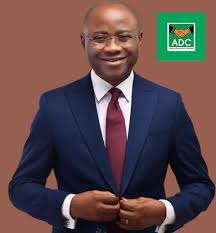
ADC candidate in 2025 Anambra Governorship election, John Nwosu
Anambra: Atiku’s Endorsement Fails to Deliver
The coalition’s next major test came in the Anambra State governorship election of November 8, 2025.
Again, expectations were high.
Former Vice-President Atiku Abubakar publicly endorsed the ADC candidate, John Nwosu, urging voters to use the election as an opportunity to reject poor governance and prevent the APC from gaining control of the state.
But the endorsement did not produce the electoral breakthrough the coalition hoped for.
The ADC finished fifth with 8,208 votes.
The All Progressives Grand Alliance dominated the election with 422,664 votes, while the APC recorded 99,445 votes. The Young Progressives Party polled 37,753, while the Labour Party secured 10,576 votes.
The figures were revealing.
Despite the national profile of the coalition and Atiku’s direct intervention, the ADC remained far behind the leading parties.
The result demonstrated a recurring reality of Nigerian politics: national political endorsements can attract attention, but they do not necessarily determine how voters behave at the local level.
The ADC remained far behind the leading parties.
In Anambra, the ADC’s national coalition machinery failed to displace the entrenched political structures of the parties that had deeper roots in the state.
June 2026 By-Elections: Another Missed Opportunity
The coalition’s difficulties became even more apparent during the June 20, 2026 by-elections, when the APC won five of the six major contests while the Peoples Democratic Party secured the Rivers South-East senatorial seat.
The ADC failed to win any of the contests.
In Enugu North, APC’s Asogwa Ikeje Israel won with 162,360 votes, while the ADC candidate recorded just 1,676 votes.
In Nasarawa North, APC candidate Danladi Envulu-Anza won with 45,362 votes. The ADC’s Alaku Ahmed received 4,244 votes, placing behind the APC, Labour Party and PDP.
In the Rivers South-East senatorial election, PDP candidate Olaka Nwogu won with 47,961 votes, while the ADC again failed to emerge as a serious contender.
The APC also dominated the contests in Ondo South, Dawakin Kudu/Warawa Federal Constituency in Kano State and Zuru State Constituency in Kebbi State.
In the supplied INEC results, ADC did not emerge victorious in any of the six contests.
The outcome reinforced the perception that the coalition’s political strength remained stronger at the level of national conversation than at the level of electoral competition.
A New Day Beckons. -AA pic.twitter.com/wAqcwtFSm7
— Atiku Abubakar (@atiku) July 2, 2025
Local Government Elections: The Grassroots Challenge
If the coalition’s performance in national and state-level contests raised questions about its electoral capacity, local government elections offered an even more important test.
Local elections are generally considered a measure of grassroots political organisation because they depend heavily on ward structures, community networks and local mobilisation.
Yet the ADC has not secured a notable breakthrough in the local government elections referenced in the results.
The situation was particularly evident in the Federal Capital Territory Area Council elections, where the PDP secured Gwagwalada Area Council while the APC won five of the six councils.
The ADC failed to win an Area Council.
For a coalition aspiring to challenge the APC nationally in 2027, the inability to convert opposition enthusiasm into victories at the local level is a significant weakness.
It suggests that the party still has considerable work to do in building a sustainable political machine beneath its national leadership.
Osun: Aregbesola’s Home State Produces Another Setback
The latest setback came in Osun State, where the ADC entered the governorship election with one of its most recognisable national officials, Rauf Aregbesola, serving as the party’s National Secretary.
The election therefore provided the party with an important opportunity to demonstrate that its leadership could translate political experience and national visibility into electoral strength.
It did not happen.
The Independent National Electoral Commission declared Ademola Adeleke of the Accord Party the winner after he polled 511,067 votes.
APC candidate Bola Oyebamiji came second with 444,815 votes, while ADC candidate Najeem Salaam finished third with only 17,180 votes.
Adeleke won 19 of the state’s 30 local government areas, while Oyebamiji secured 11.
The scale of the gap between the ADC and the two leading candidates was perhaps the most striking feature of the result.
The ADC’s 17,180 votes represented only a small fraction of the votes secured by the winner and runner-up.
For a party whose national leadership includes a former governor of Osun State, the outcome is bound to attract scrutiny.
Aregbesola’s political history in the state makes the performance particularly significant, although the result should not automatically be interpreted as a personal referendum on him.
Governorship elections are shaped by a combination of candidate popularity, party organisation, incumbency, local alliances, campaign structures and voter preferences.
Nevertheless, the ADC’s third-place finish demonstrates that the party has yet to establish itself as a dominant electoral force in Osun.

Atiku And Obi Endorsed D Mo As AMAC Chairman.
The Numbers Tell the Story
The five electoral tests reveal a consistent pattern.
The ADC has attracted political heavyweights, but its candidates have struggled to turn that political capital into votes.
Its performance has been particularly weak when compared with the expectations created by the calibre of politicians associated with the coalition.
The party has yet to secure a major victory in the electoral contests highlighted since its emergence as the coalition’s platform.
This raises a fundamental question ahead of 2027: is the ADC building a genuine grassroots political movement, or is it primarily functioning as a coalition of prominent opposition politicians?
The distinction could determine its future.
A political party cannot rely solely on nationally recognised personalities to win elections.
It needs structures extending from the national secretariat to states, senatorial districts, federal constituencies, wards and polling units.
It also needs candidates with established local networks and the capacity to mobilise voters beyond social media and political rallies.
The Peter Obi and Kwankwaso Factor
The coalition has also faced internal political adjustments.
Before the ADC convention and the subsequent emergence of the coalition’s electoral structures, some high-profile opposition figures associated with the broader movement shifted political direction.
Peter Obi and Rabiu Musa Kwankwaso eventually moved towards the National Democratic Congress (NDC) political project, further complicating efforts to maintain a single opposition platform.
Their departures were significant because both men command substantial political followership in different parts of the country.
For a coalition whose central selling point is unity, the movement of prominent political figures to another opposition platform presents an obvious strategic challenge.
It also creates the possibility of multiple opposition candidates again dividing voters in 2027 — precisely the problem the ADC coalition originally sought to solve.
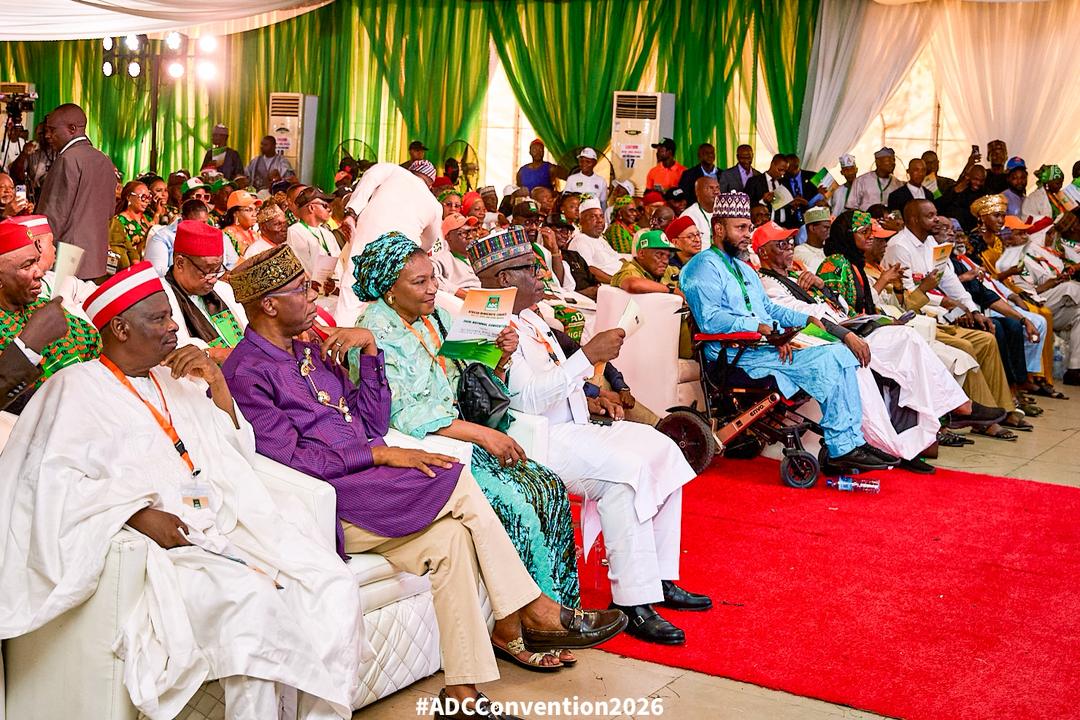
Cross-section photograph of ADC delegates at the national convention.
A Coalition With National Visibility but Limited Electoral Penetration
The ADC’s current predicament is not necessarily proof that the coalition cannot succeed in 2027.
Nigeria’s political landscape can change rapidly, particularly before a general election.
Parties can form alliances, candidates can defect, political structures can be negotiated and voter sentiment can shift dramatically.
The 2027 election is still ahead, giving the ADC time to reorganise.
But the results so far provide a useful warning.
The party’s national visibility has not yet translated into corresponding electoral penetration.
Its leaders have dominated political discussions, but its candidates have struggled to dominate ballot papers.
That distinction matters.
The ADC has the personalities. What it has yet to demonstrate is the electoral machinery to match them.
The coalition was created partly on the argument that the opposition needed a stronger and more unified structure to defeat the APC.
Yet the recent elections suggest that simply bringing prominent politicians together under one platform does not automatically create a winning political machine.
The Bigger Challenge Ahead of 2027
The ADC now faces the more difficult phase of its political project.
The excitement surrounding its formation has begun to give way to the harder work of organisation.
The party must build credible structures at the grassroots, recruit popular candidates, resolve internal differences, strengthen its presence across the 774 local government areas and develop a coherent national campaign capable of competing with the APC’s extensive political machinery.
It must also convince voters that it is more than an alliance of familiar political names.
The failure to win the five electoral tests highlighted so far does not mean the ADC has no political future.
But it does mean that the party’s current electoral record is considerably weaker than the expectations generated by the coalition’s launch.
For a movement that entered the political arena promising to reshape Nigeria’s opposition landscape, the message from the ballot boxes has been unmistakable.
The ADC has the personalities. What it has yet to demonstrate is the electoral machinery to match them.
With 2027 approaching, the next few months will therefore be critical.
The party can either use its early defeats as a diagnostic tool, rebuild from the grassroots and transform its coalition into a functioning political organisation — or continue to rely on the visibility of its national figures while voters elsewhere make their choices.
For now, the scorecard is difficult to ignore: five major electoral tests, no victory, and growing questions over whether the ADC’s national political momentum can survive the realities of Nigeria’s grassroots electoral battlefield.
Read Also:How Nafiu Bala Gombe plunged ADC into Deep Crisis
Author

Sign up for The Insight Newsletter
Get in-depth, research and data-based interpretative reports from around Nigeria.