One Healthy Meal Eats 66% of Minimum Wage; Ekiti Worst Hit: 90% of Wage Gone on Food
Key points:
- Healthy diet costs 66% of minimum wage.
- Ekiti State workers spend 90% of their wages on food.
- Subsidy removal doubled food prices in 3 years
- Insecurity, taxes push 34m into hunger
By Emmanuel Kwada
As Nigeria grapples with a prolonged cost-of-living crisis, new data from the National Bureau of Statistics (NBS) reveals that the average cost of a healthy diet for one adult now consumes a staggering 66% of the ₦70,000 national minimum wage, leaving millions of workers struggling to afford basic survival needs.
According to the NBS Cost of a Healthy Diet (CoHD) report for March 2026, the national average monthly cost stands at ₦46,230 per adult — equivalent to ₦1,541 per day. This figure comes before accounting for rent, transportation, utilities, healthcare, school fees, or other essential household expenses.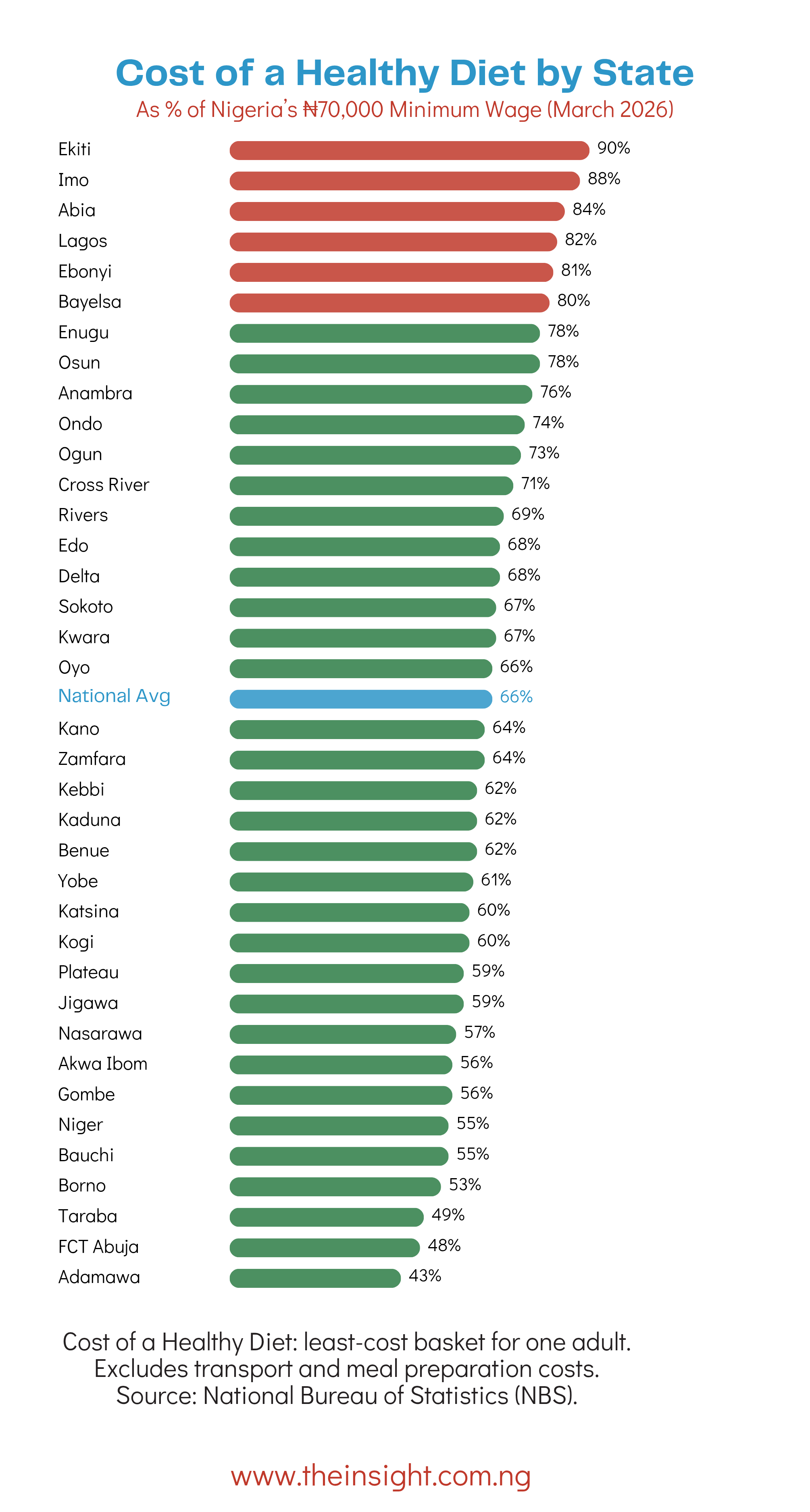
The burden is crushing in several states. Ekiti State records the highest at 90% of the minimum wage, followed by Imo (88%), with Abia, Lagos, Ebonyi, and Bayelsa all exceeding 80%. In sharp contrast, Adamawa State has the lowest burden at 43%, followed by the FCT (48%) and Taraba (49%). The South West zone remains the most expensive overall, with an average daily CoHD of ₦1,764–₦1,801.
Fuel Subsidy Removal: The Trigger of Enduring Hardship
The situation is a direct consequence of the May 2023 fuel subsidy removal, which triggered cascading price increases across the economy. Studies show the policy led to a massive surge in transportation and production costs, with one analysis indicating that a unit increase in subsidy removal correlates with a 73.8% rise in the cost of living and inflation.
Food inflation, a major driver of the healthy diet cost, spiked dramatically post-subsidy removal. Although headline inflation has moderated to around 15–16% by early 2026, cumulative price increases over the past three years have more than doubled the cost of a healthy diet.
The situation is a direct consequence of the May 2023 fuel subsidy removal.
Staples such as rice, garri, yam, and animal proteins — which make up over 35% of the CoHD — remain prohibitively expensive for most families.
Multiple Taxation and Eroding Purchasing Power
Compounding the pain are multiple layers of taxation and levies imposed by federal, state, and local governments. Despite recent tax reforms aimed at harmonisation, many low- and middle-income earners continue to face overlapping charges on businesses, transportation, and market activities.
These indirect burdens further reduce disposable income, making the ₦70,000 minimum wage insufficient for a family of four or five. Labour unions have repeatedly argued that a realistic living wage in 2026 should be closer to ₦200,000–₦250,000.
Insecurity Worsens Food Availability and Prices
Persistent insecurity, particularly in the North East, North West, and North Central regions, has severely disrupted agricultural production — Nigeria’s food basket.
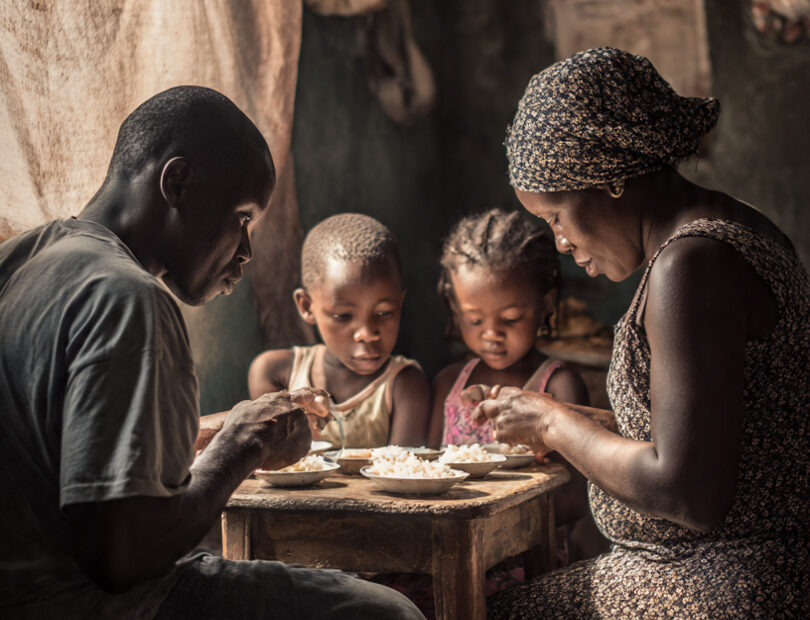
Many households have resorted to skipping meals, reducing portion sizes.
Banditry, farmer-herder clashes, and insurgency have displaced farmers, destroyed farmlands, and restricted market access, leading to below-average harvests and sustained high food prices.
Over 30–34 million Nigerians are projected to face acute food insecurity during the 2026 lean season, according to various assessments.
This combination of factors has pushed millions deeper into poverty. Many households have resorted to skipping meals, reducing portion sizes, or substituting nutritious foods with cheaper, less healthy alternatives, raising long-term risks of malnutrition, stunting, and declining workforce productivity.
Animal source foods alone account for 35.3% of the healthy diet cost, making balanced nutrition a distant dream for the average worker.
The NBS data serves as a sobering reminder that while macroeconomic indicators show some moderation, the lived reality for ordinary Nigerians remains one of severe economic hardship three years after the landmark subsidy reform.
Read Also: 10 promises Tinubu made in his third anniversary speech on May 29, 2026
Author

Sign up for The Insight Newsletter
Get in-depth, research and data-based interpretative reports from around Nigeria.