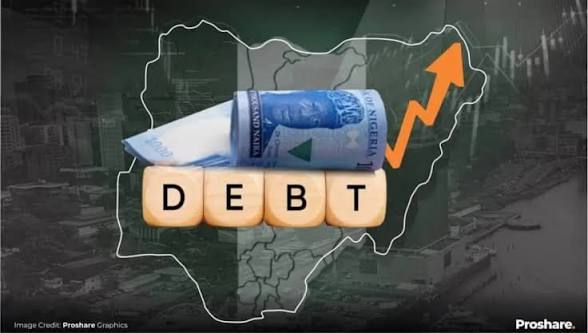
Nigeria’s Debt Interest Soars 124% Above Revenue as Capital Spending Drops to N700bn
Key Points:
- FG spent N7.7trn on interest, exceeding N6.2trn revenue by 124% — World Bank.
- Interest up 37.5%, capital spending down to N700bn — 11 times less.
- Interest and salaries gulped 74% of FG’s total N16.1trn spending.
- Nigeria’s debt now N177trn, up from N67trn in 2021.
By Emmanuel Kwada
The Federal Government spent N7.7tn on debt interest payments in the first half of 2026, exceeding its total revenue of N6.2tn by N1.5tn, according to the World Bank, raising fresh concerns about the country’s rising debt burden and its capacity to finance critical infrastructure and public services.
The figures mean that for every N100 the Federal Government generated in revenue between January and June 2026, approximately N124 went towards servicing interest on its debt, leaving the government under significant fiscal pressure despite a substantial increase in revenue collections.
The findings were contained in the World Bank’s October 2026 Nigeria Development Update, titled Beyond the Federal Purse: How Higher Revenues Shaped State Priorities, obtained by The INSIGHT.
The Federal Government’s interest payments increased from N5.6tn in the first half of 2025 to N7.7tn
The report highlighted the growing pressure of debt servicing on government finances, noting that although revenue improved significantly in the first six months of 2026, rising interest obligations and personnel costs continued to absorb a substantial share of available resources.
According to the World Bank, the Federal Government’s interest payments increased from N5.6tn in the first half of 2025 to N7.7tn during the corresponding period of 2026.
This represents an increase of N2.1tn, or 37.5 per cent, within one year.
The institution attributed the increase largely to elevated domestic borrowing costs, which have continued to make debt servicing more expensive for the government.
The report stated that interest payments rose to 3.1 per cent of gross domestic product, GDP, in the first half of 2026, compared with 2.5 per cent in the corresponding period of 2025.
Despite the increase in the absolute amount spent on interest, the proportion of revenue consumed by interest payments improved from approximately 155.6 per cent in the first half of 2025 to 124.2 per cent in the first half of 2026.
World Bank Headquarters
This represents an improvement of 31.4 percentage points.
However, the improvement has not eliminated the underlying problem, as the government continues to spend more on interest payments than it collects in revenue.
The figures illustrate the extent to which Nigeria’s debt obligations are limiting the resources available for other government responsibilities, including road construction, healthcare, education, security and social protection.
The World Bank report showed that Federal Government revenue increased from N3.6tn in the first half of 2025 to N6.2tn in the corresponding period of 2026.
The N2.6tn increase represents growth of 72.2 per cent within one year.
The improvement was attributed to a recovery in oil receipts, stronger corporate tax collections and higher independent revenues.
Customs revenue remained relatively stable, while value-added tax, VAT, collections were comparatively flat.
According to the World Bank, federal revenue increased from 1.6 per cent of GDP in the first half of 2025 to approximately 2.5 per cent in the corresponding period of 2026.
Although the growth in revenue represents a significant improvement, the figures suggest that the government is yet to generate sufficient resources to comfortably meet its financial obligations.
The situation is particularly concerning because interest payments alone exceeded the total revenue collected during the six-month period.
In practical terms, the Federal Government would have needed additional revenue or alternative financing arrangements to cover the interest bill without relying on other funding sources.
The improved early-year fiscal outturn should be interpreted cautiously given the low reported federal capital spending.
The figures also demonstrate why increased revenue collection does not automatically translate into more money for development when expenditure obligations continue to rise.
While debt interest payments increased, reported capital expenditure declined sharply, raising further questions about the balance between servicing existing debts and investing in economic development.
The World Bank reported that capital expenditure fell from approximately one per cent of GDP in the first half of 2025 to 0.3 per cent in the corresponding period of 2026.
The reported capital spending amounted to just N700bn during the six-month period.
A comparison of the figures shows that the Federal Government spent approximately 11 times more on debt interest payments than on reported capital expenditure.
Interest payments stood at N7.7tn, while capital spending amounted to N700bn.
The difference highlights the pressure debt servicing is placing on the government’s ability to finance infrastructure and other long-term development projects.
Capital expenditure typically covers investments such as roads, bridges, schools, hospitals and other public infrastructure intended to support economic growth and improve living standards.
When such spending remains subdued, projects may be delayed, infrastructure gaps may persist, and the expected benefits of public investment may take longer to materialise.
However, the World Bank cautioned against interpreting the improved fiscal balance as an unqualified sign of stronger public finances, noting that low reported capital spending was partly responsible for the outcome.
The report stated: “The improved early-year fiscal outturn should be interpreted cautiously given the low reported federal capital spending.”
The warning suggests that the government’s improved fiscal position must be assessed alongside the level of development spending actually implemented.
Personnel Costs and Interest Consume Nearly 74% of Spending
Beyond debt servicing, rising personnel expenditure is adding to the Federal Government’s financial pressure.
The World Bank reported that personnel expenditure increased from N3.7tn in the first half of 2025 to N4.2tn in the corresponding period of 2026, following wage adjustments.
When combined with N7.7tn in interest payments, personnel costs brought the total to N11.9tn.
This represented approximately 73.9 per cent of the Federal Government’s total expenditure of N16.1tn during the period.
The combined figure was also nearly twice the government’s total revenue of N6.2tn.
In other words, almost three-quarters of federal spending went towards interest obligations and personnel costs, leaving a substantially smaller proportion for capital projects and other government programmes.
The report further showed that total federal expenditure increased from N14.6tn in the first half of 2025 to N16.1tn in the corresponding period of 2026.
The N1.5tn increase represents growth of approximately 10.3 per cent.
The rising expenditure reflects the combined pressure of debt servicing, personnel costs and other government obligations.
The World Bank warned that these commitments could place additional strain on public finances as capital expenditure picks up later in the year.
It also projected that recurrent and pre-election spending would add to fiscal pressures.
The institution said personnel and interest costs continued to absorb a large share of available fiscal resources, limiting the government’s room to accommodate other spending priorities.
This compares with N67tn, or 27.6 per cent of GDP, in 2021.
Despite the increase in interest payments and total expenditure, the Federal Government recorded an improvement in its fiscal balance during the first half of 2026.
According to the World Bank, the federal deficit narrowed from N11tn, equivalent to five per cent of GDP, in the first half of 2025 to N9.9tn, or four per cent of GDP, in the corresponding period of 2026.
This represents a reduction of N1.1tn in the deficit.
The improvement coincided with the substantial increase in revenue, which helped offset rising expenditure obligations.
However, the World Bank cautioned that the reduction in the deficit should be interpreted carefully because of the sharp decline in reported capital spending.
The implication is that the government’s improved fiscal balance did not necessarily reflect a corresponding strengthening of its capacity to finance development projects.
If capital expenditure increases later in the year as planned, the government’s financing requirements could rise again, particularly if revenue growth fails to keep pace with spending.
The World Bank also identified overlapping budget cycles, weak expenditure planning and poor alignment between approved allocations and implementation capacity as persistent challenges affecting Nigeria’s fiscal management.
These weaknesses, it noted, could undermine the effective implementation of government budgets and make it more difficult to achieve intended development outcomes.
Nigeria’s Public Debt Climbs to N177tn
The pressure from interest payments comes against the backdrop of a substantial increase in Nigeria’s public debt stock over the past four years.
The World Bank estimated Nigeria’s debt stock at approximately N177tn in 2025, equivalent to 40 per cent of GDP.
This compares with N67tn, or 27.6 per cent of GDP, in 2021.
The increase reflects several factors, including exchange-rate valuation effects and the recognition of previously accumulated liabilities.
The report specifically identified the securitisation of Ways and Means advances among the factors contributing to the increase.
Ways and Means advances are short-term financing provided by the Central Bank of Nigeria to the Federal Government. Their accumulated liabilities have contributed to the country’s debt stock following measures to formally recognise and restructure such obligations.
Exchange-rate changes can also increase the naira value of foreign-currency-denominated debt, even when the underlying foreign-currency amount does not increase by the same proportion.
The World Bank’s figures therefore indicate that the growth in reported public debt reflects both additional financing obligations and changes in the valuation and recognition of existing liabilities.
Nevertheless, the rising debt stock has increased the importance of managing borrowing costs, repayment schedules and the overall sustainability of government finances.
The composition of Nigeria’s debt has also emerged as a major factor behind the rising cost of servicing government obligations.
According to the World Bank, domestic debt accounted for 57.9 per cent of Nigeria’s total debt stock in 2025 but generated 72.6 per cent of interest payments.
This disparity indicates that domestic borrowing carries a disproportionately large share of the government’s interest burden.
The report linked the trend to relatively high domestic borrowing costs.
When the government borrows at elevated interest rates, a larger share of public revenue must be allocated to servicing those obligations, reducing the resources available for other priorities.
High borrowing costs can also increase refinancing risks, particularly when existing debts mature and must be replaced with new borrowing at prevailing market rates.
The World Bank consequently recommended limiting expensive borrowing, prioritising concessional financing and extending debt maturities to reduce refinancing risks.
Concessional financing generally offers more favourable terms than commercial borrowing, including lower interest rates and longer repayment periods.
Extending debt maturities can also reduce the pressure associated with having to refinance large amounts of debt within a short period.
However, the effectiveness of these measures would depend on the government’s ability to improve revenue mobilisation, strengthen expenditure controls and manage new borrowing responsibly.
World Bank Projects Wider Fiscal Deficit in 2026
Looking ahead, the World Bank projected that Nigeria’s consolidated fiscal deficit would widen from 3.1 per cent of GDP in 2025 to 3.5 per cent in 2026.
The projected increase was linked partly to rising federal interest payments, personnel expenditure and pre-election spending.
The forecast suggests that the improvement recorded in the first half of 2026 may not be sufficient to prevent renewed pressure on public finances over the full year.
As expenditure obligations increase, the government could face difficult choices between financing development projects, meeting recurrent commitments and raising additional revenue.
The World Bank urged the Federal Government to strengthen revenue mobilisation, improve budget credibility and maintain fiscal discipline to prevent debt obligations from further constraining development spending.
It also highlighted the need to address weaknesses in budget planning and implementation to ensure that approved allocations translate into actual public investment.
For Nigeria, the challenge is not simply the size of its debt but also the cost of servicing it relative to the revenue available to the government.
A debt burden becomes particularly difficult to manage when interest payments consume resources that could otherwise support infrastructure, economic expansion and essential public services.
The World Bank’s findings present a mixed picture of Nigeria’s public finances.
On one hand, Federal Government revenue increased by 72.2 per cent in the first half of 2026, while the fiscal deficit narrowed by N1.1tn compared with the corresponding period of 2025.
The figures show that although the government is collecting more revenue, rising debt servicing and personnel costs continue to limit the amount available for development.
On the other hand, interest payments rose by 37.5 per cent, total expenditure increased by 10.3 per cent, and reported capital expenditure fell to N700bn.
The figures show that although the government is collecting more revenue, rising debt servicing and personnel costs continue to limit the amount available for development spending.
The most striking indicator is the interest-to-revenue ratio of 124.2 per cent, which means that the Federal Government’s interest bill exceeded its entire revenue during the six-month period.
This ratio does not mean that Nigeria’s entire public revenue, including revenue collected by state governments, was spent on federal debt interest. It specifically compares Federal Government revenue with federal interest payments, as reported in the World Bank’s assessment.
The distinction is important because federal and state governments have different revenue streams, expenditure responsibilities and debt obligations.
Nevertheless, the federal figures highlight the scale of the challenge confronting the national budget.
The central question for policymakers is whether stronger revenue collection can be sustained while borrowing costs are reduced and capital expenditure is restored to levels that support economic growth.
Without improvements in these areas, rising debt obligations could continue to restrict the government’s ability to invest in infrastructure, strengthen public services and meet broader development priorities.
The World Bank’s assessment therefore underscores the need for a more sustainable fiscal strategy that balances debt management, revenue generation and productive public investment.
Read Also: Fight Malnutrition With Eggs — Experts Tell Nigerian Parents
Author

Sign up for The Insight Newsletter
Get in-depth, research and data-based interpretative reports from around Nigeria.