
How Nigerians are working against God


A pan-African movie, The Woman King, written by Dana Stevens and produced by Maria Bello and Cathy Schulam, overflows with suspense, surprises, courage, and valuable life lessons. I hear voices from the movie behind me always; it remains as memorable as instructions in wisdom I received in my boyhood years from my grandfather.
Haven aged, looked tired, and thought more of after-life than the decades he had wasted in life, the old man poured stories of wisdom into my young memory to excess. But many of them stuck, like those about totem and taboos that may attract unforgiven consequences.
She [Nanisca]dismisses the fear in the soul and body of her ‘prophetess’ elder sister. She argues that the kingdom’s defenders must rather learn strategies and tactics to defeat the enemies, instead of wasting time spreading fear and prophesying defeat
One of the scenes in The Woman King that has so glued to my mental library is where Nanisca, a role played by Viola Davis, the lead character, disagrees with her elder sister about a bad dream that contains a dark omen.
Nanisca’s frail and fearful looking elderly sister claims to have had a dream about impending misfortune the previous night. Not just her words alone, but her physique cries out about how the enemies of the kingdom invaded the land, killed soldiers and rendered the kingdom desolate.
She expects Nanisca, the protagonist in the arm struggle against slave merchants, to collapse with apprehension. Nanisca did not. Rather, she dismisses the fear in the soul and body of her ‘prophetess’ elder sister. She argues that the kingdom’s defenders must rather learn strategies and tactics to defeat their enemies, instead of wasting time spreading fear and prophesying defeat.
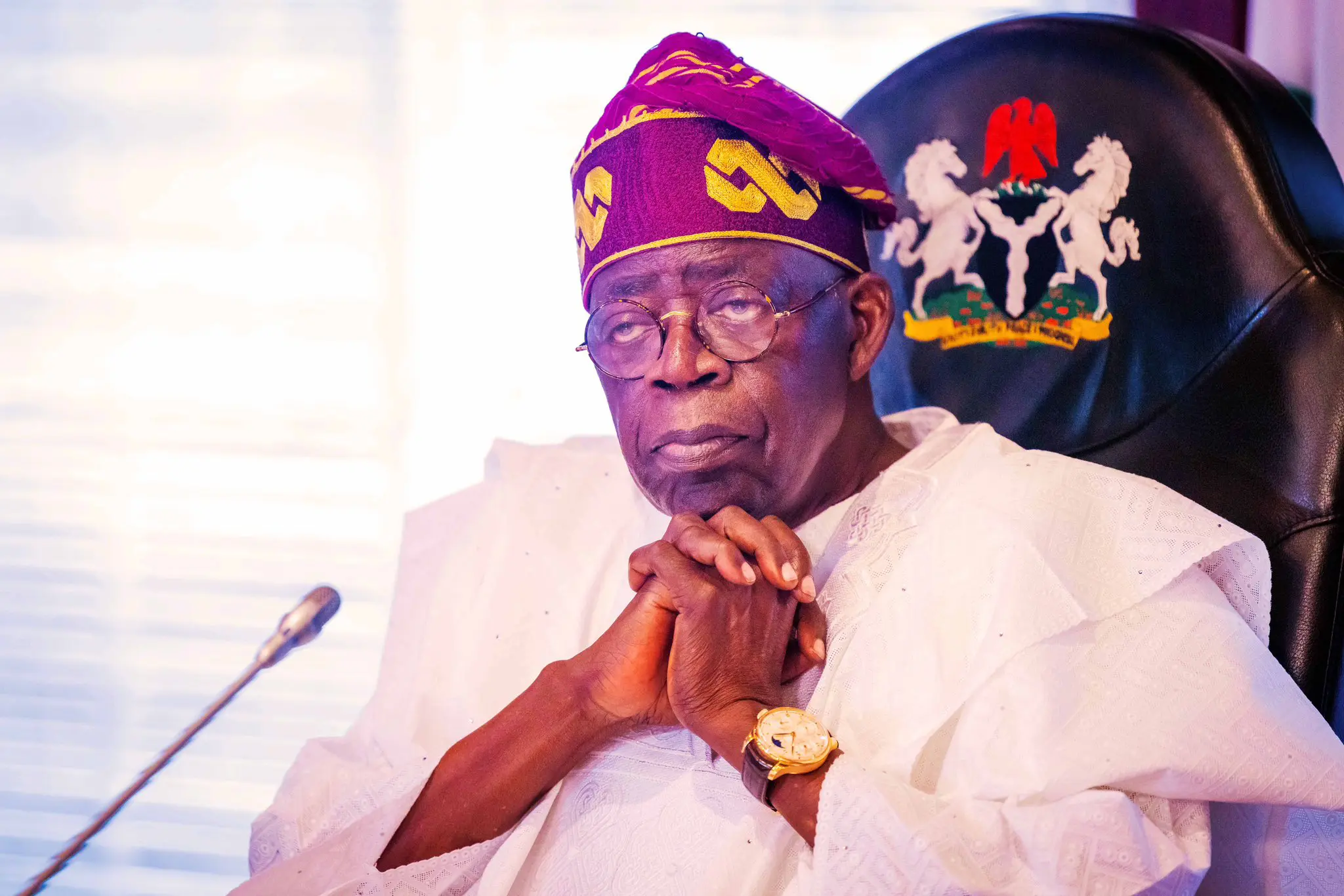
President Bola Tinubu
In subsequent scenes, the all-female military unit caste is found equipping themselves with martial arts instead of making sacrifices to some gods against their enemies.
The spectacular role of Nawi, who is Nanisca’s daughter in the movie, points to the kind of victory life holds in stock when both the old and young throw away fear to confront evil with courage.
Though the movie is derived from an ancient history about the exploits of the all-female military in the old Republic of Dahomey, now Benin Republic, the theme of courage to challenge evil of slave trade, resonates in contemporary Nigeria where complacency has replaced courage.
The country has entered into a dispensation of superstition where individual and collective responsibilities are outsourced to supernatural forces or God, and evil men are permitted to escape with obvious crimes that leave the population in ruins.
The government’s town criers reel out numbers to mark its second anniversary. But the numbers lack human face, more like the face of hippopotamus, that confuse onlookers with its ugliness and wicked visage. I
Unable to win the sympathy of a president who makes governors, lawmakers and the political class rich, richer and richest, Nigerians who have been rendered poor, poorer, and poorest, cry out to God.
Two years after President Bola Ahmed Tinubu drained blood from Nigerians through the removal of fuel subsidy, and bludgeoned them further with the devaluation of the Naira, the resort to God has become more profuse and profound.
The government’s town criers reel out numbers to mark its second anniversary. But the numbers lack human face, more like the face of hippopotamus, that confuses onlookers with its ugliness and wicked visage. Inflation has dropped from 35 per cent in 2024 to 25 per cent in 2025. But a bag of rice which was N45,000 two years ago remains as high as N80,000, an increase of 90 per cent. How does the statistic show positive impact on the ordinary Nigeria?
Logically, salaries must mount in line with inflationary trends. At least, that is the tradition handed down by those who introduced ‘white-collar jobs’ in Nigeria.
The incongruence in the numbers and statistics by the government starred at me from a question my son asked me few weeks ago. Of course, children have a queer way of unsettling unprepared parents with questions about illogical happenings around them.
I’m a constant victim of such interrogations. As a result of the astronomical rise in the cost of living, teachers at my children’s school boycotted classes for almost a week. They sought an increase in their salaries, not to approximate the rate of inflation, but as a gesture that the school authorities appreciated their predicament.
The school’s board refused to bend to the teachers’ protest. After the boycott was called off, my son engaged me in a chat to find out if what his teacher told his class was true.
“Our teacher told us that when she was employed at the school, a bag of rice was N7,000,” he began.
“Okay,” I urged him to quickly tell me his class teacher’s story.
“Now, a bag of rice is N85,000, but her salary remains the same. Why is it so?”
It occurred to me that from the scenario she had paintedm my son’s class teacher had won her students over.
Logically, salaries must mount in line with inflationary trends. At least, that is the tradition handed down by those who introduced ‘white-collar jobs’ in Nigeria.
Where this fails to happen, the cry about injustice and unfairness becomes justifiably aloud. For me to extricate myself from the labyrinth my son’s question threw me into, I simply responded by saying we all were in the boat of his class teacher. There was little anyone could do to alter the situation, other than to cry to God Almighty.
Oil magnates and top officials in our security architecture engaged in oil theft are lucky; their bread is buttered by God.
When winners of elections are cheated and their victory handed on the platter to a loser, he turns to God by saying, ‘it is not the wish of God for me to win.’ When government officials steal a huge chunk of loans from bilateral and multilateral organizations, we accept that God opened the opportunity for them to become rich. It rarely matters to us that there is hardly any proof of how the multibillion-dollar loans were utilized.
What did the former government of President Muhammadu Buhari do with all the loans it took? Where are the railway lines; highways, hospitals, schools, water resources, electricity, and public utilities provided from the loans?
Not to worry, God gave Buhari’s officials the opportunity to become rich through those loans. Now, our Naira has been foolishly devalued and we are taxed on all fronts to enable Tinubu repay those loans. Again, we revert to God. His grace will help us to survive the searing condition.

AI generated image of Nigerians suffering
Oil magnates and top officials in our security architecture who engage in oil theft are lucky; their bread is buttered by God. The directors in civil and public service who forge contract documents and channel funds into their private pockets enjoy the favour of God.
Those of us who pay through our ears to access facilities that should be provided by government look up to God for help. If I am able to pay my son’s school fees, though the country’s policy on education claims that basic education is free, I sing praises to God.
But God may actually be yawning at Nigerians. We have read volumes of books about Him, but still, we can’t understand His ways. We cry louder to him than, perhaps, peoples of other countries, but our predicament demonstrates that we barely reach Him. We punctuate our speeches with phrases that allude to God, but we do not feel the reality of Him who may be closer to us than our spouses.
Though I grew up in a community that outsources everything to God, I was set free from the cave by Lao Russell, who in her book, God Works With Us, Not for Us, elaborately enunciates a collaborative relationship between the divine and the human.
Written in 1955, when electricity was still the most popular technology of note, the author gives a clear example of how this works. The author encourages children to be taught that for anything to manifest, they must demonstrate a sense of responsibility toward them.
She says, “Show them [children] that when they are watering a little plant and caring for its soil, God is making it grow and that is the way they are working with God by creating a plant with Him. Then demonstrate that if they stop watering the plant or caring for its soil, the plant will die. That is working against God.” (P108).
There are many indicators that Nigeria’s people and leadership are unserious and work against God though they yearn for a better living standard for the people.
Over the past two years, the people are alienated from the government that is not really serious about the welfare, security and public service, but obsessed with power retention. There are many indicators that Nigeria’s people and leadership are unserious and work against God though they yearn for a better living standard for the people.
The evidence of its unseriousness is hidden in plain sight, as anti-corruption efforts are performative or weaponized against opponents; complex issues are oversimplified; facts are secondary to narratives; leadership relies heavily on slogans, symbolism, or social media gimmicks; whistleblowers, critics, or opposition figures are silenced or vilified; oversight bodies (e.g., judiciary, legislature, auditors) are weakened; economic policy is ad hoc, with little support for sustainable growth; independent journalists face intimidation or censorship; leadership surrounds itself with loyalists rather than qualified professionals; important positions are filled with family, friends, or sycophants; and decisions are made on whim, ideology, or conspiracy theories. All these are deliberate measures and acts against God in Heaven.
Nigerians must work with God to change the country. God is not a servant who can be compelled to accomplish tasks that we failed to lift our fingers to carry out. We must intentionally work out our salvation from our current predicaments.
Our political parties, National Assembly members, Federal Executive Council (FEC) members, heads of governments agencies cannot deliver a better Nigeria when they intentionally work to accomplish the opposite. God is not our servant; He can work with us, but will not be moved by the noisome prayers and pretentious holiness of our religious crowd whose actions damage the plant rather than nurture it to growth.

AI generated image of children suffering
Author

Sign up for The Insight Newsletter
Get in-depth, research and data-based interpretative reports from around Nigeria.