Tinubu Reverted National Anthem Within 24 Hours, Electoral Act 2026 Can Still Be Amended – Sam Amadi

By Emmanuel Kwada
A prominent member of the African Democratic Congress (ADC), Sam Amadi, has called for the swift amendment of the newly signed Electoral Act 2026 to eliminate a controversial proviso allowing manual transmission of election results in cases of network failure.
Speaking at the Citizens’ Townhall on the 2026 Electoral Act held in Abuja on Sunday, March 1, 2026, Amadi argued that the provision undermines the push for transparent, technology-driven elections ahead of the 2027 general polls.
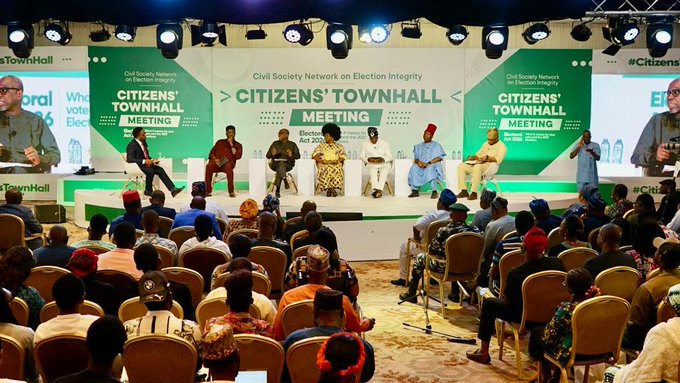
Citizens’ Townhall on the 2026 Electoral Act held in Abuja on Sunday, March 1, 2026
The event, organized by civil society groups including the Civil Society Network on Electoral Integrity and broadcast live brought together electoral experts, civil society leaders, and citizens to dissect the implications of the Electoral Act 2026.
Signed into law by President Bola Tinubu in February 2026 following intense debates in the National Assembly, the Act amends the 2022 legislation but retains a fallback option for manual transmission under Section 60(3) when electronic upload to the INEC Result Viewing (IReV) portal fails due to technical or network issues.
Amadi, a former chairman of the Nigerian Electricity Regulatory Commission and an ADC chieftain, pointed to the rapid legislative action on the national anthem as evidence that swift change is possible.
By default, electronic transmission is now optional. We can still amend this law.
President Tinubu had recently overseen the reversion to Nigeria’s old national anthem through an expedited process completed in roughly 24 hours.
“By default, electronic transmission is now optional,” Amadi stated during the townhall. “My position is that we can still amend this law; by the way, President Tinubu amended the national anthem in one day. Let there be consensus to amend this section to allow INEC to do their regulation, INEC captures the event of failure.”
He warned that the proviso introduces significant risks of confusion and potential abuse. “Communication is not just electronic—this is a bad law,” Amadi emphasized.
“It could go for anything, including poor communication from the headquarters to the polling officer. Even if you have the internet, the polling officer may refuse to transmit on the basis that there was no communication. We should amend this section of the law quickly; it is very important.”

Samson Itodo, Executive Director of YIAGA Africa
Echoing Amadi’s concerns, Samson Itodo, Executive Director of YIAGA Africa—a leading civil society organization focused on electoral integrity urged the National Assembly to immediately recommence the amendment process to scrap the manual transmission clause entirely.
Itodo described the proviso as a negation of the core objective behind the original push to amend the 2022 Act, which was to enhance transparency by minimizing human interference in result transmission.
“I just wish that the lawmakers would eliminate that particular proviso,” he said. “This is why we made a call to them to commence the process of amending that Act and just delete that particular proviso.
“That way, as a country, we will maximise the utility of electronic transmission of results because it limits human interference, it makes the whole process open and transparent.”
Even if you have the internet, the polling officer may refuse to transmit on the basis that there was no communication.
He added that if political actors have no fear of genuine transparency, there should be no resistance to full electronic transmission. Critics, including opposition parties and civil society groups, have repeatedly labeled the manual fallback as a potential “booby trap” or loophole that could enable manipulation, erode public trust, and reverse gains made in previous electoral reforms.
The townhall highlighted broader citizen demands for stronger safeguards in the electoral framework, with participants stressing the need for reforms that prioritize credibility and inclusivity ahead of 2027.
While some officials have defended the hybrid approach as a pragmatic measure to avoid disenfranchisement in areas with poor connectivity, voices like Amadi and Itodo insist that the provision creates unnecessary ambiguity and discretion that could compromise results.
The Electoral Act 2026 represents one of the most significant updates to Nigeria’s electoral laws in recent years, but ongoing debates suggest the conversation is far from over. Calls for fresh amendments continue to grow, with stakeholders urging President Tinubu and the National Assembly to act decisively to restore confidence in the process.
Read Also: Electoral Act Now Law: What You Should Know
Author

Sign up for The Insight Newsletter
Get in-depth, research and data-based interpretative reports from around Nigeria.


