EU Grants: How new machines did not help Nigerian voters

By Theophilus Abbah
“I was so frustrated and exhausted,” Josephine Ochadamu says when asked about her experiences as an Assistant Presiding Officer at a polling unit in Nasarawa State during Nigeria’s 2023 elections. Connected through a mutual acquaintance, she has agreed to a telephonic interview to share her struggles with the new technology that was meant to deliver, in the words of the then-national electoral commission chair, the “best election ever.” Through state-of-the-art machines, the Bimodal Voter Accreditation System (BVAS) was intended to upload votes directly to a connected Result Viewing Portal.
But when it came to the crucial presidential vote, it did not do so.
“The BVAS machine performed perfectly well at first,” Ochadamu explains. “We scanned and uploaded the parliamentary result sheets on the portal. But we just could not upload the results of the presidential election.” The elections officer wracked her brain, asking herself what she was doing wrong. What technical aspects of the European Union-funded BVAS training programme had she failed to apply?
A countrywide malfunction
“The crowd, made up of all parties, was watching us. I was worried that they might assume that we had some game up our sleeves, and I began to feel foolish,” she adds. “There was tension in the air, because the (opposition) Labour Party candidate, Peter Obi, had secured huge votes at our polling unit. His supporters might suspect us of a plot to manipulate the results. But then we learned that the technical problem in uploading the presidential result sheets was nationwide.”
The same had happened at my own polling unit in Lugbe, Abuja. Even as the Labour Party candidate in the Senatorial Election was winning, and the ruling party APC candidate trailed behind, with their hopes of victory seeming buried, the system began to malfunction nationwide. That evening, the phrase ‘technical glitches’ appeared on television as a precursor to the results of the presidential election. Although parliamentary results had been uploaded smoothly, the far more crucial presidential results consistently encountered technical barriers. Amid massive outrage, ruling party candidate Bola Tinubu was declared the winner. https://www.theguardian.com/world/2023/feb/28/nigeria-election-bola-tinubu-leads-amid-anger-at-count-delays-and-rigging-claims
We already know the outcome of the polls; even if everybody votes for Peter Obi, we’ll still win
Seeing the news, I recalled my conversation with an APC ruling party agent in Lugbe on election day. While many supporters of his party at the polling station were growing anxious as votes mounted in favour of the opposition, he told me he did not share their concern. “We’ll still win,” he confided, speaking to me privately under a large neem tree where we sheltered from the scorching sun. “We already know the outcome of the polls; even if everybody votes for Peter Obi, we’ll still win.”
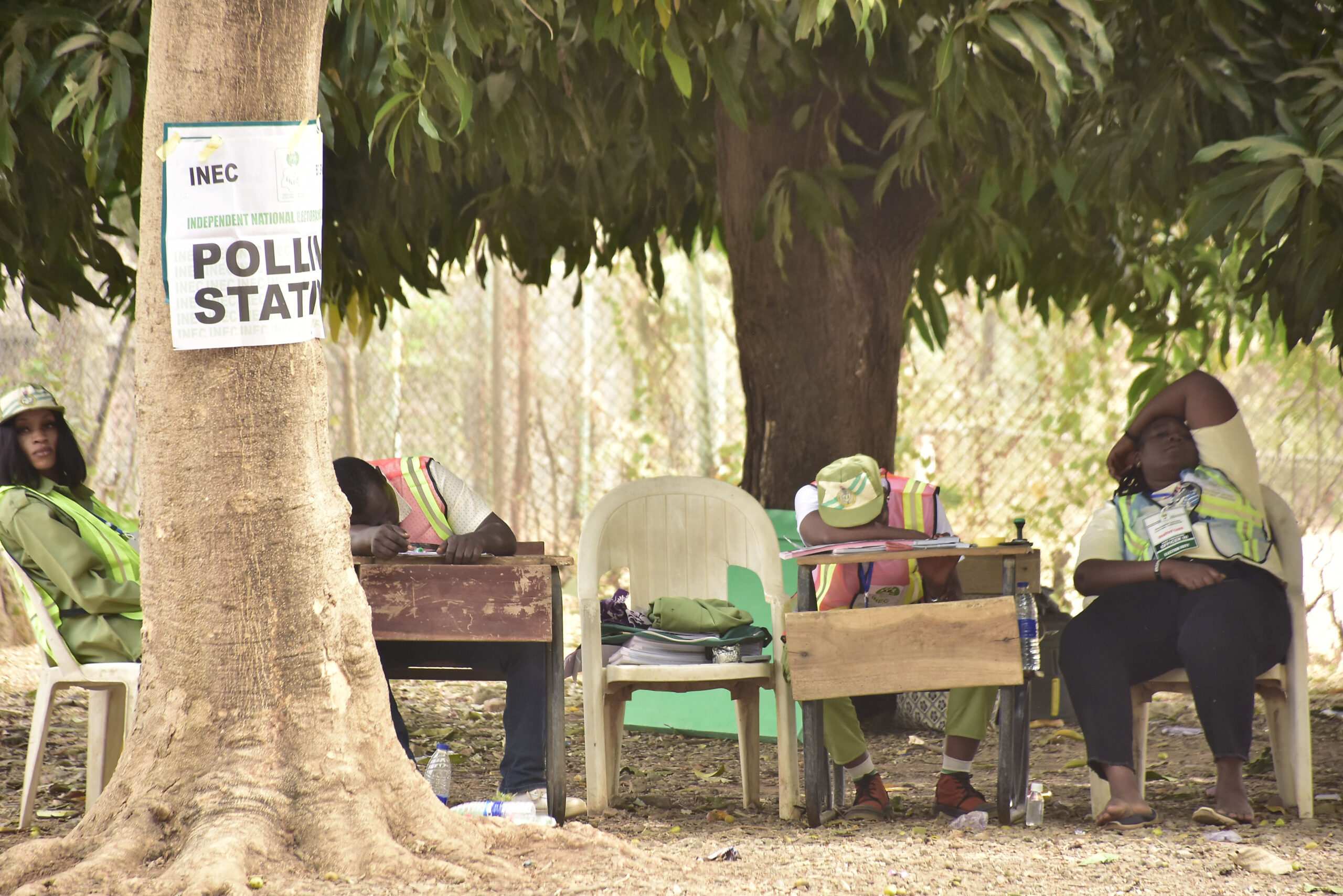
The Independent National Electoral Commission (INEC) ad-hoc staff sleeping at a polling unit in Wuse, Abuja as low turnout of voters mars the Federal Capital Territory (FCT) Area Council elections held in Abuja on the 21th February, 2026
“The best election ever”
Ironically, the introduction by Nigeria’s Independent National Electoral Commission (INEC) of BVAS technology, along with the INEC Results Viewing Portal (IReV), was intended to correct the defects in previous elections in which the results of parliamentary, governorship, and presidential contests in Nigeria were disputed due to a lack of credibility and transparency. For the 2023 elections, INEC spent the local naira equivalent of €70 million on 200,000 BVAS machines to be deployed across the country’s 8,809 wards and 119,973 polling units.
The European Union’s Support to Democratic Governance in Nigeria (EU-SDGN) programme contributed €13 million to the training of INEC staff and other ad hoc election personnel on how to use technological innovations during the elections. Earlier EU electoral support to the controversial 2019 elections, under Phase 1 of the SDGN programme, was of a similar amount. In Phase 2, intended to cover the 2023 elections, the lion’s share of the funds was spent on technological capacity building and training for the use of BVAS machines.
EU’s technical support were introduced with enthusiasm by Nigeria’s then INEC Chairman, Mahmood Yakubu
In the run-up to the elections, new technologies and the EU’s technical support were introduced with enthusiasm by Nigeria’s then INEC Chairman, Mahmood Yakubu, who promised the electorate that “the 2023 general election will be our best election ever […]” [https://orientalnewsng.com/inec-says-2023-general-election-to-be-best-ever/].
Afterwards, however, amid widespread protests around the election of incumbent President Tinubu, widely seen as fraudulent, the INEC boss would blame ‘technical glitches’ for the failure to upload presidential election results from the BVAS machines to the IReV portal.
Tonie Iredia, former director at Nigeria’s now-defunct Federal Electoral Commission, strongly doubts that it was a mere “technical glitch” that affected BVAS machines countrywide. “The technical support didn’t fail. Voters were accredited; the results of the senatorial and House of Representatives elections were uploaded on IReV, but not those of the presidential run.” Iredia says he can only conclude that “human intervention by politicians was responsible for the technical glitches, not electronic. It was manipulation.”
In his view, new technology is simply no match for Nigeria’s political machinations. “Even previous election results were never based on real votes, but on concocted figures. The ‘technical glitches’ once again allowed for figures to be concocted. That’s it. It was not about a failure of technology.”
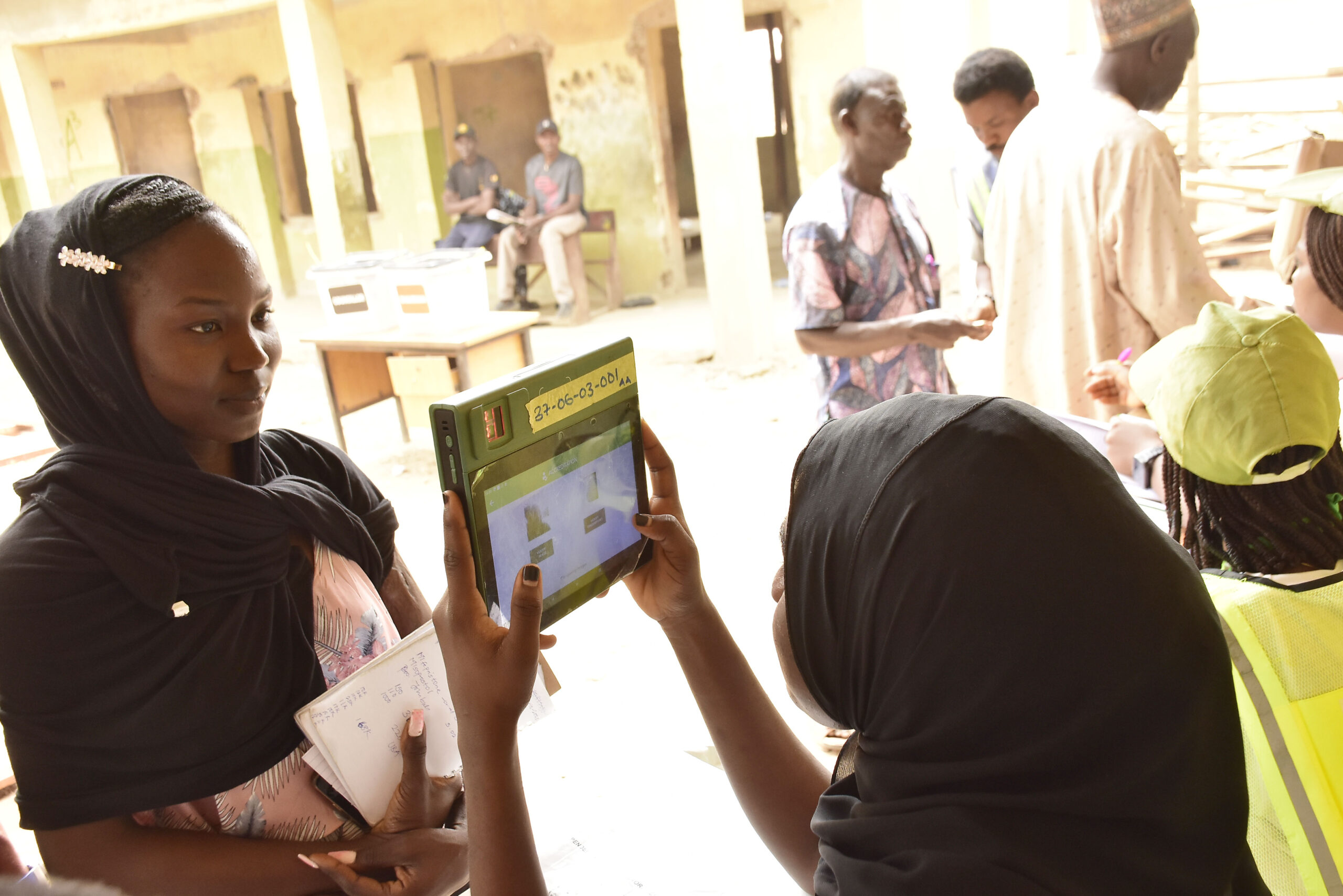
A voter going through capturing and verification with the Bimodal Voter Accreditation System (BVAS) by an Independent National Electoral Commission (INEC) ad-hoc staff at a polling unit in Kubasa ward, during the 2023 general elections.
Smart card
A technological innovation was also promoted as a cure-all for electoral problems on a previous occasion. In 2019, INEC assured Nigerians that “lessons learned” from dubious elections in the past had now led to a sure-fire solution. That year’s elections would be supported by a new Voter Smart Card Reader, with “better calibration and training for officials” to “reduce technical failures”.
Government spokespersons blamed the failure on technical malfunctions, poor internet connectivity, battery issues, and inadequate training of election officials
However, during the polls, the device did not function in many parts of the country, leading to widespread delays and forced manual accreditation in many polling units, once again creating room for the manipulation of figures. While government spokespersons blamed the failure on technical malfunctions, poor internet connectivity, battery issues, and inadequate training of election officials, many reports pointed to the repeated occurrence of longstanding problems such as a lack of transparency at collation centres, intimidation of opposition figures by security agencies, and abuse of the process by incumbent authorities. This now included the suspension of the Chief Justice of Nigeria, Justice Walter Onnoghen, whom the ruling party mistrusted because it considered him close to the opposition party, the PDP. As the highest judicial officer, Onnoghen’s position was crucial should the election dispute be referred to the Supreme Court of Nigeria for adjudication.
Gaps between the numbers
The many reported flaws in Nigeria’s 2023 elections appear to support Iredia’s view that the real problem may lie in manipulation by the powerful, and that such manipulation remains evident even when technology functions properly. In many places where systems did not glitch, and results were correctly uploaded to the iReV portal, inexplicably wide gaps between the number of accredited voters and votes recorded on result sheets were nevertheless reported. In a 2023 report by The Insight about the governorship election in Kogi State, North-Central Nigeria, supposed voters surpassed accredited voters by more than 100 per cent. In Kogi State’s Adavi Local Government Area, BVAS accredited 28,070 voters, but the recorded votes totalled 88,413—a 300 per cent increase. In the Okehi Local Government Area, BVAS accredited 29,995 voters, but the total votes cast were 57,678, close to double the number of accredited voters. Though prohibited by the Electoral Act, the electoral umpire validated the disputed figures by declaring a winner. Other media investigations of the 2023 polls also found that political interests frustrated the use of technology.
In Kano State, local gangs threatened violence against people if they were seen supporting Obi’s candidature at the polls
In Rivers State, BBC journalists who counted the votes in the IReV portal from 6,000 polling station tally sheets [https://www.bbc.com/news/65163713] found that opposition candidate Peter Obi had won by a “wide margin.” The electoral commission, INEC, nevertheless officially declared ruling party candidate and now President, Tinubu, the winner. Reports of alterations on result sheets, rewriting of figures, fraudulent miscalculations, and even mutilation of result sheets were generally rampant in many parts of the country.
That the elections were never likely to be very fair in the first place was also clear from the many recorded incidents of intimidation and violence against the opposition. In several polling units across Lagos, political thugs attacked voters suspected of supporting Peter Obi. In Kano State, local gangs threatened violence against people if they were seen supporting Obi’s candidature at the polls.
The result was a historically low voter turnout of 26%, even lower than the 34.7% recorded in the 2019 elections. Campaigns to elect more women, targeting an informed and committed electorate, also failed, with only 15 women winning seats in the National Assembly: just 3.5% of the 423 declared seats. This represented a sharp decline compared to 2019, when 29 women were elected.
“Abuse of incumbency”
While official state sources attributed the dismal election process and outcomes mainly to “misinformation, disinformation and biased reporting” in the media, the EU Election Observation Mission reported [https://www.eeas.europa.eu/sites/default/files/documents/2023/EU%20EOM%20NGA%202023%20FR.pdf] that there had been a “lack of transparency and operational failures (that) reduced trust in the process and challenged the right to vote”; that the elections “did not ensure a well-run, transparent, and inclusive democratic process as assured by the Independent National Electoral Commission”; and that “abuse of incumbency by various political office holders distorted the playing field and widespread vote buying detracted from the appropriate conduct of the elections.”
The report did not question why the EU had predominantly relied on technological support to address such issues.
Civil society
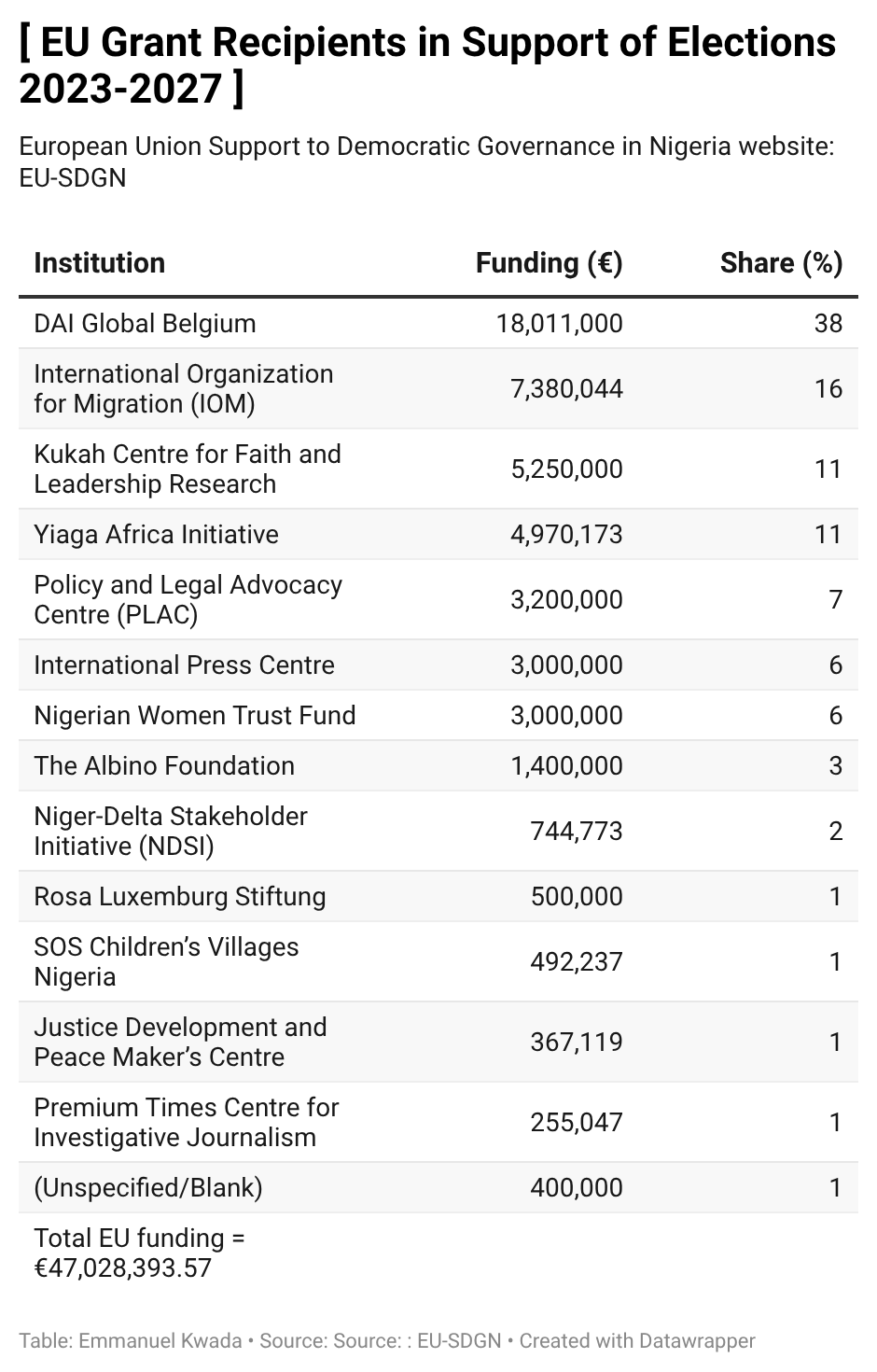
While close to 40 per cent of the total €65 million EU-SDGN funds have been allocated to Nigeria’s election commission, INEC, the programme’s website also shows that the remaining 60 per cent is allocated to civil society organisations (CSOs). This civil society funding, totalling €39 million in the EU SDGN programme for the years between 2023 and 2027, appears substantial. However, a closer look at the EU’s CSO list reveals that the EU’s definition of “civil society” also encompasses funding for political parties and parliament, presumably including the ruling party. There is no itemisation of what exactly is funded for these entities.
SOS Children’s Village
Another question arising from the EU’s “civil society” list is why certain CSOs are selected over others. Why is SOS Children’s Villages included, given that children do not vote and the organisation is unlikely to engage in voter education? Why are UK-based entities such as BBC Media Action and the Westminster Foundation for Democracy included? Real CSOs such as ElectHER, the Nigerian Women Trust Fund, the Justice, Development and Peacemakers Centre, and the Civil Society Legislative Advocacy Centre, which work to inform and mobilise the population in exercising their right to vote, are also included on the list. However, it is once again not clear how much funding each organisation received, or for what purpose.
When asked for a breakdown of the SGDN Phase 2 funding for CSOs, the EU office in Abuja, through its spokesperson, responds that “we will find everything needed there (on the EU-SDGN website), except the amounts to civil society.” The office only responds to a question about the EU’s technical assistance to the electoral commission’s voting machinery, stating that “it may be important to point out that we don’t give INEC money, but work with partners who provide technical support to INEC.”
To me, EU funding of our elections is unnecessary and changes nothing. Our political parties are not built on any ideology
A direct approach by Netherlands-based ZAM colleagues to the International Partnerships department of the European Commission in Brussels, made under an EU regulation that grants EU citizens access to EU information, achieves what I, as a Nigerian, could not. A detailed Excel sheet on SGDN funding for both phases has been received.
Professor of History and former Vice-Chancellor of Adamawa State University, Alkasum Abba, who has monitored Nigeria’s elections from the military-ruled era in the 1990s up to the 2023 elections, does not mince his words. “To me, EU funding of our elections is unnecessary and changes nothing. Our political parties are not built on any ideology. Politicians want to win elections and loot the treasury. That is all.”
Barrister Festus Okoye, former INEC Commissioner and Chair of INEC’s Information and Voter Education Committee from 2018 to 2023, likewise blames the political class for sham elections and suggests that EU support for Nigeria’s elections should exclude the top levels of the state electoral agency and instead be directed towards the political grassroots. “Nigerian political parties are poorly organised. Funding should be directed towards organising parties at the grassroots level.” The same, in Okoye’s view, applies to civil society organisations. “They need capacity building for their staff on how to manage elections. Support should also be directed to auditing the 774 electoral agency’s local offices.”
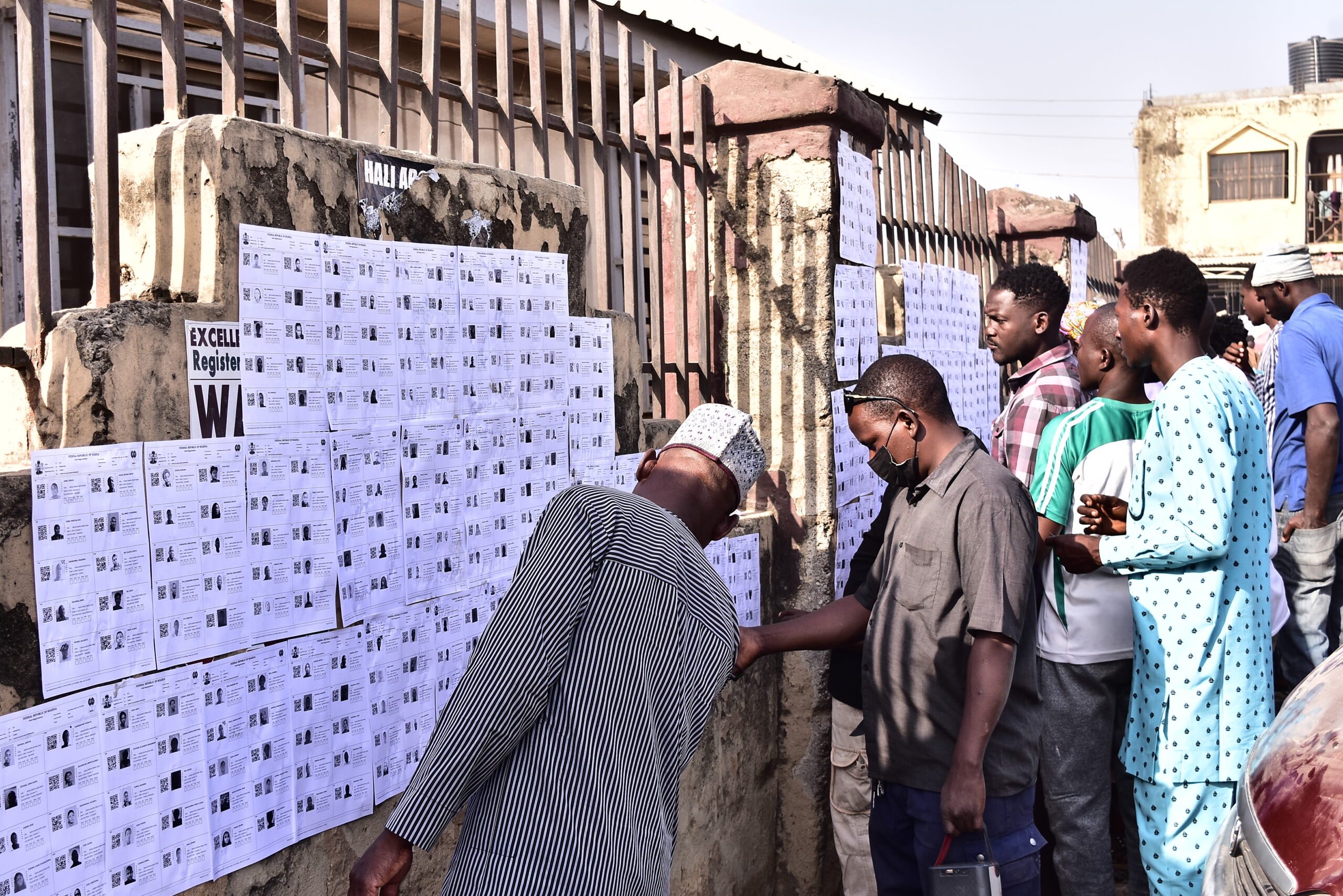
Voters checking their names at a polling unit before the commencement of voting during the 2023 general elections.
Learned it from the colonists
The manipulation of elections in Nigeria dates to the colonial era, when British district officers and lieutenant governors supported the Northern People’s Congress (NPC) against rival political parties. Professor Abba, who has addressed the matter in his PhD research, recalls a confession by Sir Bryan Sharwood-Smith, the first Governor of the Northern Region of Nigeria (1954–1957), who oversaw the transition toward self-government. “Sir Bryan admitted that he actively ensured voters supported the NPC rather than other northern, radical, and populist parties and that for the 1951 election, he personally prepared the NPC’s manifesto, slogans, and campaign strategies.” Sir Bryan’s remark, “In the case of more than a dozen, I had to hold and guide the pen hand, after cajoling from them in the names of those for whom they wished to vote”, is also recorded here https://www.vanguardngr.com/2017/08/nigeria-distress-way-forward-great-future-3/.
The investigation by NAIRE, the Network of African Investigative Reporters and Editors, was coordinated and edited by ZAM, www.zammagazine.com/investigations. The original ZAM publication can be seen here: https://www.zammagazine.com/investigations/2092-elections-circus.
Other Investigations by NAIRE/ZAM Magazine on European Union Funding of Elections in Nigeria
- Elections Circus – ZAM
- Ivory Coast | A mirage of democracy – ZAM
- Uganda | A humanitarian veneer – ZAM
- Kenya | Sound and fury – ZAM
- Zambia | Restraint and fear – ZAM
Author

Sign up for The Insight Newsletter
Get in-depth, research and data-based interpretative reports from around Nigeria.