
2026 First CBT WAEC Records Lower Pass Rate as Nearly 4 in 10 Candidates Fail to Secure Five Credits
…38.5% of Candidates Miss University Admission Benchmark as WAEC Records Slight Decline in First Fully Computer-Based Examination
By Emmanuel Kwada
Nigeria’s transition to a fully computer-based West African Senior School Certificate Examination (WASSCE) has produced mixed outcomes, with the 2026 results showing a slight decline in candidates meeting the minimum university admission requirement, even as examination malpractice recorded its lowest level in nearly a decade.
The West African Examinations Council (WAEC), which released the results on Wednesday, disclosed that 61.54 per cent of candidates obtained five credits, including English Language and Mathematics, the benchmark required for admission into most tertiary institutions across the country.
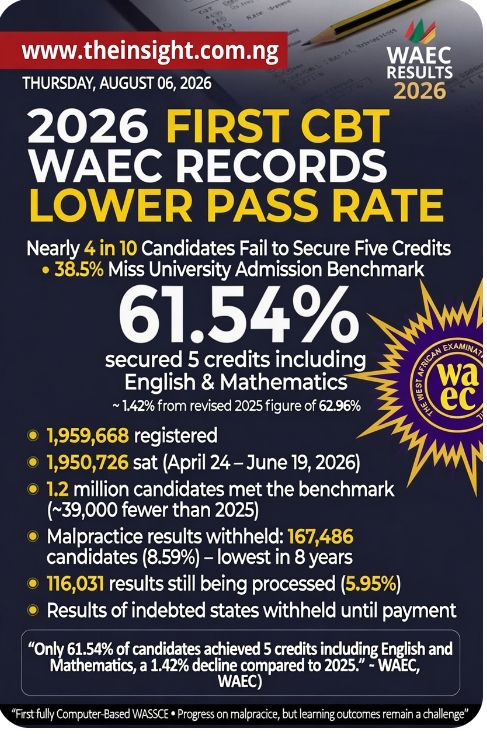
Consequently, 38.46 per cent, or nearly four out of every ten candidates, failed to attain the critical requirement.
The examination marked a significant milestone as the first fully
Computer-Based Test (CBT) WASSCE for school candidates in Nigeria, reflecting WAEC’s ongoing efforts to modernise its assessment system, curb examination malpractice and improve the credibility of its certificates.
The figures show that 1,959,668 candidates registered for the examination, while 1,950,726 eventually sat for the papers conducted between April 24 and June 19, 2026.
Although the decline appears marginal, Prof. Aliyu Tanko, an educationist at Aliko Dangote University of Science and Technology, Kano, said it represents a significant setback considering the sheer number of candidates involved.
Compared to the revised 2025 pass rate of 62.96 per cent, the 2026 result represents a 1.42 percentage-point decline, translating to roughly 39,000 fewer candidates meeting the minimum entry qualification for universities.
WAEC’s statistics indicate that about 1.2 million candidates secured the required five credits, including English and Mathematics, compared to approximately 1.24 million in the previous year.
The decline extends beyond the university admission benchmark.
Overall performance, measured by candidates obtaining five credits irrespective of English and Mathematics, also fell sharply from 91.14 per cent in 2025 to 86.50 per cent in 2026, suggesting broader learning challenges among secondary school students.
Despite the lower pass rate, one area showed measurable improvement. WAEC reported that 167,486 candidates, representing 8.59 per cent of the total candidature, had their results withheld over allegations of examination malpractice.
While still substantial, the figure is lower than the estimated 9.7 per cent recorded in 2025, making it the lowest malpractice rate in approximately eight years.
According to Prof. Tanko, the slight improvement in performance can be linked to key reforms by WAEC. He cited the full migration to computer-based testing, stricter supervision in exam halls, and the serialisation of question papers as major factors. He noted that these steps were deliberately introduced to tackle long-standing issues such as mass cheating, collusion, and the leakage of examination questions.
The examination body also announced that 116,031 candidates’ results, representing 5.95 per cent of the total, are still being processed due to unresolved issues. In addition, results of candidates from states yet to settle outstanding financial obligations to WAEC remain withheld until the debts are cleared.
The 2026 results have also revived conversations about the quality of education in Nigeria. While the country continues to record high enrolment figures, the steady decline in candidates meeting the minimum university entry requirement raises concerns over classroom learning, teacher quality, inadequate infrastructure and widening inequalities between public and private schools.
The results become even more significant when viewed against recent performance trends. In 2021, more than 81 per cent of candidates achieved the university admission benchmark.
That figure declined to about 76 per cent in 2022, recovered to nearly 80 per cent in 2023, slipped to around 72 per cent in 2024, fell further to 62.96 per cent in 2025 after WAEC revised an earlier erroneous result, and has now dropped again to 61.54 per cent in 2026.
Inadequate teacher training, poor learning environments, insecurity in some regions, limited access to digital tools, and economic hardship continue to shape student performance.
Prof. Tanko noted that the trend shows Nigeria’s education challenges go deeper than exam reforms alone. Issues including inadequate teacher training, poor learning environments, insecurity in some regions, limited access to digital tools, and economic hardship continue to shape student performance across the country.
One important clarification, however, is that the widely circulated claim that 38.5 per cent “failed five subjects” is misleading. The figure simply represents candidates who did not obtain five credits including English and Mathematics, the benchmark required for university admission.
Many of those candidates may still have passed several individual subjects but fell short of the admission requirement.
Education stakeholders have urged both federal and state governments to look beyond examination statistics and address the underlying issues affecting learning outcomes.
They argue that improvements in teacher development, curriculum implementation, school infrastructure, digital education and student support systems are essential if Nigeria is to reverse the downward trend in examination performance.
As nearly two million candidates await the next stage of their academic journey, the 2026 WAEC results present a mixed picture. The successful rollout of the country’s first fully computer-based WASSCE and the reduction in examination malpractice demonstrate progress in safeguarding examination integrity.
However, the decline in the number of candidates meeting the university admission benchmark underscores the urgent need for sustained investment and reforms to improve learning outcomes across Nigeria’s secondary education system.
Read Also: WAEC Releases 2025 WASSCE Results: 9.75% Withheld, Only 38.32% Pass Maths, English
Author

Sign up for The Insight Newsletter
Get in-depth, research and data-based interpretative reports from around Nigeria.