The Conviction of Nnamdi Kanu – A Decade-Long Battle Over Separatism, Terrorism, and Justice in Nigeria

By Emmanuel Kwada
In a courtroom thick with tension and heavy security, Justice James Omotosho of the Federal High Court in Abuja delivered a verdict that has sent shockwaves through Nigeria’s southeast and beyond.
Nnamdi Kanu, the fiery leader of the Indigenous People of Biafra (IPOB), a separatist group advocating for the independence of the Igbo-dominated southeast from Nigeria, was convicted on all seven counts of terrorism-related charges.
He was sentenced to life imprisonment on four counts, 20 years on another, and five years on the final charge, all to run concurrently, with no option of a fine.
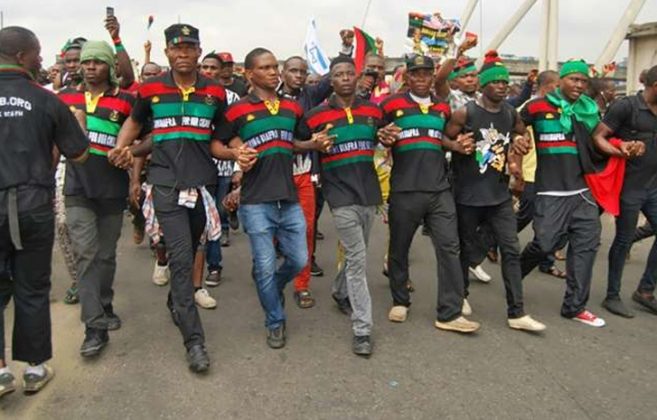
IPOB members protesting in the south east
The ruling caps a torturous 10-year legal saga marked by arrests, escapes, international intrigue, and accusations of judicial bias.
For supporters, it’s a stark symbol of ethnic persecution; for the government, it’s a long-overdue triumph against threats to national unity.
As Kanu’s legal team vows an immediate appeal, the decision risks reigniting separatist fervor in a region already plagued by insecurity, economic woes, and “sit-at-home” protests enforced by IPOB loyalists.
Timeline of Arrests, Flight, and Rendition
Kanu’s journey from radio broadcaster to convicted “terrorist” is a microcosm of Nigeria’s fractured ethnic politics and security challenges.
Born in 1967 in Abia State, Kanu launched Radio Biafra in 2015 from London, using it to rail against perceived Igbo marginalization and call for a referendum on Biafran secession, a nod to the 1967-1970 civil war that killed over a million, mostly Igbo, people.
Kanu was arrested in Lagos on October 14, 2015, charged with treasonable felony for allegedly inciting secession. He was granted bail in 2017 after two years in detention, amid protests by IPOB supporters.
Hours after his release, a military operation codenamed “Operation Python Dance” raided Kanu’s home in Umuahia, Abia State, killing several supporters.

IPOB leader broadcasting live on Radio Biafra
Kanu fled Nigeria, resurfacing via Radio Biafra broadcasts from an undisclosed location, where he escalated rhetoric, accusing the government of genocide and urging resistance.
On June 27, 2021, Kanu was seized in Kenya, an operation his team calls “extraordinary rendition” involving torture and illegal deportation. The Nigerian government denies this, claiming he was extradited legally. He was flown back to Abuja and charged under the Terrorism (Prevention) (Amendment) Act, 2013.
The charges ballooned to 15 counts, later pruned to seven. Kanu’s case became a legal ping-pong. In October 2022, Justice Binta Nyako struck out charges for lacking merit, but the Court of Appeal upheld them in 2023.
The Supreme Court, in December 2023, ordered the trial to continue, rejecting claims of unlawful rendition but criticizing procedural flaws. Kanu, often disruptive in court, fired his legal team multiple times, refused to mount a defense, and argued the Terrorism Act was repealed in 2013 (a claim the court dismissed). In September 2025, his no-case submission was rejected, and by November, the judge ruled he had waived his right to defend after missing deadlines.
The trial’s delays, exacerbated by Kanu’s outbursts, bail bids, and jurisdictional challenges – turned it into a symbol of Nigeria’s creaky justice system. Over 20 witnesses testified, mostly for the prosecution, presenting videos of Kanu’s broadcasts as evidence.
Prosecutors, led by the Department of State Services (DSS), accused Kanu of masterminding violence through speeches that “orchestrated threats, incitement, and directives” to IPOB followers.
Terrorism cannot be defended under any principle of law
Terrorism, under Nigerian law, includes acts intended to intimidate or coerce via threats of violence; no direct action required.
Justice Omotosho ruled the prosecution proved its case “beyond reasonable doubt,” citing Kanu’s broadcasts, e.g., threats that “people will die” and “Nigeria will perish” – as direct incitement.
He highlighted Kanu’s “sit-at-home” orders as restricting freedoms and fueling chaos, and noted his refusal to show remorse or defend himself.
“Terrorism cannot be defended under any principle of law,” the judge said, rejecting defenses rooted in free speech or self-determination. Prosecutors sought the death penalty, but Omotosho opted for life, invoking biblical mercy: “The death penalty is frowned upon globally… I must temper justice with mercy.”
Kanu’s team argues the charges criminalize advocacy. “Seeking a separate nation is not a crime,” lead counsel Aloy Ejimakor said post-verdict. They claim reliance on repealed laws and ignore Kanu’s non-violent intent.
Life Behind Bars, But Appeals Ahead
On November 20, 2025, after convicting Kanu on all counts, Omotosho imposed life imprisonment on Counts 1, 4, 5, and 6; 20 years on Count 3; and 5 years on Count 7.
All concurrent, meaning Kanu, 58, faces effective life in solitary DSS custody, no digital devices allowed. The judge barred fine options to underscore severity, blaming Kanu’s “arrogance” and disruption for prolonging the case.
We are not surprised
Ejimakor immediately vowed to appeal: “We are heading to the Court of Appeal… the only court that sits as a jury. If they disagree, the Supreme Court. By God, Nnamdi Kanu will not stand convicted.” He called it a “travesty,” convicting a man “for what he said, not what he did” – broadcasts from hiding, untied to specific violence.
From Outrage to Warnings of Unrest
The verdict has polarized Nigeria, with reactions exposing deep ethnic fault lines. Supporters decry it as “Igbo persecution,” contrasting it with northern bandit amnesties; critics hail it as rule-of-law enforcement. Security was beefed up in the southeast amid fears of reprisals.
Pro-Kanu and Igbo voices frame the ruling as a martyrdom moment, with IPOB spokesperson Emma Powerful issuing a blistering statement rejecting it as baseless, claiming the judge “relied on no written law… full of defects and illegalities,” and vowing global exposure to predict “Biafra’s rise.”
Kanu’s wife, Uchechi Okwu-Kanu, blasted Justice Omotosho in a tearful video, calling it “evil against humanity” and a constitutional violation for convicting without citing the written law, urging international intervention as “persecution” against a freedom fighter.
Senator Enyinnaya Abaribe (PDP, Abia) said “We are not surprised,” lamenting ignored amnesty pleas and highlighting “faith persecution and political control,” echoing U.S. Congressman James, who linked it to broader Igbo marginalization.
Former Senate President Adolphus Wabara expressed shock that “Ndigbo imprisoned for life… a Boko Haram leader got five years while a non-violent activist gets life,” warning of escalating tensions.
This judgment is nothing but a grave injustice and a painful reminder of the double standards that have crippled this country. After keeping Nnamdi Kanu in detention for years, after ignoring court orders for his release, the same system has now rushed to pronounce him guilty—yet…
— naija_vibes_Tv (@Naija_Vibes_Tv) November 20, 2025
As the Federal High Court sits today, one truth remains louder than every charge on paper: Mazi Nnamdi Kanu is not the terrorist in this story.
How do you accuse a man who asked for a referendum of ‘terrorism,’ while the real killers roam our bushes freely?
How do you hold him… pic.twitter.com/4cNguDaqaY— Mercy (@LaVidaMercy) November 20, 2025
Deputy Speaker Benjamin Kalu offered optimism for political release, saying “all hope not lost.” Reuben Abati noted the case “hasn’t ended,” with appeals ahead despite the 144-page judgment.
Government and pro-unity reactions celebrate justice served. FG counsel Adegboyega Awomolo said, “I congratulate Nigeria… no one is above the law. This ends insecurity in the southeast,” though his words drew backlash as “insensitive” amid ongoing kidnappings in the country.
Kanu’s appeal could drag years, but as Ejimakor said, “Nobody tramples on Nnamdi Kanu.” In a nation weary of insecurity, this verdict; merciful yet merciless, may not end the Biafra question. It might just amplify it.
Author

Sign up for The Insight Newsletter
Get in-depth, research and data-based interpretative reports from around Nigeria.