
Silo maintenance, storage cost Nigeria N2.5bn in 12 months

By Emmanuel Kwada
The Federal Government of Nigeria spent N2,534,863,003.11 on silo maintenance, storage, and procurement between 2023 and 2024, according to records obtained by The Insight from BudgIT’s accountability platform, GovSpend, on Friday.
This sum was allocated to various contractors and service providers across multiple states for the rehabilitation, construction, and maintenance of silo complexes.
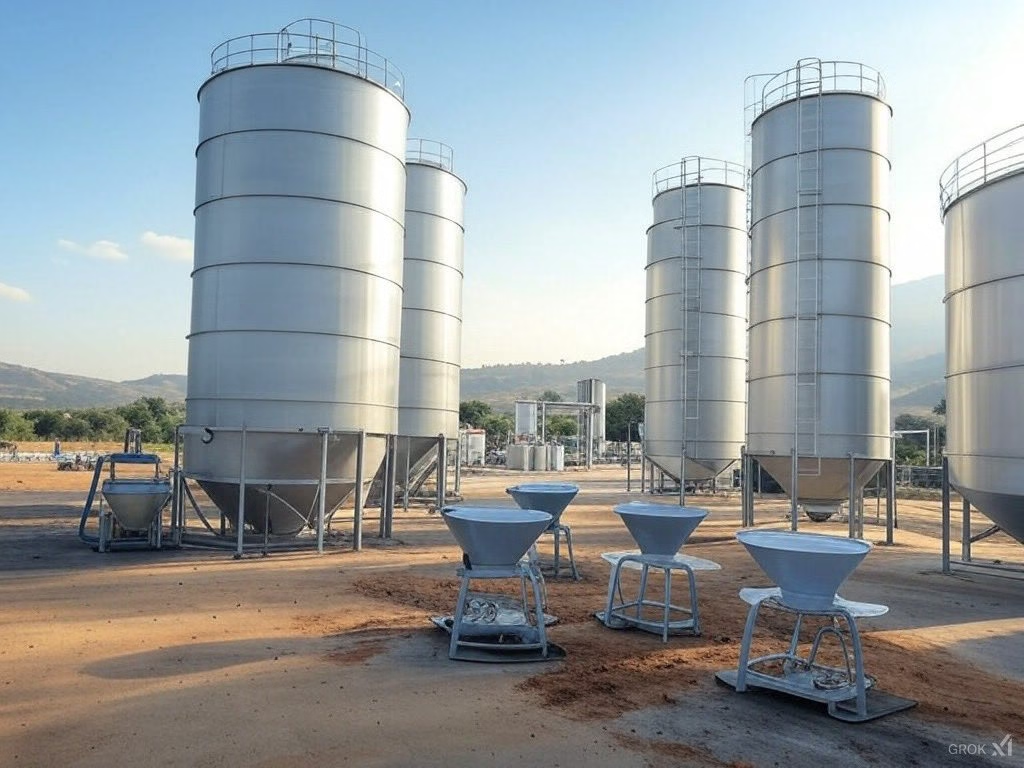
Siilos. Credit: OviaAli X
The bulk of the payments were directed toward the rehabilitation and maintenance of silo complexes in Bauchi, Akwa Ibom, Kwara, and Niger states, with additional funds allocated for the construction of new storage facilities and digitization efforts aimed at improving operational efficiency.
Silos play a crucial role in agriculture, particularly in the storage and preservation of grains and other crops. They provide a safe, dry environment for storing grains, protecting them from moisture, pests, and diseases.
They reduce crop waste, ensure a steady food supply throughout the year, and minimize food spoilage
Silos also streamline harvesting and logistics, reducing labor costs and improving efficiency. The use of silos also has broader economic and environmental benefits. They reduce crop waste, ensure a steady food supply throughout the year, and minimize food spoilage.
The payments, made between June 2023 and May 2024, focused largely on the renovation and expansion of silo facilities, as well as the procurement of essential materials for their upkeep.
The breakdown of key contracts and their corresponding amounts includes the following:
Willbond Consulting Limited received N22,180,374.36 for the emergency production of grain
On June 22, 2023, Willbond Consulting Limited received N22,180,374.36 for the emergency production of grain delivery certificates and flow line tickets for the Federal Government’s retained silo complexes in Abuja.
On June 28, 2023, Global Softlayer Limited was paid N62,360,975.69 for the emergency procurement of environmental chemicals at the Minna Silo Complex in Niger State.

Imota Rice Mill Silo, Lagos. Credit: Positive Naija vibe X
Also on June 28, 2023, Legend Otolorin Construction Limited received N105,845,055.00 for constructing a 2,000-metric ton specialized warehouse for food commodities at the Federal Government’s retained silo complex in Lafia, Nasarawa State.
On December 30, 2023, Global Legend Integrated Concepts Ltd was paid N352,986,777.12, representing 30 per cent of the contract sum for the rehabilitation of a 25,000-metric ton silo complex in Bauchi State.
Sabiti Nigeria Ltd was awarded N377,907,706.50 on December 30, 2023, as a 30 per cent mobilization fee for the rehabilitation of a 25,000-metric ton silo complex and reclamation/erosion control in Uyo, Akwa Ibom State.
Credit: Nigeria 24
Also, on December 30, 2023, JCR Engineering Construction Ltd received N106,271,336.22, representing 30 percent of the contract fee for the rehabilitation of a 25,000-metric ton silo complex in Ilorin, Kwara State.
On February 15, 2024, A4A International Ltd was paid N130,396,504.84 for the rehabilitation and maintenance of Federal Government-retained silos.
FFA Continental Concept Limited was awarded N252,071,456.56 for the procurement of 285.46 metric tons of maize
On the same day, FFA Continental Concept Limited was awarded N252,071,456.56 for the procurement of 285.46 metric tons of maize at the Yola Silo Complex in Adamawa State.
Achhibat Nigeria Ltd was paid N201,658,931.32 on February 15, 2024, for the procurement of 228.37 metric tons of maize at the Minna Silo Complex in Niger State.
On March 26, 2024, Global Legend Integrated Concepts Ltd received N822,165,035.04 for the rehabilitation of the 25,000-metric ton silo complex in Bauchi State.

Additionally, on May 9, 2024, Hephzibah Integrated Technologies Ltd was awarded N60,820,851.51 for the digitization of records and the establishment of a data center to centralize all digital records on silos for the Office of the Secretary to the Government of the Federation at Shehu Shagari Complex in Abuja.
The government also budgeted N120,000,000 in 2025 for the concession of selected Federal Government-owned silos to promote food security and N720,000,000 for the rehabilitation and calibration of these silo complexes in readiness for strategic food reserve stocking.
50 per cent of fresh agricultural produce in Nigeria is lost at the post-harvest stage
In 2024, the United States Agency for International Development revealed that 50 per cent of fresh agricultural produce in Nigeria is lost at the post-harvest stage.
USAID Mission Director Melissa Jones, speaking at the First Post-Harvest Connect Conference and Exhibition in Abuja, noted that such losses contribute to the rising food inflation in the country, which has reached 37.77 per cent.
She stated, “Currently, Nigeria’s post-harvest losses are almost 50 per cent for fresh produce. We all must come together to ensure that the hard work of farmers is not lost after harvest and that it reaches consumers in need.”
Read Also: Nigeria Faces Economic Squeeze as Tariffs, Charges Skyrocket Across Multiple Sectors
The Food and Agriculture Organization also identified post-harvest loss as a major challenge to economic growth globally.
In Nigeria, reports suggest that between 20 per cent and 40 per cent of rice is lost at harvest points and market stages.
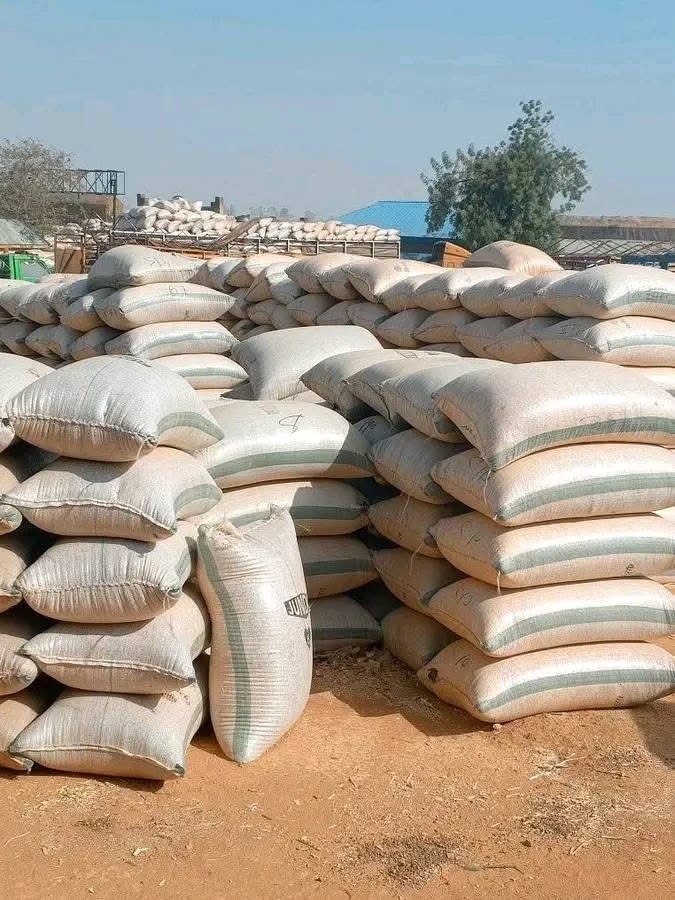
Bags of rice in open space. Credit: OviaAli X
According to the FAO, post-harvest losses occur at various stages, including production, post-harvest handling, marketing, distribution, and processing.
A 2023 report titled “Strategic Food Reserve in Nigeria: An Assessment of Optimal Stock Levels and Storage Capacity,” published by the Federal Ministry of Agriculture and Rural Development in collaboration with AGRA, highlighted that Nigeria’s emergency reserve stocks stood at only 100,000 metric tons or 7.6 per cent of the required six-month provision of 1,323,000 MT for minimum food security.
Read Also: Women farmers unveil blockchain initiative to boost agriculture
The report further stated that the storage capacity of 225,000 MT held by the Federal Government is grossly inadequate.
It also warned that maintaining a high proportion of food grains in reserve would be unsustainable given the country’s current economic reality.
The report recommended an optimal stock of 414,425 MT to offset historical supply shortfalls and an optimal emergency reserve capacity of 2,564,098 MT for vulnerable groups.
Nigeria currently has a total storage capacity of 1,336,000 MT when fully utilized
The report concluded that maintaining a buffer stock capacity of 1,323,000 MT could help ensure price stability and provide for vulnerable groups and relief programs at a minimum cost. To meet the country’s food security needs, the report recommended a yearly buffer stock capacity requirement of 2,646,000 MT.
Nigeria currently has a total storage capacity of 1,336,000 MT when fully utilized, spread across 51 warehouses with a combined capacity of 108,000 MT.
However, the exact quantity of food currently in the country’s strategic food reserve remains unknown.
At the time of filing this report, efforts to obtain an update from the Ministry of Agriculture and Food Security were unsuccessful.
Read Also: Africa Must Take Charge of Its Destiny, Says President Tinubu
Author

Sign up for The Insight Newsletter
Get in-depth, research and data-based interpretative reports from around Nigeria.