
Nigeria: Borno Cholera Cases Hit 35,500 as Atiku, Tinubu Trade Words; Ango: “The North Has Lost Its Values”

By Emmanuel Kwada
Nigeria witnessed another eventful week marked by major political exchanges, public health concerns, judicial rulings and pressing security challenges. From the escalating cholera outbreak in Borno State to the war of words between President Bola Tinubu’s administration and former Vice President Atiku Abubakar, the nation’s headlines reflected the complex issues shaping public discourse.
The week also saw fresh revelations in the controversy surrounding the alleged “phantom” Presidential Foreign Investment Promotion Council, as the Central Bank of Nigeria disclosed that it opened accounts for the council on the directive of the Office of the Accountant-General of the Federation.
In the education sector, President Tinubu challenged Nigerian universities to take the lead in providing practical solutions to insecurity, food shortages and other national challenges through research and innovation.
Security concerns remained at the forefront as residents of Kwara State demanded urgent government action to rescue 176 people who have spent 171 days in kidnappers’ captivity, while elder statesman Prof. Ango Abdullahi warned that Northern Nigeria had lost the values that once defined its leadership and society.
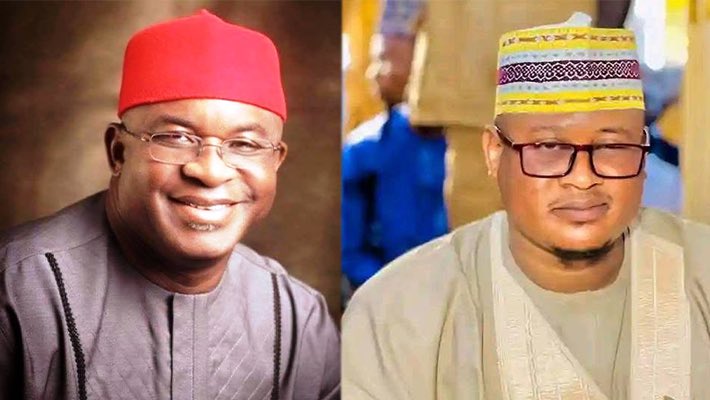
The political landscape was equally dramatic, with a High Court ruling reshaping the leadership tussle within the African Democratic Congress (ADC), as David Mark and Rauf Aregbesola suffered a legal setback in favour of Nafiu.
Here is your comprehensive roundup of the biggest stories that made headlines across Nigeria this week.
Outrage in Kwara as Community Demands Rescue of 176 Abductees Held 171 Days
Residents of Kaiama Local Government Area of Kwara State have staged a peaceful protest, demanding urgent government intervention to rescue 176 people abducted during a deadly attack on Woro community nearly six months ago.
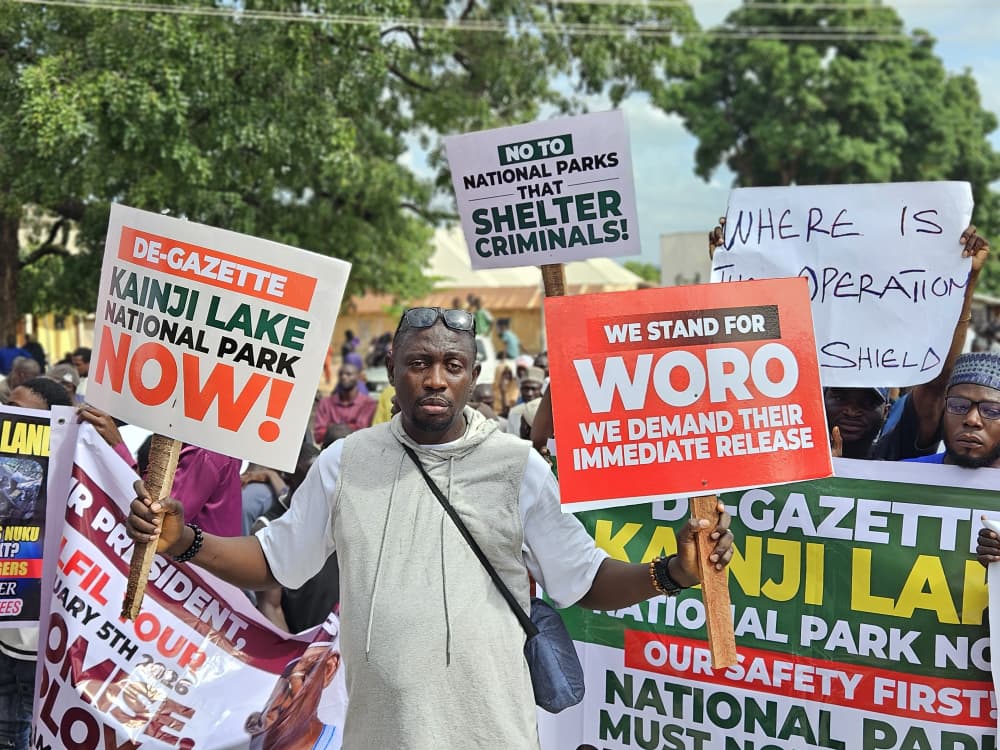
Hundreds of youths, women, and community leaders in Kwara State storm streets to protest insecurity in the state.
The protesters, comprising hundreds of youths, women and community leaders, said the victims had now spent 171 days in captivity, describing the prolonged silence over their plight as unacceptable.
Carrying placards and chanting solidarity songs, the demonstrators marched from the Kaiama main roundabout to the Emir of Kaiama’s Palace, proceeded to the Divisional Police Headquarters, and concluded the procession at the local government secretariat.
Hundreds of youths, women, and community leaders in Kwara State storm streets to protest insecurity in the state.
Speaking on behalf of the organisers, Abdulhameed Abubakar said the protest was aimed at drawing the attention of the Federal Government and relevant authorities to what he described as the continued neglect of the abducted residents.
“Our people have remained in captivity for 171 days. We are appealing to the government to act decisively and ensure their safe return. We also want stronger security presence in Kaiama and the fulfilment of the President’s reported promise to deploy an Army battalion to the area,” he said.
The protesters also called for the de-gazetting of the Kainji Lake National Park, alleging that it had become a major hideout for terrorists and other criminal elements operating in the region.
Our people have remained in captivity for 171 days. We are appealing to the government to act decisively and ensure their safe return.
The Village Head of Woro, Umar Bio Salihu, whose wife and child are among those still being held by the kidnappers, made an emotional appeal to the authorities to intensify efforts to secure the release of all the victims.
“Our appeal is simple. We want our people back. We are pleading with the government to bring them home as quickly as possible,” he said.
Also addressing the gathering, the National President of the Kaiama Development Association (KDA), Mallam Yakubu Salihu, lamented that the prolonged captivity had left families devastated and the entire community traumatised.
He expressed concern that despite the scale of the attack, the community believed it had not received the same level of attention accorded to victims of similar incidents in other parts of the country.
“It has been 171 days and we have not seen the kind of response we expected. We are appealing to the government to rescue the victims without further delay,” he said.
Salihu further warned that insecurity remained a serious challenge in Kaiama, noting that kidnappings and attacks had continued despite ongoing security operations.
Kidnappers recently collected about ₦40 million in ransom from residents of Venra community.
He cited a recent attack on Aboki community, where security operatives reportedly repelled the assailants, and alleged that kidnappers recently collected about ₦40 million in ransom from residents of Venra community.
The Chairman of the State Intervention Committee on the Woro and Nuku attacks, Ahmed Ibn Muhammed, urged the Federal Government to accord the Woro victims the same level of urgency given to victims of similar attacks elsewhere.
He noted that abductees from Papiri and Oyo had regained their freedom and appealed for equal commitment toward rescuing those still held from Woro.
Muhammed also identified the poor state of roads linking Kaiama to neighbouring communities and states as a major obstacle to effective security operations, calling on the Federal Government to improve the infrastructure.
Representing women in the community, Hajia Hauwa Mohammed said mothers had continued to live in fear since the attack, adding that killings and kidnappings had persisted across several communities before and after the Woro incident.
She appealed to both the federal and Kwara State governments to urgently address the worsening security situation and restore confidence among residents.
The security agencies are not sleeping over the Woro case. Efforts are ongoing to ensure the victims return safely.
Receiving the protesters, the Divisional Police Officer of Kaiama, CSP Afiz Nafiu, assured the community that security agencies had not abandoned the victims.
“The security agencies are not sleeping over the Woro case. Efforts are ongoing to ensure the victims return safely. We urge everyone to remain peaceful as these efforts continue,” the police officer said.
The protest underscores growing frustration among residents of Kaiama, who say they are running out of patience as families continue to wait for the safe return of their loved ones after nearly six months in captivity.
‘The North Has Lost Its Values’ — Ango Abdullahi Warns of Deepening Leadership, Moral Crisis
Elder statesman and former Vice-Chancellor of Ahmadu Bello University (ABU), Prof. Ango Abdullahi, has raised fresh concerns over what he described as the steady erosion of the moral foundations that once defined Northern Nigeria, warning that the region’s worsening insecurity, poverty and underdevelopment are rooted in a collapse of values and leadership.
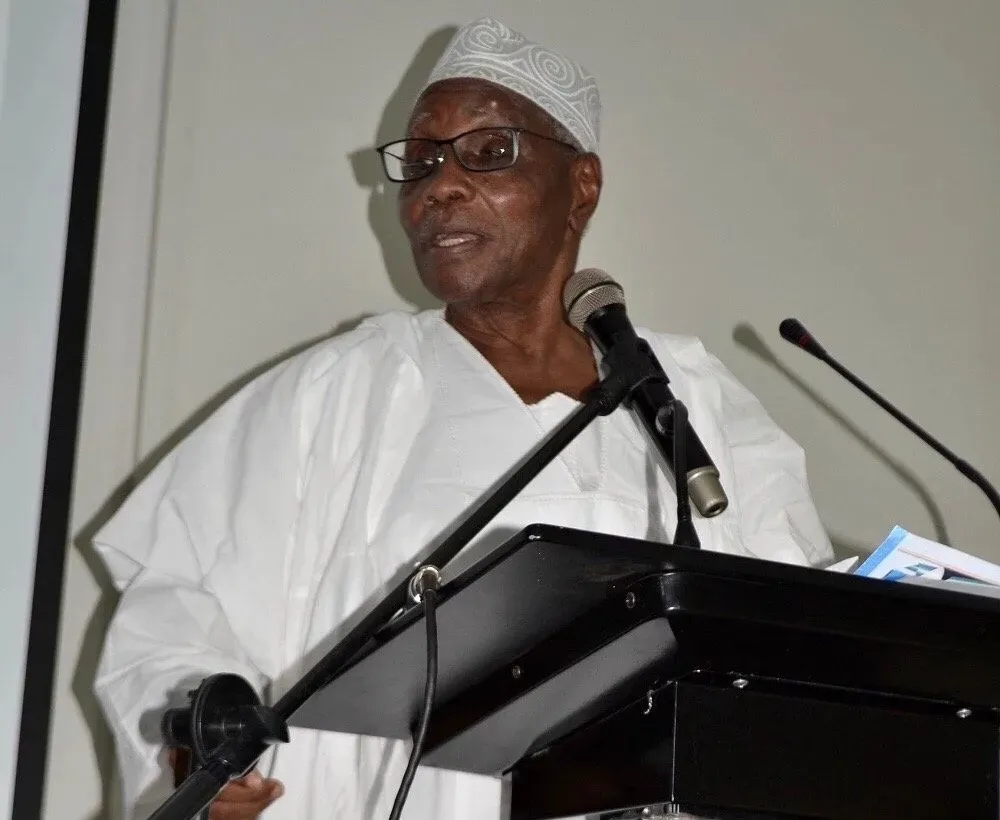
Prof. Ango Abdullahi.
Speaking on Saturday at the third edition of the Late Gen. Hassan Usman Katsina Memorial Conference held at Arewa House in Kaduna, Abdullahi said the North’s current predicament was not caused by a lack of physical development but by a gradual abandonment of the principles of integrity, discipline and selfless service that guided the region’s founding leaders.
The conference, themed “From Sacrifice to Strategy: Rekindling Gen. Hassan Usman Katsina’s Vision for a Prosperous Northern Nigeria,” brought together academics, policymakers, traditional leaders and other stakeholders to reflect on leadership and the future of the region.
Addressing participants, the elder statesman lamented what he described as a departure from the enduring values handed down by previous generations.
“The North has lost its values. You may not want to hear this, but that is the case today. If we have not lost the values we inherited from our parents, from our pioneer leaders, the North will not be where it is today,” he declared.
The North is in a pathetic situation. For me, that is the only reason why the North has stagnated.
According to him, although many cities across Northern Nigeria have witnessed rapid physical expansion and infrastructural growth, the virtues that once distinguished the region—honesty, sacrifice, discipline and accountability—have steadily diminished.
“The North is in a pathetic situation. For me, that is the only reason why the North has stagnated. Don’t worry about the buildings you see. The basic issue concerning where the North finds itself today is the loss of our values,” he said.
Abdullahi urged today’s political and community leaders to emulate the late Gen. Hassan Usman Katsina, describing the former military governor as an embodiment of integrity, transparency and commitment to public service.
“If we can go back to those values, particularly by remembering those who inherited them and practised them, there is no doubt in my mind that the North would have been different today,” he added.

File photo: Northern State Governors, traditional rulers and Elders Forum in Kaduna state government House.
Delivering the keynote address, renowned scholar and public affairs commentator Dr. Usman Bugaje echoed Abdullahi’s concerns, painting a grim picture of the region’s socio-economic realities.
Bugaje said Northern Nigeria had experienced decades of economic decline, institutional decay and worsening insecurity because successive leaders had drifted away from the ideals exemplified by leaders such as Gen. Hassan Katsina.
“The troubles of the North are many and varied. Food production is going down daily, hundreds of thousands are being displaced from their homes, the economy has been shrinking, poverty has nearly tripled, education and healthcare have collapsed, and our human capital has been depleted,” he said.
He argued that persistent insecurity has crippled agriculture, disrupted commerce and weakened social cohesion across the region, making it increasingly difficult for communities to thrive.
It is indeed time to ask how much of the North still remains. Or better still, how much of the sanity of the elite, especially those in government, still remains?
Questioning the quality of contemporary leadership, Bugaje challenged the region’s political elite to provide direction rather than merely lament its problems.
“It is indeed time to ask how much of the North still remains. Or better still, how much of the sanity of the elite, especially those in government, still remains? Today, who is there to go to? Where are the General Hassans to complain to? Where exactly is the leadership? Where is the direction?” he asked.
Bugaje also criticised what he described as the complacency of some Northern elites, accusing them of acknowledging the region’s decline without taking concrete steps to reverse the trend.
“It has become the pastime of the elite to sit in the comfort of their homes and say that the North is in trouble. Some even scream that the North is finished. These comments only betray the complacency or even the complicity of the northern elite,” he said.
Reflecting on his personal encounter with the late Gen. Hassan Katsina, Bugaje narrated how the respected military leader stood by him after the then United States ambassador complained about an article he had written criticising Western imperialism.
According to Bugaje, rather than discouraging him, Hassan Katsina encouraged him to continue speaking truth to power.
“The American ambassador came all the way to Kaduna to complain about the article. General Hassan read it himself and called me. Instead of asking me to stop, he told me to write more of such articles. That was the kind of leader they were. When they knew what was being done was right, they encouraged it,” he recalled.
Bugaje described leaders of Hassan Katsina’s generation as men who successfully blended modern education with the traditional Northern values of justice, modesty, discipline and service to society.
It has become the pastime of the elite to sit in the comfort of their homes and say that the North is in trouble.
“General Hassan’s generation had an infusion of a high dose of our value system. We saw it in their contentment, commitment to their communities, respect for rules and procedures, modesty and decorum, and their vision of a prosperous North where every Northerner became his brother’s keeper,” he said.
He urged today’s leaders to embrace those enduring principles as a pathway to tackling the region’s growing social, economic and security challenges.
The annual memorial conference was organised to preserve the legacy of the late Gen. Hassan Usman Katsina while promoting dialogue on governance, leadership and sustainable development in Northern Nigeria.
The gathering concluded with a renewed call for responsible leadership, institutional reforms and a return to the values of accountability, sacrifice and unity, which participants said are essential to restoring the North’s lost glory.
“He’d Be Rotting in Jail in China”: Presidency Slams Atiku Over $1.2m Lobbying, Death Penalty for Drugs; Atiku Fires Back
Nigeria’s political atmosphere has become increasingly heated as the Presidency and former Vice President Atiku Abubakar exchanged blistering accusations over allegations of foreign lobbying, corruption, and drug-related claims, further deepening the rivalry ahead of the 2027 general elections.
At the center of the latest political war of words is an allegation by the Presidency that Atiku spent $1.2 million to hire American lobbyists to persuade the United States government to revisit President Bola Ahmed Tinubu’s decades-old civil forfeiture case in the U.S.

Former Vice President Atiku Abubakar
The allegation, which Atiku has strongly rejected while counterattacking the Presidency, has sparked a fresh round of political recriminations between two of Nigeria’s most prominent political figures.
Presidency Accuses Atiku of Internationalising Nigeria’s Politics
In a statement issued by the Special Adviser to the President on Information and Strategy, Bayo Onanuga, the Presidency described the alleged lobbying effort as an attempt to drag Nigeria’s internal political affairs before foreign governments.
According to Onanuga, Atiku’s alleged engagement of American lobbyists to petition U.S. President Donald Trump and the U.S. State Department over Tinubu’s 1993 civil forfeiture case amounted to an assault on Nigeria’s sovereignty.
The Presidency argued that the forfeiture matter had long been resolved, stressing that there was no criminal conviction against President Tinubu.
It maintained that the issue was thoroughly debated during the 2023 presidential election, scrutinised by Nigerian courts and ultimately settled after the Supreme Court upheld Tinubu’s victory.
“It is important to remind Atiku and his associates that Nigeria is a sovereign nation, not a satellite of any foreign power,” the statement said.
The Presidency insisted that Nigeria’s political disputes should be resolved through domestic institutions rather than by appealing to foreign governments.
Presidency Revives Corruption Allegations Against Atiku
Beyond the lobbying allegation, the Presidency also revisited past allegations involving Atiku’s public service record.
If Atiku had committed similar offences under China’s legal system, “he would be rotting away in jail.
Onanuga referenced the William Jefferson bribery investigation and a 2010 U.S. Senate report titled Keeping Foreign Corruption Out of the United States: Four Case Histories, which mentioned Atiku and his former wife, Jennifer Douglas.
According to the Presidency, the report detailed financial transactions involving offshore companies and funds suspected to be linked to bribery involving multinational corporations.
The statement also criticised Atiku’s role during Nigeria’s privatisation programme while serving as Vice President, alleging that strategic national assets were sold to political associates below market value, resulting in job losses and hardship for workers.
In one of its strongest attacks, the Presidency declared that if Atiku had committed similar offences under China’s legal system, “he would be rotting away in jail.”
The statement concluded by saying President Tinubu remained focused on implementing the administration’s Renewed Hope Agenda and would not be distracted by political opponents.
Atiku Fires Back, Says Presidency Walked Into Its Own Trap
Responding through his Senior Special Assistant on Public Communication, Phrank Shaibu, Atiku dismissed the Presidency’s claims as politically motivated and described its comparison with China as a “monumental own goal.”
According to the former vice president, the Presidency inadvertently subjected President Tinubu himself to greater scrutiny by invoking China’s strict legal system.
“It takes a peculiar kind of unintelligence for a spokesman to set out to drag an opponent before a hypothetical Chinese court, only to end up dragging his own principal into the dock,” the statement said.

President Bola Ahmed Tinubu
Atiku argued that China’s legal system is internationally known for imposing the death penalty for serious drug trafficking offences, adding that the Presidency’s argument had opened the door for Nigerians to revisit questions surrounding Tinubu’s 1993 civil forfeiture case in the United States.
“Atiku Has Never Been Convicted”
The ADC presidential candidate maintained that he has never been indicted or convicted for corruption, narcotics offences or any criminal offence anywhere in the world.
“The facts are neither complicated nor disputable. Atiku Abubakar has never been indicted or convicted by any court in Nigeria or anywhere else in the world,” the statement said.
Atiku further argued that if China was indeed the benchmark chosen by the Presidency, Nigerians were equally entitled to examine Tinubu’s own legal history, including the $460,000 forfeited to the United States government in the 1993 civil forfeiture proceedings involving funds alleged to be connected to narcotics trafficking and money laundering.
He stressed that under China’s legal framework, financial forfeiture would likely trigger even greater official scrutiny rather than close an investigation.
Renewed Hope Under Fire
The former vice president also widened his criticism beyond the legal dispute, accusing the Tinubu administration of failing to address Nigeria’s pressing economic and security challenges.
Diplomatic correspondence between sovereign governments is routine.
He alleged that the government had instead become preoccupied with political propaganda while ordinary Nigerians battled rising inflation, widespread hunger, insecurity and declining public institutions.
Atiku also criticised the Presidency’s reliance on what he described as routine diplomatic correspondence from the United States, arguing that such communication should not be presented as judicial vindication or proof of innocence.
“Diplomatic correspondence between sovereign governments is routine. It is neither a judgment of a court nor an instrument for rewriting history,” the statement said.
The latest exchange represents one of the sharpest confrontations yet between President Tinubu’s administration and Atiku Abubakar, who has emerged as one of the leading opposition voices ahead of the 2027 presidential election.
While the Presidency insists that Atiku is pursuing personal political ambition by attempting to draw foreign governments into Nigeria’s domestic affairs, Atiku argues that the administration is using diversionary tactics to deflect attention from economic hardship, insecurity and governance challenges.
The escalating rhetoric underscores the increasingly combative nature of Nigeria’s political landscape, with both camps showing little sign of backing down as preparations for the next electoral cycle gradually gather momentum.
Fresh revelations have emerged in the ongoing investigation into the controversial Presidential Foreign Investment Promotion Council (PFIPC), with the Central Bank of Nigeria (CBN) informing the House of Representatives that it opened two domiciliary accounts for the council following an official directive from the Office of the Accountant-General of the Federation (OAGF).
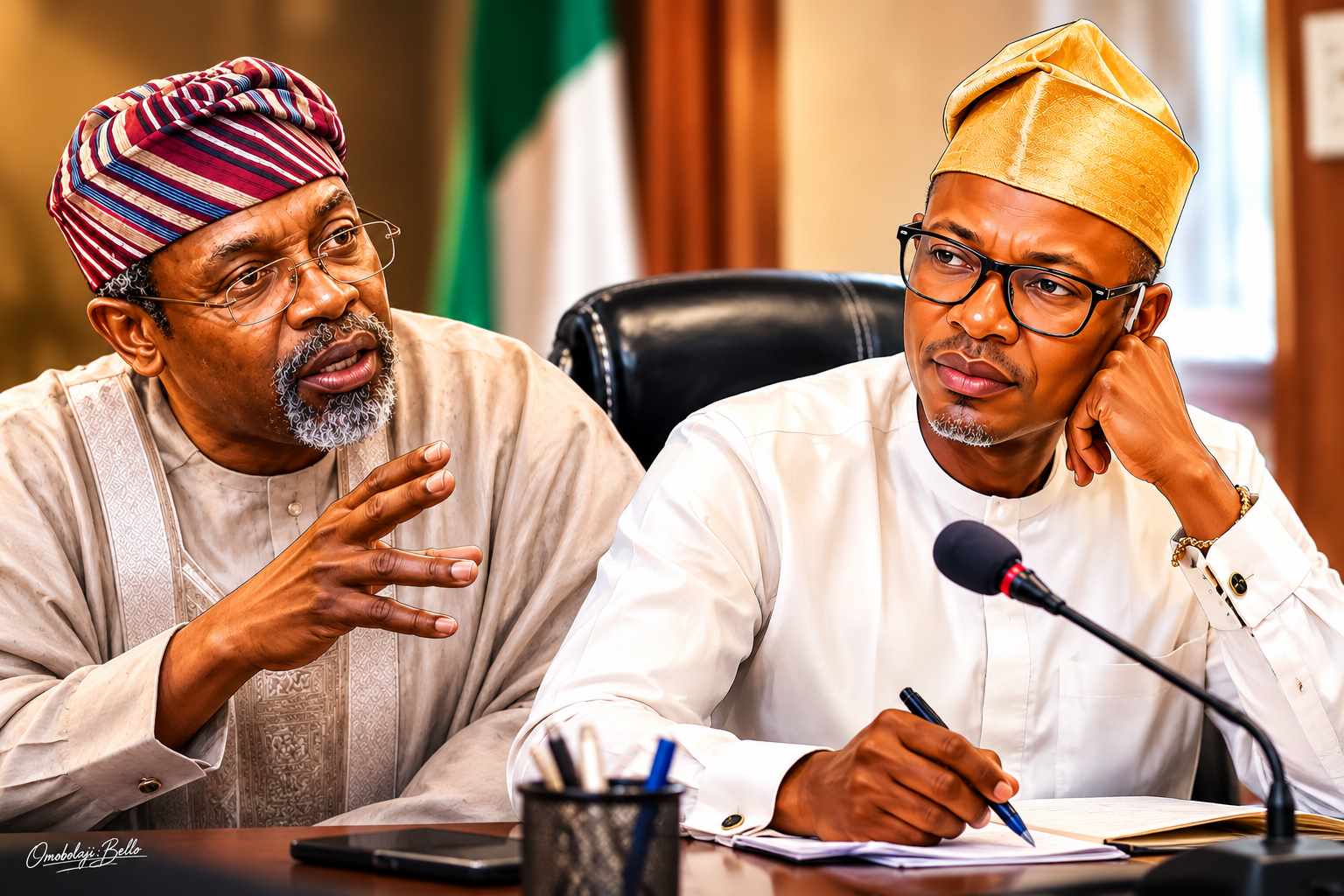
Combo photo of CoS to president Bola Ahmed Tinubu Femi Gbajabiamila and Mathew Adeniyi the acclaim DG of the ‘Phantom’ Council
The disclosure came as the House ad hoc committee investigating the legal basis, operations and budgetary inclusion of the council commenced its public hearing at the National Assembly, while the Independent Corrupt Practices and Other Related Offences Commission (ICPC) confirmed questioning the Chief of Staff to the President, Femi Gbajabiamila, over allegations linked to the disputed agency.
The PFIPC has come under intense scrutiny after more than ₦1.3 billion was allocated to it in the 2026 Appropriation Act despite questions over its legal existence and establishment.
Appearing before lawmakers, a Director at the CBN, Hamisu Abdullahi, representing the Governor of the apex bank, explained that the bank acted on a formal mandate received from the OAGF before opening the accounts.
According to Abdullahi, the CBN received the instruction on July 30, 2025, following a letter dated July 29, 2025, directing it to open one United States dollar domiciliary account and one Pound Sterling account for the Presidential Economic Advisory Council/Presidential Foreign Investment Promotion Council.
He said the bank carried out its standard verification procedures to confirm the authenticity of the directive before processing the request.
We verify its authenticity before proceeding.
“The process for opening government accounts requires a mandate from the Office of the Accountant-General of the Federation. Once we receive the mandate, we verify its authenticity before proceeding,” Abdullahi told the committee.
He clarified, however, that although the accounts were successfully created, they were never activated because the council failed to submit the authorised signatories required for operations.
“The two accounts remain inactive with zero balance and have never been operated,” he said.
Abdullahi further informed lawmakers that no financial activity had taken place on either account since they were opened.
“There have been no foreign exchange allocations, no remittances, no inflows and no outflows. The accounts have maintained zero balance from inception to date,” he added.
The CBN official also explained that the apex bank does not deal directly with Ministries, Departments and Agencies (MDAs) regarding government account openings, closures or modifications except through the Office of the Accountant-General.
His testimony appeared to contradict earlier claims by the OAGF, which had maintained that the controversial council had no account with the CBN and alleged that fake documents were used to mislead government officials.
Also testifying before the committee, the Head of the Civil Service of the Federation, Mrs. Didi Esther Walson-Jack, distanced her office from the establishment of the council.
She explained that while the Office of the Head of the Civil Service approves administrative structures for existing federal agencies, it has no constitutional responsibility to create government institutions.
According to her, the council requested approval for its organisational structure in August 2025, but the request was rejected because the necessary legal documents establishing the agency were not provided.
She revealed that during the 2025 manpower budget defence exercise, officials of the council sought approval for an establishment structure and recruitment waiver.
It was observed that the document presented by the council as its enabling law.
Based on the information presented at the time, approval was granted for 314 positions, including 14 existing officers and 300 new staff.
However, she disclosed that subsequent verification raised serious concerns over the authenticity of the legal instrument presented by the council.
“It was observed that the document presented by the council as its enabling law or legal instrument did not carry the requisite legal features,” she said.
Walson-Jack also denied reports suggesting that her office deployed civil servants to the council or allocated office accommodation at the Federal Secretariat.
Meanwhile, the House committee directed the CBN to submit comprehensive records relating to the accounts and any associated financial transactions as part of its ongoing investigation.
Earlier, inaugurating the committee, Speaker of the House of Representatives Abbas Tajudeen said the investigation was intended to establish facts rather than fuel political controversy.
He stressed that the inquiry would determine whether the council was lawfully created, how it found its way into the federal budget and whether due process was followed throughout its operations.
The House has not constituted this committee to validate speculation or amplify controversy.
“The House has not constituted this committee to validate speculation or amplify controversy. Our objective is simply to establish the facts,” Abbas said.
He urged all government officials appearing before the committee to provide truthful testimony.
“This House expects the truth, not rehearsed scripts or defensive posturing. Nigerians deserve candour. They deserve explanations that withstand scrutiny,” the Speaker stated.
Chairman of the ad hoc committee, Rep. Yusuf Adamu Gagdi, assured Nigerians that the investigation would be conducted fairly, transparently and in accordance with constitutional provisions.
He said every institution and individual connected with the matter would be given an opportunity to present evidence before the committee submits its report to the House.
In a related development, the ICPC confirmed that Femi Gbajabiamila, Chief of Staff to President Bola Tinubu, honoured its invitation over allegations made by the self-acclaimed Director-General of the PFIPC, Prince Adeniyi Adeyemi.
Read Also: Controversial Presidential Council: How Tanimola Died in Mysterious Fire
Adeyemi had alleged that he paid ₦400 million through the late Babatunde Dolapo Tanimola to secure his appointment and further claimed that Gbajabiamila demanded 48 per cent of the council’s proposed ₦27.3 billion take-off grant.
The Chief of Staff has strongly denied the allegations and has filed a ₦15 billion defamation suit against Adeyemi.
Confirming his appearance before investigators, Gbajabiamila’s lawyer, Jiti Ogunye, said his client fully cooperated with the ICPC.
Universities do not merely graduate students; they shape ideas, destinies and preserve the moral and intellectual.
According to him, the Chief of Staff honoured the invitation, answered investigators’ questions and returned to his official duties after giving his statement.
As the House investigation continues, the committee has invited several top government officials and heads of key institutions, including the Ministers of Finance, Justice, Industry, Trade and Investment, Budget and Economic Planning, the Secretary to the Government of the Federation, the Auditor-General, the Nigerian Investment Promotion Commission, the EFCC, ICPC, DSS, Inspector-General of Police and other relevant agencies.
The panel is expected to submit its findings and recommendations to the House of Representatives after concluding its investigation into the controversial council’s legal status, operations and funding.
Tinubu Challenges Universities to Tackle Insecurity, Food Crisis Through Research
President Bola Ahmed Tinubu has challenged Nigerian universities to move beyond their traditional role of teaching and become engines of innovation by developing practical, research-driven solutions to the country’s pressing challenges, including insecurity, food insecurity, climate change and technological underdevelopment.
The President made the call on Saturday during the 55th Convocation Ceremony of the University of Nigeria, Nsukka (UNN), urging institutions of higher learning to ensure that their research findings translate into public policy, industrial growth and real-life solutions that improve the lives of Nigerians.

President Bola Ahmed Tinubu
Represented by the Vice-Chancellor of the University of Benin (UNIBEN), Prof. Edoba Omoregie, Tinubu described universities as the intellectual backbone of national development, stressing that they must play a more active role in shaping the country’s future.
“Universities do not merely graduate students; they shape ideas, destinies and preserve the moral and intellectual foundations upon which nations rise,” the President said.
He noted that while the Federal Government continues to implement reforms across key sectors, universities must complement those efforts by producing evidence-based recommendations and innovations capable of addressing Nigeria’s complex socio-economic problems.
“Our country is facing numerous challenges—insecurity, food insecurity, climate change, technology lag, among others. We are looking up to the universities to provide evidence-based advice and innovative solutions to these problems,” he said.
Tinubu emphasized that academic research should no longer remain confined to libraries and scholarly publications but should be commercialised and deployed to industries, government institutions and communities where it can make tangible impacts.
Our country is facing numerous challenges—insecurity, food insecurity, climate change, technology lag.
“Research outputs from our universities should move from the shelves to industries where they are needed, and should translate into policies that shape our developmental priorities,” he added.
The President described education as Nigeria’s most strategic investment, noting that sustainable economic growth, technological advancement, national security and national cohesion depend on a strong and functional higher education system.
He reaffirmed his administration’s commitment to expanding access to tertiary education through the Nigerian Education Loan Fund (NELFUND), assuring Nigerians that no qualified student should be denied higher education because of financial hardship.
Tinubu also pledged sustained investment through the Tertiary Education Trust Fund (TETFund) to improve infrastructure, strengthen research, modernise curricula, develop academic staff and promote innovation across Nigerian universities.
According to him, these investments are aimed at producing graduates who are capable of creating jobs and driving economic growth rather than merely seeking employment.
He further promised improved welfare packages and enhanced professional development opportunities for both academic and non-teaching staff, stressing that motivated personnel remain essential to building world-class universities.
Addressing the graduating students, the President acknowledged concerns over unemployment but encouraged them to remain optimistic, assuring them that his administration is implementing policies designed to create more opportunities for young Nigerians.
I know that you are anxious about what the future holds for you, especially in the face of the unemployment rate in the country.
He highlighted ongoing investments in digital skills acquisition, technology hubs and entrepreneurship while revealing plans to reform the National Youth Service Corps (NYSC) into a more skills-driven and technology-oriented programme.
“I know that you are anxious about what the future holds for you, especially in the face of the unemployment rate in the country. I will not stand here to paint a picture of effortless prosperity to you, but I can assure you that my administration is doing everything possible to ensure that our youth are productively engaged,” Tinubu said.
The President also commended the management of the University of Nigeria for aligning with the Renewed Hope Agenda, praising the institution’s achievements in infrastructure development, digital transformation, research, institutional governance and global visibility.
He specifically applauded the Governing Council led by Prof. Adegboyega Adebayo Karim and Vice-Chancellor Prof. Simon Uchenna Ortuanya for what he described as remarkable progress recorded within the past year.
In his remarks, the Chancellor of the university and the Ooni of Ife, Oba Adeyeye Enitan Ogunwusi, praised the institution’s leadership for repositioning UNN through infrastructure renewal, enhanced campus security, improved research and innovation.
As ambassadors of the University of Nigeria, let your conduct everywhere reflect the values of discipline.
The monarch urged graduates to understand that academic certificates alone would not guarantee success in today’s rapidly changing world shaped by artificial intelligence, climate change and evolving labour markets.
“As ambassadors of the University of Nigeria, let your conduct everywhere reflect the values of discipline, excellence, integrity, hard work and respect for humanity,” he advised.
He further encouraged them to use their education as a tool for national transformation by contributing to entrepreneurship, healthcare, scientific innovation, environmental sustainability, democratic development and peacebuilding.
Speaking earlier, the Pro-Chancellor and Chairman of the Governing Council, Prof. Adegboyega Adebayo Karim, described the convocation as a celebration of excellence, resilience, innovation and service.
He reaffirmed the institution’s commitment to restoring human dignity through knowledge in line with the vision of the university’s founder, Dr. Nnamdi Azikiwe.
Vice-Chancellor Prof. Simon Uchenna Ortuanya declared that rebuilding the University of Nigeria was inseparable from rebuilding Nigeria itself.
Delivering his address titled “Arise! Let Us Rebuild the University of Nigeria: Reimagining the University, Reinventing Institutional Capacity, and Restoring the Dignity of Man,” Ortuanya said the institution was committed to becoming a globally respected centre of scholarship, innovation and research while maintaining its African identity.
He emphasized the importance of international collaboration, research partnerships and global visibility in strengthening the university’s competitiveness in the knowledge economy.
The Vice-Chancellor announced that the university awarded 2,994 postgraduate qualifications during the convocation, comprising 1,390 Doctor of Philosophy (PhD) degrees, 1,340 Master’s degrees and 214 Postgraduate Diplomas.
He described the graduating students’ accomplishments as a testament to intellectual excellence, resilience and dedication, expressing confidence that they would contribute meaningfully to Nigeria’s development and the global knowledge economy.

Author

Sign up for The Insight Newsletter
Get in-depth, research and data-based interpretative reports from around Nigeria.


