Fuel Subsidy Removal Pushes 63% of Nigerians into Poverty, Study Reveals
By Emmanuel Kwada
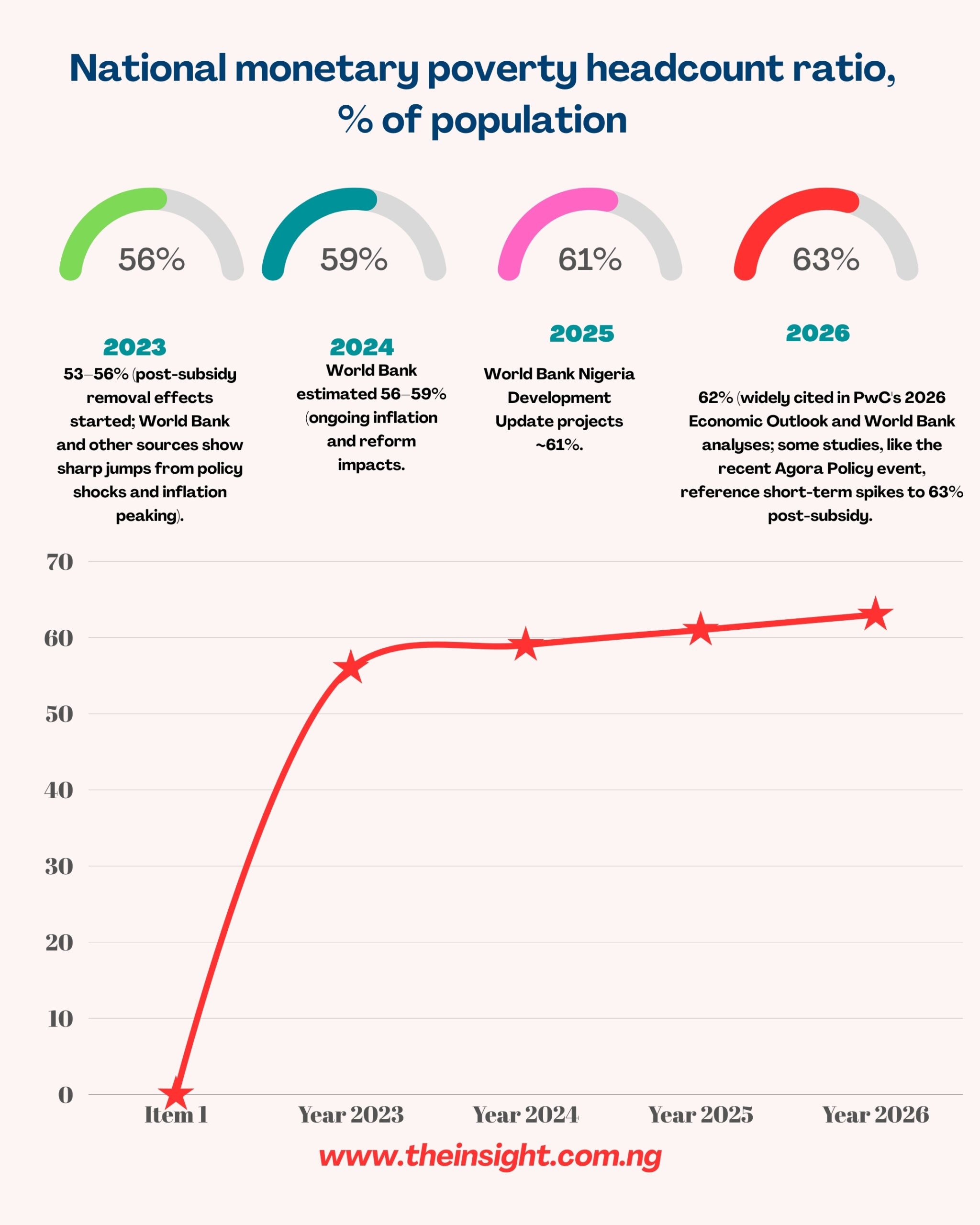
A new independent study has revealed that Nigeria’s national poverty rate surged to approximately 63% in the immediate aftermath of the federal government’s removal of petrol subsidies in 2023, underscoring the profound short-term welfare costs of the country’s bold economic reforms.
The findings, presented by Dr. Mohammed Shuaibu, a Senior Lecturer in the Department of Economics at the University of Abuja, were unveiled during a high-level stakeholders’ dialogue organized by Agora Policy in Abuja on Thursday, March 12, 2026.
The event, themed “Sustaining and Deepening Economic Reforms in Nigeria,” brought together policymakers, economists, civil society representatives, private sector leaders, and international experts to assess the ongoing impacts of President Bola Tinubu’s reform agenda.
According to the research, which combined quantitative economic modeling with qualitative insights from focus group discussions across Nigeria’s six geopolitical zones, the national poverty headcount rose sharply from a pre-reform baseline of about 49.8% to roughly 63% following the abrupt removal of the petrol subsidy.
This spike was driven primarily by cascading price increases in fuel, transportation, food, and other essentials, which severely eroded household purchasing power particularly among low-income and rural families.
After the subsidy removal, poverty increased from a baseline of about 50 per cent to 63 per cent.
Dr. Shuaibu explained: “After the subsidy removal, poverty increased from a baseline of about 50 per cent to 63 per cent.”
He noted that low-income households bore the brunt, with poverty levels among this group climbing from around 50% to roughly 63%, while higher-income households remained largely insulated due to greater financial buffers.
The study also highlighted a widening poverty gap a measure of the depth of poverty—from 31.6% pre-reform to more than 45% post-removal, signaling that not only were more Nigerians pushed below the poverty line, but those already poor fell even deeper into deprivation.

Fuel Pump Nozzle and Naira Notes Demonstrate Fuel Subsidy
The research acknowledged some relief from subsequent government interventions. The introduction of social protection measures, notably cash transfers and other palliatives, helped moderate the poverty rate to around 56.2%.
Dr. Shuaibu stated: “However, when social protection measures such as cash transfers were introduced, the poverty rate moderated to around 56.2 per cent.”
These programs provided a cushion, particularly for vulnerable households, though their impact was constrained by implementation delays, limited scale, inadequate coverage, and challenges in targeting the most needy via the National Social Register.
Focus group participants across zones reported widespread adoption of survival strategies: cutting back on food and non-essential spending, reducing transport usage, rationing electricity, borrowing money, or seeking informal support networks.
Many households received little to no direct government assistance, leading Dr. Shuaibu to observe that “households adjusted to the shocks not through recovery but through sacrifice.”
The economy is improving at the macro level, but that improvement has not trickled down to the common man and many small businesses.
The reforms extended beyond fuel. Adjustments to electricity tariffs contributed to modest increases in consumer prices (initially about 0.26%, rising to roughly 0.52% post-social measures) but delivered small positive effects on real GDP (an estimated 0.42% boost, moderating to 0.21% with social costs factored in) and firm-level investment.
However, the petrol subsidy removal exerted a contractionary drag on the economy, fueling inflation, raising operating costs for businesses, and prompting many firms to hike prices, reduce staff, shut down operations, or switch to costlier alternative energy sources.
Promised support was often insufficient or unreachable, exacerbating challenges for small and medium enterprises already grappling with high borrowing costs and economic uncertainty.
President Bola Tinubu announced the end of the long-standing petrol subsidy regime during his inauguration speech on May 29, 2023, describing it as essential to eliminate economic distortions, free up fiscal resources, and redirect savings toward infrastructure, health, education, and human capital development.
Experts at the dialogue, including Deputy Governor for Economic Policy at the Central Bank of Nigeria, Dr. Muhammad Abdullahi, defended the necessity of the moves amid inherited crises: collapsing oil revenues (dropping from $92 billion in 2012 to less than $2 billion in 2023, a 98% decline), a $7 billion foreign exchange backlog (with $4.5 billion cleared), and subsidy plus exchange rate distortions costing an estimated 6% of GDP annually.
Dr. Abdullahi highlighted early macroeconomic gains: inflation has declined for 19 consecutive months, approaching single digits with food inflation at its lowest in 13 years; net foreign reserves have strengthened significantly (from near $800 million in usable terms to reported $32 billion, though partly borrowed); and non-oil exports rose to $6 billion last year, with ambitions to double that.

Picture showing poor Almajiris scrambling for food in northern Nigeria.
Director-General of the Lagos Chamber of Commerce and Industry, Dr. Chinyere Almona, noted annual savings from subsidy removal of about $7.5 billion but stressed: “The economy is improving at the macro level, but that improvement has not trickled down to the common man and many small businesses.”
She called for better use of savings to fund infrastructure and improve credit access for the private sector.
World Bank Senior Economist Dr. Samer Matta urged expanding social protection programs and strengthening targeting mechanisms to make growth more inclusive.
Participants emphasized the need for gradual implementation of future reforms, upfront and robust safety nets, improved communication, and evidence-based policymaking.
Agora Policy’s dialogue, supported by partners including the Nigeria Economic Stability and Transformation programme and the UK’s Foreign, Commonwealth and Development Office, aimed to foster constructive debate on balancing fiscal sustainability with social equity.
Read Also: How Some Countries Effectively Police Their Forests: Lessons for Nigeria
Author

Sign up for The Insight Newsletter
Get in-depth, research and data-based interpretative reports from around Nigeria.