
Economic consequences of state of emergency in Rivers -Senator Ojudu

By Clement Adeyi, Abuja
Former Senator representing Ekiti Central Constituency, Ekiti State, Babafemi Ojudu, has raised the alarm on the imminent economic consequences of the state of emergency declared by President Bola Tinubu in Rivers State in a nationwide broadcast on Tuesday evening, following the current political imbroglio in the state.
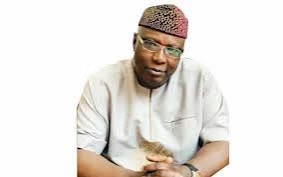
Senator Babafemi Ojudu
The lingering crisis degenerated to an alarming proportion on Tuesday when militants hit two oil installations, leading to massive explosions.
Piqued by the worrying development, Tinubu decided to declare a state of emergency in the state with effect from Tuesday, March 18.
While making the proclamation during the broadcast, the president explained that his decision was with a view to restoring stability and peace to the state.
He stressed that since Governor Siminalayi Fubara and his deputy, Mrs Ngozi Odu, could not arrest the situation and also failed to reach out to him on the way out, he would not fold his hand and watch the state degenerate further into an uncontrollable situation, hence his decision to declare the state of emergency.
The economic consequences speak volume and would put terrible toll on the nation’s economy
But Senator Ojudu has upbraided the president’s action and highlighted the negative economic implications on the entire nation.
According to him, the economic consequences speak volume and would put terrible toll on the nation’s economy.
“If the situation escalates, we risk another shutdown of vital oil production facilities. We risk renewed pipeline sabotage, illegal oil bunkering, and militant activities. We risk another economic nosedive—at a time when Nigeria can least afford it,” Ojudu said.

Combo photo of Gov Siminalayi Fubara and the Deputy Governor, Prof Mrs Ngozi Odu
“The global oil market is unforgiving. Investors do not wait for internal political conflicts to be resolved. They simply take their capital elsewhere,” he added.
Ojudu stressed that Tinubu should have treaded a path of caution by initiating a round table dialogue between the warring parties to achieve the peace and stability he is seeking, instead of declaring a state of emergency, which, he noted, is not the way out of the perturbation.
Back to Ground Zero: Who Advised President Bola Ahmed Tinubu to Do This?
I have just picked up my phone after breaking my fast to find multiple missed calls and countless messages about an alarming development: President Bola Ahmed Tinubu has reportedly declared a state of emergency in Rivers State.
If this is true, then I must ask: Who advised the President to take this course of action? Whoever it is, they are certainly not a friend of his administration, nor do they have the best interests of Nigeria at heart.
This must be the work of fifth columnists
How could the President willingly walk into a raging inferno with his eyes wide open? No, no, no… this must be the work of fifth columnists. The Tinubu I once knew would not have made such a reckless and unnecessary decision.
To what end? This is a simple political dispute that requires a simple solution. Call the two gladiators, sit them down, and read them the riot act. One of them, after all, is your own appointee. What will it benefit you, Mr. President, to keep Wike and lose the Nigerian economy?
If the situation escalates, we risk another shutdown of vital oil production facilities
The Dangerous Economic Implications of This Decision
Does the President realize that the Niger Delta crisis twice pushed Nigeria into recession under President Muhammadu Buhari.
Has he been informed that at one point, Nigeria’s oil production collapsed to below 400,000 barrels per day, down from 2.5 million barrels per day? That catastrophic drop in production was a direct result of political mismanagement and conflict in the region.
Read Also: Explainer: How State of Emergency in Rivers is Different from Previous Ones
It took years of painstaking effort and immense risks to stabilize the region, stop the sabotage of oil infrastructure, and restore some level of production. I should know—I was part of that difficult and excruciating process.
This decision threatens to undo all that progress.
If the situation escalates, we risk another shutdown of vital oil production facilities. We risk renewed pipeline sabotage, illegal oil bunkering, and militant activities. We risk another economic nosedive—at a time when Nigeria can least afford it.
It is about Nigeria’s economic survival
The global oil market is unforgiving. Investors do not wait for internal political conflicts to be resolved. They simply take their capital elsewhere.
Mr. President, this is not just about Rivers State. It is about Nigeria’s economic survival.
And What About the Soldiers Fighting to Keep Nigeria Safe?
While we waste energy escalating political battles in Rivers State, thousands of Nigerian soldiers are still fighting for their lives—and for the nation’s survival—against insurgents, bandits, and kidnappers in the North East, North West, and North Central.
These are the real emergencies. These are the crises that demand decisive leadership.
The men and women of our armed forces are stretched thin, battling terrorists and criminal networks daily. They do not need yet another crisis to divert resources and attention.
Do not open a new war front in Rivers State while real wars are still raging elsewhere
Nigeria cannot afford to be fighting on multiple fronts—politically, economically, and militarily. Mr. President, do not open a new war front in Rivers State while real wars are still raging elsewhere.
This Is Not the Way to Manage This Crisis, Mr. President
This portends disaster—for your administration, for the economy, and for the nation.
A state of emergency is not a strategy—it is an admission of failure. There are far more effective, far less destructive ways to handle this situation.
I urge you, Mr. President, to rethink this decision before irreparable damage is done.
Read Also: Meet Rivers State new sole administrator appointed by Tinubu
Author

Sign up for The Insight Newsletter
Get in-depth, research and data-based interpretative reports from around Nigeria.