
FG, Stakeholders Validate Action Plan To Boost Local Milk Production
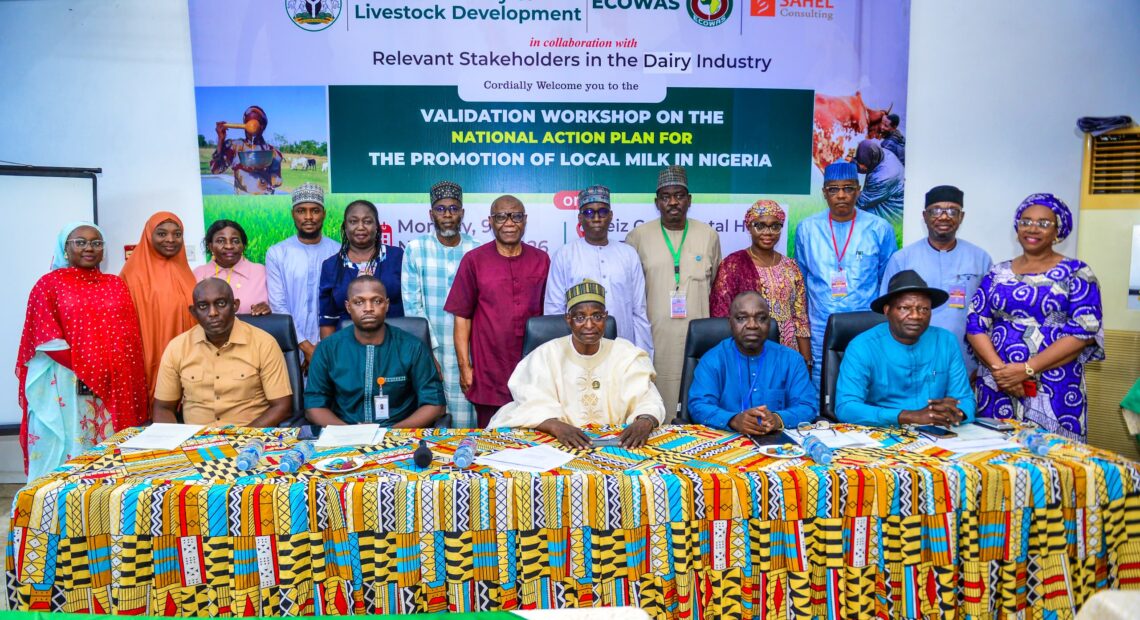
The Federal Government and stakeholders in Nigeria’s dairy and livestock sectors have validated a National Action Plan aimed at boosting local milk production, strengthening the dairy value chain and reducing the country’s dependence on imported dairy products.
The validation followed a review and deliberation process involving government institutions, development partners, private sector operators, dairy farmers and other stakeholders.
The workshop, convened by the Federal Ministry of Livestock Development in collaboration with the Economic Community of West African States (ECOWAS) and Sahel Consulting, was held on Monday, November 9, 2026, in Abuja.
Speaking at the event, the Minister of Livestock Development, Idi Mukhtar Maiha, said Nigeria needed to move beyond policy discussions to practical interventions capable of addressing the challenges confronting local dairy producers.
Maiha disclosed that the country spends more than $1.5bn annually on dairy imports despite its considerable livestock resources.
He said reversing the trend would require coordinated action, sustained investment and stronger connections between dairy farmers and processors.
The minister identified improved dairy breeds, access to quality feed and water, animal health services, extension support, milk collection and cooling infrastructure, processing capacity and market access as critical areas requiring attention.
He also called for the development of commercially viable dairy clusters supported by reliable infrastructure, private sector participation and clearly defined institutional responsibilities.
Maiha stressed that interventions should reflect the realities of different locations and deliver measurable benefits to farmers.
He further called for deliberate efforts to create opportunities for women and young people across the dairy value chain.
The minister urged stakeholders to ensure that the action plan contained clear implementation timelines, funding arrangements, measurable targets and accountability mechanisms.
In his goodwill message, the ECOWAS representative, Dr Bio Goura Soule, commended Nigeria for developing the action plan, noting the country’s importance to dairy development in the West African region.
He also highlighted the importance of regional cooperation in advancing the sector.
Similarly, the representative of the Commercial Dairy Ranchers Association of Nigeria (CODARAN), Dianabasi Akpainyang, described the plan as timely and aligned with national efforts to strengthen the dairy industry.
Akpainyang called for sustained commitment from stakeholders to ensure its implementation.
The representative of Sahel Consulting, speaking on behalf of its Managing Partner, Temi Adegoroye, said the organisation had contributed to local dairy development through the Advancing Local Dairy Development in Nigeria project.
He disclosed that the project had facilitated the sourcing of more than 16 million litres of milk from local farmers since 2020.
He, however, stressed the need to expand the utilisation of locally produced milk by processors to guarantee sustainable markets for farmers and strengthen the domestic dairy value chain.
Also speaking, the representative of the Federal Ministry of Industry, Trade and Investment described the ministry as a strategic partner in developing the sector and pledged support through relevant structures, incentives and institutional mechanisms to promote growth.
The validated action plan is expected to provide a coordinated framework for improving local milk production, strengthening dairy value chains, attracting investment and advancing Nigeria’s drive towards greater dairy self-sufficiency.
Author

Sign up for The Insight Newsletter
Get in-depth, research and data-based interpretative reports from around Nigeria.