
Diaspora Advocacy: Youth Voices in Times of National Crisis
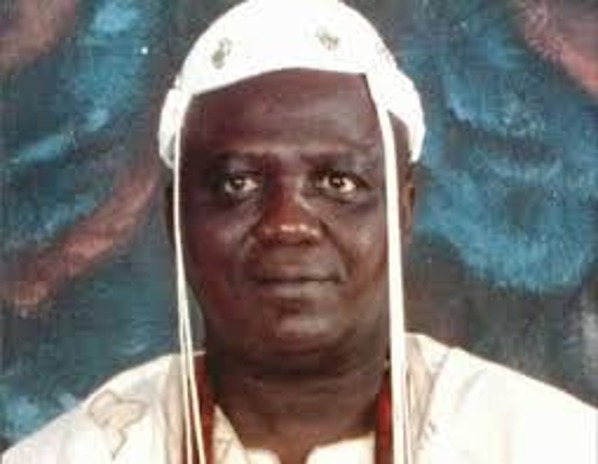
How a generation of Nigerian students in Britain took their country’s future into their own hands
In the middle of 1967, as Nigeria descended into the bloodiest conflict in its short post-independence history, a group of Nigerian students based in Great Britain made a decision that was equal parts bold and improbable.
Rather than watching from a distance as their country fractured, they organised, wrote, lobbied, and travelled home to put their proposals directly before the head of state.
That they did so not as politicians or diplomats, but as students and young professionals in their twenties and early thirties, makes the episode remarkable. That their efforts were well received makes it instructive.
Leading that delegation was Samuel Adegboyega Osunbade, then National President of the Nigerian Union of Students in Great Britain and Ireland, a young man from Orile-Igbon in what is now Oyo State, who had come to Britain to qualify as a chartered accountant and had found, along the way, that he could not stay silent about what was happening to the country he intended to return to.
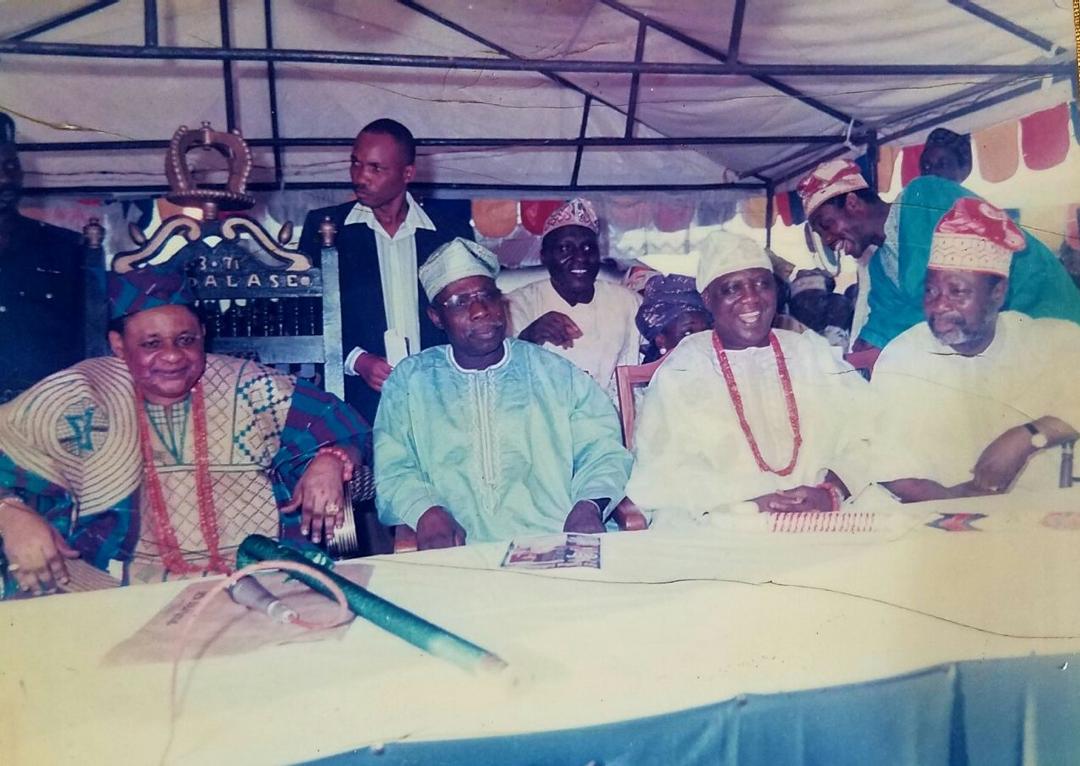
Lt. HRM Oba (Dr) Samuel Adegboyega Osunbade, Oba Lamidi Olayiwola Adeyemi III; Alaafin of Oyo, and Chief Olusegun Obasanjo at an event
He would go on to become the 21st Olugbon of Orile-Igbon, a first-class traditional ruler and vice chairman of the Oyo State Council of Obas and Chiefs, serving his domain with the same combination of discipline, national consciousness, and personal commitment that had defined him as a student leader decades earlier. He passed away on 14th October 2016.
His story, and the broader history of Nigerian student diplomacy during the Civil War, offers lessons that reach well beyond that particular crisis.
The Making of a Student Leader
Osunbade was born in Zaria in 1937 into the Olugbon Royal Family of Orile-Igbon. His early education took him from Akaje Primary School in Yaba, Lagos, to Osupa Baptist Day School in Ogbomosho, and then to Ogbomoso Grammar School, where he was one of only 34 foundation students and one of only seven who completed the full course. From the outset, those who knew him described a person of clear intellect, genuine humility, and an instinct for leadership that expressed itself not through dominance but through the trust he inspired in others.
After secondary school, he taught briefly and worked as a clerk in the Western Region civil service before resigning to travel to the United Kingdom with his wife, Olori Abimbola Ayinke, in June 1961. In Britain, he qualified as a Fellow of the Institute of Chartered Accountants (FCA) and a Fellow of the Institute of Chartered Secretaries (FCIS), later adding a fellowship in taxation (FCIT). These were serious, demanding professional qualifications that required years of sustained effort alongside whatever else was taking his attention.
What was also taking his attention was student politics. He served first as Branch Chairman of the Nigerian Union of Students in Birmingham before being elected National President of the Union, a body with jurisdiction across the whole of Great Britain and Ireland, in 1965.
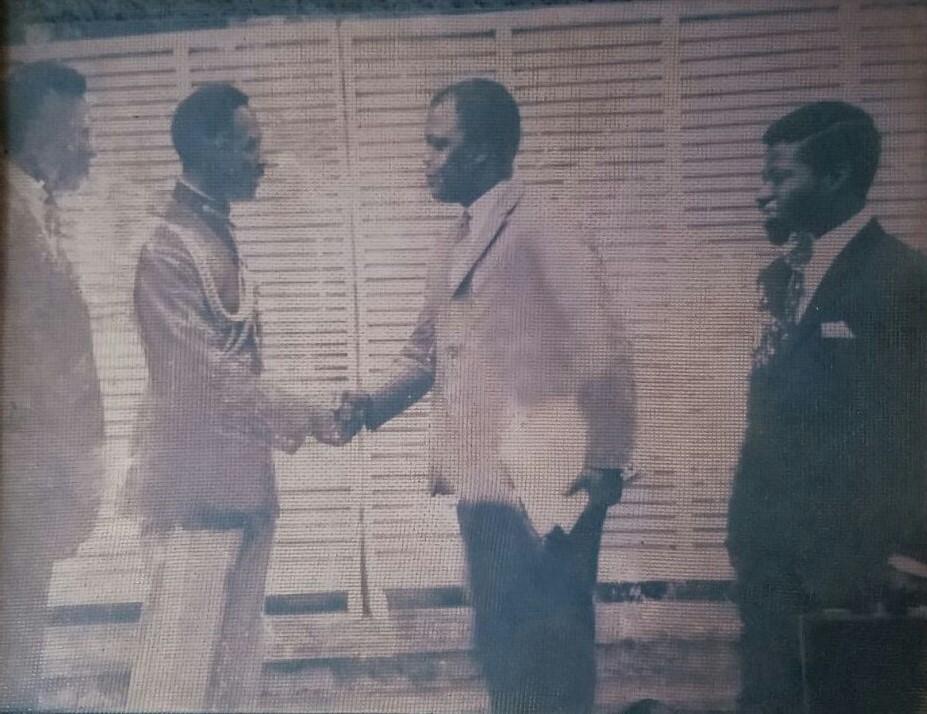
Lt. HRM Oba (Dr) Samuel Adegboyega Osunbade, presenting his proposal to General Yakubu Dan-Yumma Gowon, Head of State at the time
He served through 1966 and 1967. The timing was not incidental. These were the precise years during which Nigeria’s political crisis deepened from constitutional uncertainty into open war.
The Context: What Was at Stake
The Nigerian Civil War, which ran from July 1967 to January 1970, was preceded by two years of escalating political and ethnic crisis. The coup and counter-coup of 1966 had brought Lieutenant-Colonel Yakubu Gowon to power and unleashed a wave of violence against Igbo communities in the north. By May 1967, the Eastern Region, under Lieutenant-Colonel Odumegwu Ojukwu, had declared itself the independent Republic of Biafra.
The federal government’s response was military. The conflict that followed claimed between 500,000 and two million lives, with a significant portion of those deaths resulting from blockade-induced famine rather than combat.
For Nigerian students in Britain, the war was not an abstraction. They had friends and family on both sides of the conflict.
They were studying in a country whose government was one of the few to supply arms to the federal side, while British public opinion was increasingly influenced by harrowing images of Biafran famine.
The political environment in which they were operating was charged with competing narratives, international pressure, and the constant risk that the world’s view of Nigeria would be shaped entirely by voices other than Nigerians themselves.
In this context, the decision of the Nigerian Union of Students to engage directly, rather than observe quietly, reflected a particular understanding of what diaspora communities owe to their home countries in moments of national extremity.
The Delegation and Its Purpose
Under Osunbade’s leadership, the Union organised a historic delegation of Nigerian students based in the UK to travel to Nigeria and meet directly with General Yakubu Gowon.
The purpose was not ceremonial. The students came with substantive proposals: a considered set of recommendations on how to end the conflict, and equally importantly, how to manage post-war recovery in ways that would rebuild national unity rather than deepen division.
The significance of this act should not be underestimated. Securing access to a head of state during wartime, as a student body rather than an established political or diplomatic organisation, required credibility, organisation, and persistence. It also required that the proposals being brought were serious enough to merit a serious audience.
The visit was well received by Gowon, a reflection not only of the moment’s political openness to constructive engagement but also of the quality of what the students brought with them.
Osunbade also presented papers to the Queen of England in his capacity as National Student President, extending the Union’s engagement beyond Nigeria’s internal politics to the international arena. Britain’s role in the conflict, both its material support for the federal government and its influence over international coverage of the war, made that channel of engagement strategically significant.
These were not casual acts of youthful idealism. They were structured, documented, diplomatic communications from organised representatives of a constituency that had both the distance to see the crisis clearly and the emotional investment to care about its resolution.
Upon returning to Nigeria, Osunbade continued in this vein, writing to General Gowon with his thoughts on the Nigerian constitution, pursuing in peacetime the same practice of written, substantive engagement with authority that had defined his student leadership.
What This Form of Advocacy Achieves
Youth-led diaspora advocacy of the kind Osunbade practiced operates through a specific set of mechanisms that distinguish it from other forms of political engagement. It draws on the unique position of people who are simultaneously insiders and outsiders: rooted enough in their home country to understand its internal dynamics, and distant enough from its immediate pressures to think with some clarity about longer-term solutions.
Student bodies, in particular, carry a form of moral authority in national crises that more obviously political organisations cannot always claim. They are understood to be acting from conviction rather than interest. When they organise across ethnic and regional lines, as the Nigerian Union of Students in Great Britain did during a war defined precisely by ethnic and regional fracture, they model a form of national solidarity that is itself part of the argument they are making.
The written memoranda, letters, and papers produced by such bodies also serve a function beyond their immediate political purpose. They constitute a record: evidence that, in the middle of a crisis, some voices were calling for peace, proposing practical paths forward, and engaging state institutions with the seriousness those institutions deserve.
Osunbade’s published works and diplomatic communications remain, in this sense, part of the historical documentation of Nigerian civil society’s response to its gravest post-independence test.
A Life Built on the Same Foundations
The arc of Osunbade’s life after his student years is consistent with the values that drove his activism. He returned to Nigeria in 1968, built a distinguished professional career in accountancy, and in 1975 established his own accounting and management firm, Osunbade, Okiti and Company.
When he was selected as the 21st Olugbon of Orile-Igbon in December 1991 and crowned in July 1992, he brought to the position the same insistence on personal accountability and practical contribution that had marked everything before it.
As Olugbon, he invested his own resources in the development of Orile-Igbon without borrowing from any financial institution, a point of personal pride that speaks directly to his long-held conviction that communities should build what they can with what they have, rather than waiting for external resources or incurring obligations that constrain future freedom of action.
Under his stewardship, the town saw the establishment of a police station, an international market, a high court complex, health and vocational centres, educational institutions, and infrastructure that transformed Orile-Igbon’s standing in the region. He grew the annual Olugbon Festival, a tradition dating to the 11th century, into an international cultural destination for the Orile-Igbon diaspora at home and abroad.
He served alongside military administrators, state governors, and federal institutions across more than two decades on the throne, respected consistently for the quality of his counsel. His death on 14th October 2016 followed a battle with cancer. He was survived by his wife, four princes, one princess, and grandchildren across generations.
The Continuing Relevance
Nigeria’s current circumstances are not those of 1967. The crisis that Osunbade’s generation faced was military and existential in a way that most contemporary challenges, serious as they are, are not. But the underlying question his student leadership poses remains current: what do Nigerians abroad owe to the country they came from, and what forms of engagement are most likely to produce genuine benefit?
The answer Osunbade modelled was not passive solidarity or symbolic gesture. It was substantive, organised, written, and direct. It engaged state institutions at the highest level, not to claim personal prominence, but to deliver proposals that had been developed through collective deliberation. It maintained the credibility that comes from being known to have nothing to gain personally from the outcome.
At a time when Nigeria’s diaspora is larger, better connected, and more economically significant than at any previous point in the country’s history, the model Osunbade and his contemporaries practised in the lecture halls and committee rooms of British universities deserves more than historical commemoration.
It deserves active application. The tools available today, digital communication, organised networks, access to policy platforms, direct investment channels, are vastly more powerful than anything available to a student president travelling from Birmingham to Lagos in the 1960s. The question is whether the same sense of obligation, and the same willingness to act on it seriously, is present.
The record suggests it can be. It has been before.
HRM, the late Oba (Dr.) Samuel Adegboyega Osunbade J.P., F.C.A., F.C.A.C.A., F.C.I.S., F.C.I.T. was the 21st Olugbon of Orile-Igbon (26 March 1937 to 14 October 2016). He was Vice Chairman of the Oyo State Council of Obas and Chiefs and Chairman of the Traditional Council of Surulere Local Government Area.
Author

Sign up for The Insight Newsletter
Get in-depth, research and data-based interpretative reports from around Nigeria.


