
Borno, Katsina, Zamfara Lead as Violence Claims 15,000 Lives in One Year – Report
By The Insight Team
Violence across Nigeria claimed 15000 lives in the 12 months between July 2025 and June 2026, with Borno, Katsina and Zamfara emerging as the country’s deadliest conflict hotspots.
This is according to data by the Armed Conflict Location and Event Data (ACLED), a global conflict data repository.
The data, obtained on Friday, paints a grim picture of a country where insurgency, banditry, communal clashes, kidnappings, violent criminality and other forms of insecurity continue to affect millions despite repeated assurances by the Federal Government that the security situation is improving.
According to the dataset, Nigeria recorded 7,956 conflict events, 14,845 fatalities and an estimated 66.8 million people exposed to violence or living in affected areas during the review period. The figures underline the widespread impact of insecurity beyond those directly killed, with tens of millions living under the constant threat of attacks, displacement and disruption of livelihoods.
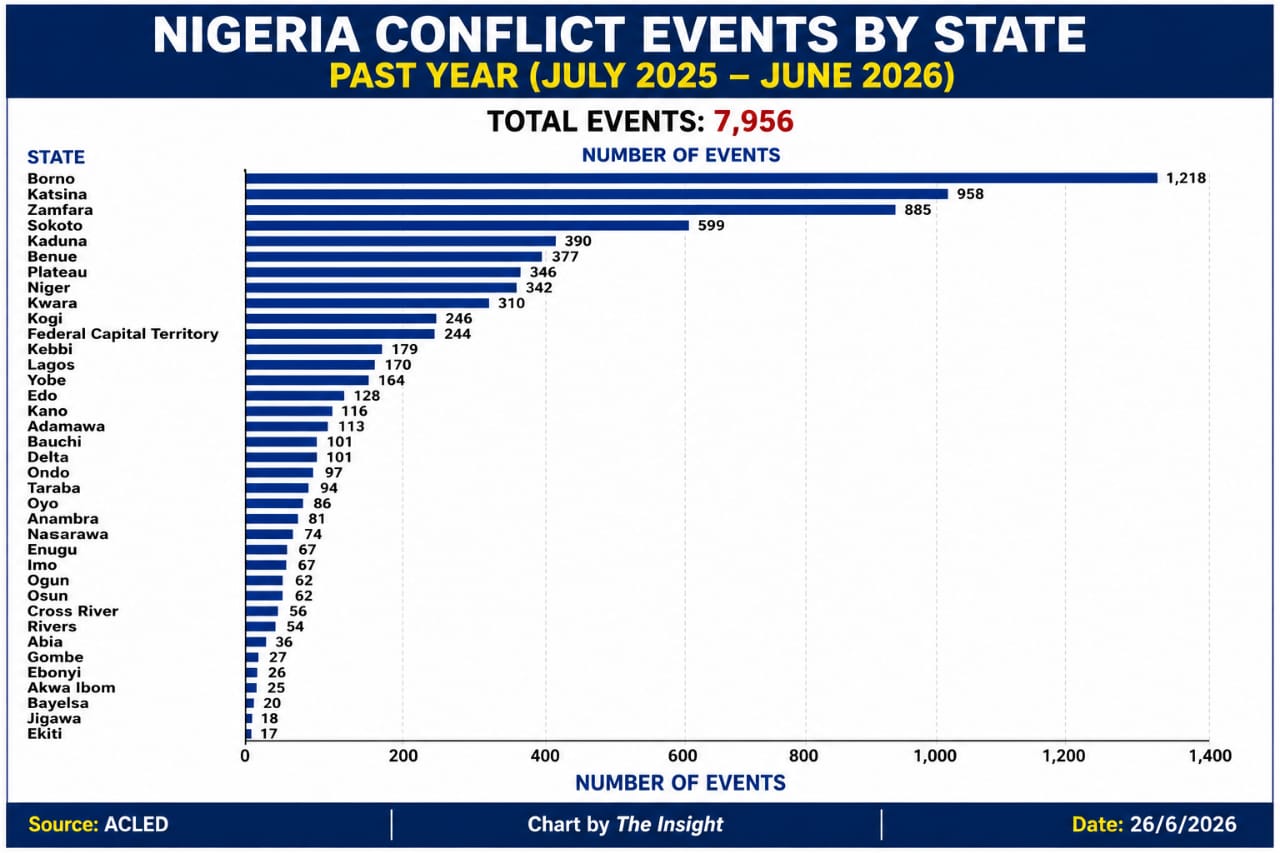
The statistics show that violence against civilians remained the dominant form of conflict in Nigeria. Out of the 7,956 recorded incidents, 3,494 were classified as violence against civilians, accounting for nearly half of all events documented during the period. Another 2,458 incidents involved battles between armed actors, while 739 were classified as strategic developments. ACLED also documented 734 protests, 278 riots and 253 explosions or remote violence incidents, illustrating the multiple dimensions of insecurity across the country.
State-by-state analysis reveals that Borno remained Nigeria’s most conflict-affected state with 1,218 recorded events during the year. The state has continued to bear the brunt of the Boko Haram insurgency and attacks by factions linked to the Islamic State West Africa Province (ISWAP), despite years of sustained military operations in the North-East.
Katsina ranked second with 958 conflict events, reflecting the growing intensity of bandit attacks, kidnappings and rural violence across several local government areas. Zamfara followed closely with 885 events, reinforcing its status as one of Nigeria’s epicentres of armed banditry and violent attacks on communities.
Beyond the three worst-hit states, the data shows that insecurity remains geographically widespread. Sokoto recorded 599 events, Kaduna 390, Benue 377, Plateau 346, Niger 342, Kwara 310, Kogi 246 and the Federal Capital Territory 244.
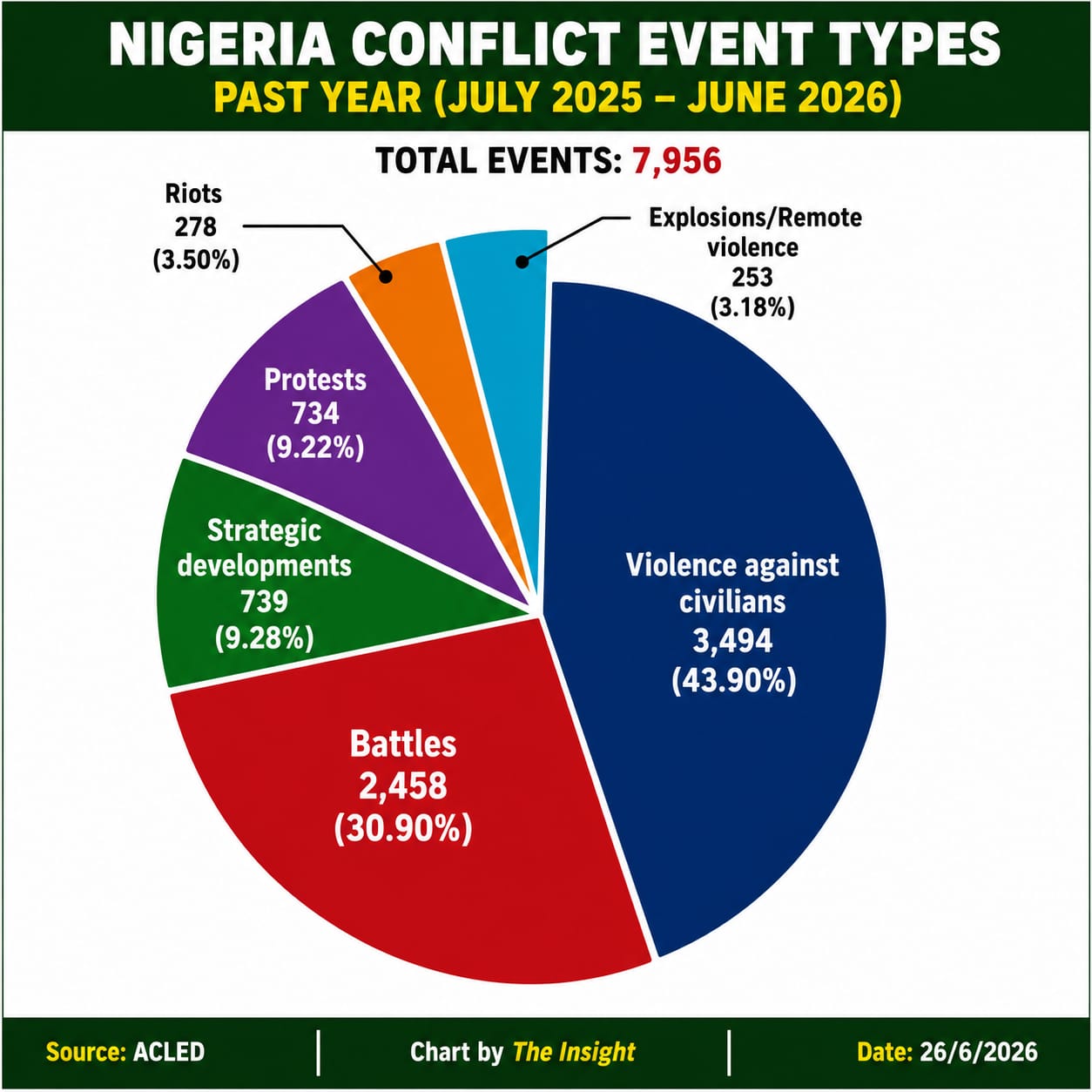
The remaining states also witnessed varying levels of conflict. Kebbi recorded 179 events, Lagos 170, Yobe 164, Edo 128, Kano 116, Adamawa 113, Bauchi 101, Delta 101, Ondo 97, Taraba 94, Oyo 86, Anambra 81, Nasarawa 74, Enugu 67, Imo 67, Ogun 62, Osun 62, Cross River 56, Rivers 54, Abia 36, Gombe 27, Ebonyi 26, Akwa Ibom 25, Bayelsa 20, Jigawa 18 and Ekiti 17.
The distribution highlights how conflict has spread well beyond the traditional insurgency-ravaged North-East into the North-West, North-Central and parts of southern Nigeria, where communal clashes, cult violence, criminal attacks and protests have contributed to the national tally.
The ACLED figures come against the backdrop of worsening insecurity in several parts of the country. In recent years, insurgency, banditry, farmer-herder conflicts, kidnappings for ransom, attacks on communities and other violent crimes have continued to threaten lives and livelihoods. Millions of Nigerians have also remained exposed to recurring attacks, displacement and humanitarian crises.
Recent incidents illustrate the continuing security challenges. Eight people were reportedly killed in Gulma community of Argungu Local Government Area of Kebbi State after a dispute erupted when cattle allegedly strayed into a farmer’s land, leading to the deaths of both the farmer and the herder before reprisals claimed additional lives. In Katsina State, seven residents were recently killed after bandits attacked Sayaya community in Matazu Local Government Area. In Kaduna State, two police officers lost their lives during an operation to rescue kidnapped victims in Birnin Gwari Local Government Area.
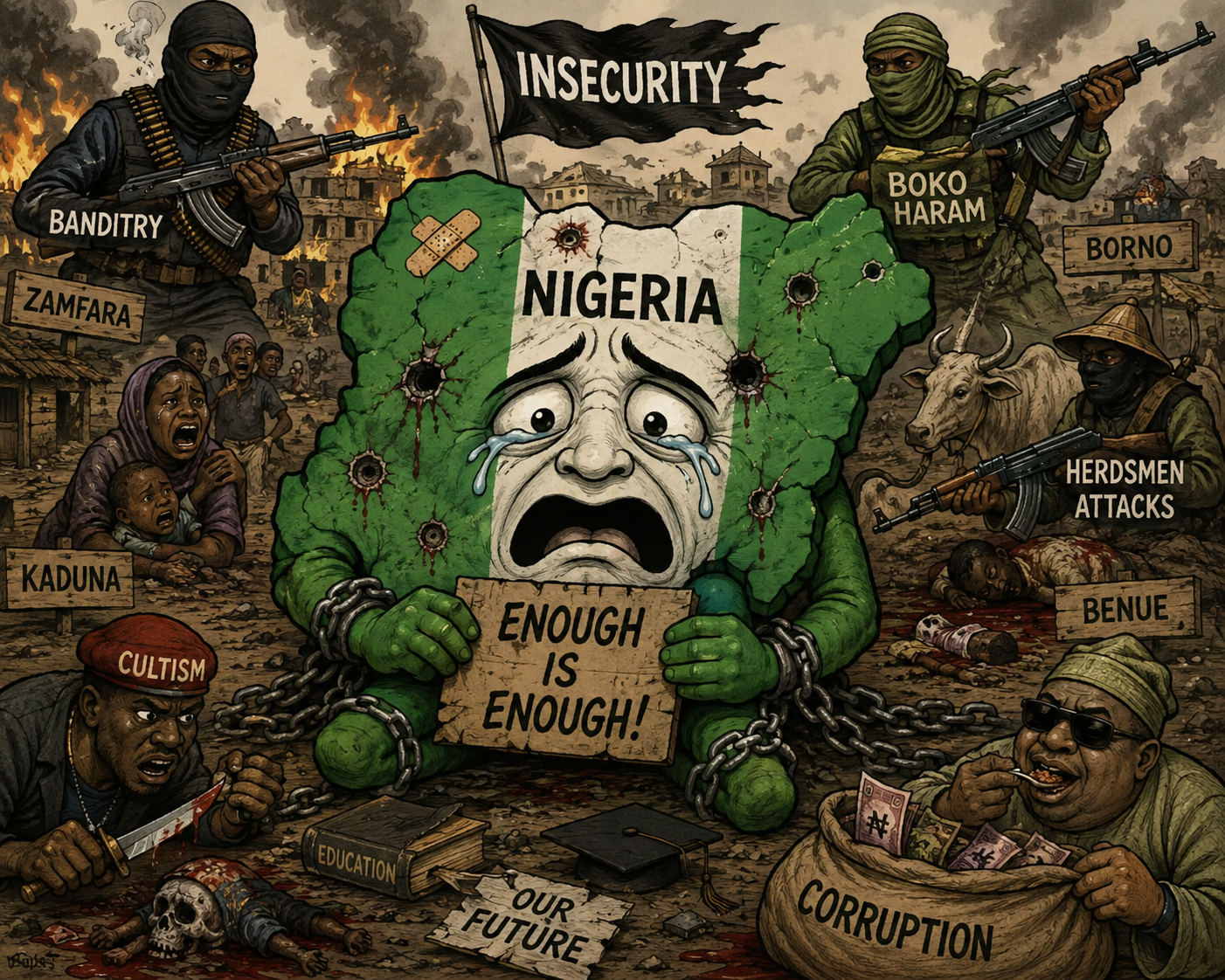
Caricature of violence in Nigeria
The Federal Government has consistently pledged to reverse the trend. Earlier this year, President Bola Tinubu declared that Nigeria would defeat terrorism and banditry, describing the country’s security challenges as unacceptable and alien to Nigeria’s values.
Speaking while declaring open the Second National Economic Council Conference at the State House Conference Centre in Abuja, the President said: “I promise you here that I’ll play my part. Seven zones of mechanisation are coming. I promise Nigerians that this will be delivered, and I am here again to further find ways to strengthen our security forces and defeat terrorism.
”That, I promise you, is what has kept all of us sleepless at night, but I assure you we will win with determination and resilience. We will overcome this unacceptable terrorism and banditry. It’s not part of our culture. It’s foreign to us.”
While the annual figures underscore the scale of insecurity across Nigeria, ACLED’s monthly data indicates that the violence has shown little sign of easing.
Between May 20 and June 19, 2026, the conflict database recorded 826 events, 1,205 fatalities and an estimated 15.8 million people exposed to violence across the country, suggesting that attacks continued at a significant pace during the most recent reporting period.
As with the yearly data, violence against civilians remained the most prevalent category, accounting for 343 incidents during the month. Battles between armed actors followed with 246 events, while 97 strategic developments were recorded. The database also documented 90 protests, 27 explosions or remote violence incidents, and 23 riots, reflecting the diverse security challenges confronting the country.
The monthly state-by-state breakdown again placed Borno at the top with 111 conflict events, reinforcing its position as Nigeria’s principal conflict hotspot. Zamfara followed with 107 events, while Katsina ranked third with 86.
Other states that recorded high levels of conflict included Sokoto (73), Kaduna (54) and Plateau (54), followed by Niger (47) and Kebbi (38).
The Federal Capital Territory recorded 22 events, while Kwara posted 23 and Benue 20. Kogi recorded 18, Yobe 17, while Nasarawa, Osun and Oyo each registered 14 events during the period.
Further down the list, Delta and Lagos each recorded 13 events, while Taraba had 9. Ogun, Adamawa, Edo, Enugu and Ondo each posted 7 events, while Kano recorded 6.
The remaining states experienced relatively fewer incidents but were not spared. Anambra, Bauchi, Cross River and Imo each recorded 5 events, while Abia, Akwa Ibom, Bayelsa, Ekiti and Rivers each posted 3 events. Ebonyi and Gombe recorded one event each, highlighting that conflict incidents, although unevenly distributed, affected virtually every region of the country.
The latest weekly data also shows that violence remained persistent.
Within the seven-day period ending June 19, 2026, ACLED documented 176 conflict events, 206 fatalities and approximately 4.29 million people exposed to violence.
Daily records indicate that June 12 witnessed the highest number of incidents with 39 events. This was followed by 33 events on June 16, 30 on June 15, 21 on June 14, 18 each on June 13 and June 17, nine on June 19, and eight on June 18.
Violence against civilians again dominated the week’s data with 74 incidents, while 50 battles were recorded. ACLED also documented 23 strategic developments, 20 protests, five riots and four explosions or remote violence incidents, suggesting that attacks on civilians continued to account for the largest share of conflict nationwide.
Unlike the yearly and monthly rankings, Sokoto emerged as the state with the highest number of conflict events during the week, recording 27 incidents.
Borno followed with 21 events, while Plateau recorded 20. Zamfara posted 16 incidents, Katsina 14, Kebbi 11, Kaduna 10 and Niger 9.
The weekly figures further showed Delta recording 6 events, Oyo 5, while the Federal Capital Territory and Kwara each registered 4 events.
Edo, Kogi, Lagos and Osun each recorded 3 incidents during the week. Akwa Ibom, Benue, Enugu, Nasarawa, Ondo, Rivers and Yobe each recorded 2 events, while Cross River, Gombe and Ogun registered one event apiece.
The Nigerian figures form part of a broader pattern of global conflict documented by ACLED.
Worldwide, the conflict monitoring organisation recorded 428,418 events, 242,865 fatalities and an estimated 898 million people exposed to violence during the past year.
For the most recent month, the global database recorded 37,259 conflict events, 14,610 fatalities and 265 million people exposed, while the latest weekly figures stood at 8,930 events, 3,220 fatalities and 112 million people exposed.
Despite accounting for only one country among dozens monitored by ACLED, Nigeria contributed 6.11 per cent of all conflict-related fatalities recorded globally during the past year, underscoring the country’s continued significance in the global security landscape.
The figures also show that while conflicts around the world produced more than 428,000 events, Nigeria alone accounted for nearly 8,000 incidents, illustrating the scale and persistence of violence within Africa’s most populous nation. The country’s 14,845 deaths over the period likewise represent a substantial share of global fatalities, highlighting the heavy human cost of insurgency, banditry, communal violence, criminal attacks and other armed confrontations.
Beyond the statistics, the ACLED data reflects the human cost of a security crisis that has persisted for more than a decade and evolved into multiple forms of armed violence across Nigeria.
The impact extends far beyond the number of people killed. ACLED’s estimate that 66.8 million people were exposed to violence over the past year highlights the scale of the humanitarian
For millions of Nigerians living in communities repeatedly affected by insurgency, banditry, communal clashes and criminal attacks, the statistics represent more than numbers. They reflect daily realities marked by fear, displacement, interrupted livelihoods and the continuing search for lasting peace as the country confronts one of the most complex security crises in its recent history.
Author

Sign up for The Insight Newsletter
Get in-depth, research and data-based interpretative reports from around Nigeria.