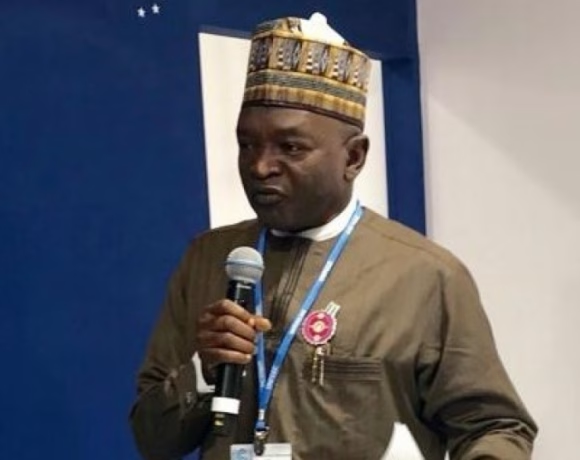
Atiku Abubakar: Nigeria’s most resilient politician still banks on the North for 2027

Key Points:
- With the demise of Buhari, there is a political vacuum in the North
- Atiku may be tempted to contest the 2027 presidency, but it may not be a thoroughfare for him
- It is still not clear if the ADC will zone its presidential ticket to the North or South
- Atiku and Peter Obi may likely join forces in the fight to dislodge APC in 2027
By Emmanuel Kwada
Atiku Abubakar, Nigeria’s former vice president and a prominent political figure, has been a central figure in the country’s political landscape for over three decades. Known for his resilience in pursuing the presidency, his frequent party switches, and his strong regional influence, particularly in the North East, Atiku’s political career is a study in adaptability and ambition.
Atiku Abubakar’s political career is marked by a series of party changes, reflecting his strategic manoeuvring within Nigeria’s dynamic political environment. As of July 2025, Atiku has switched political parties at least four times, a pattern that has earned him the moniker of a “political nomad” in some circles.

Atiku’s political journey began in the late 1990s with the Social Democratic Party (SDP), where he contested the presidential primaries in 1993, losing to Moshood Abiola. At Nigeria’s return to democratic rule in 1999, he joined the PDP, under which he was elected vice president from 1999 to 2007, in a joint ticket with former President Olusegun Obasanjo.
His first exit from the PDP came in 2006 when he joined the Action Congress (AC) to contest the 2007 presidential election, placing third behind Umaru Yar’Adua and Muhammadu Buhari.
Atiku Abubakar has contested the Nigerian presidency six times (1993, 2007, 2011, 2015, 2019, and 2023)
In 2014, Atiku left the PDP again to join the All Progressives Congress (APC), seeking the party’s presidential ticket for the 2015 election, but yielded the ticket to Muhammadu Buhari. He returned to the PDP in 2017 ahead of the 2019 elections. He remained until his third departure in 2025 to join the African Democratic Congress (ADC), alongside former Labour Party candidate Peter Obi, in a bid to form a united opposition against the APC in 2027. These shifts highlight Atiku’s pragmatic approach to politics, aligning him with platforms that best serve his presidential ambitions at a given time.
Yesterday, I vowed to stand against the stealing of elections and oppose bad governance.
I made the pledge while receiving a delegation of Gombe stakeholders led by former Minister and Senator Idris Abdullahi.
I stressed that enough is enough, and that Nigerians cannot… pic.twitter.com/4i3LpBjwZ9
— Atiku Abubakar (@atiku) July 5, 2025
Atiku Abubakar has contested the Nigerian presidency six times (1993, 2007, 2011, 2015, 2019, and 2023), with his most significant performances in 2019 and 2023 under the PDP. In 2019, Atiku faced incumbent President Muhammadu Buhari of the APC. According to INEC, Buhari secured 15,191,847 votes (55.6%), while Atiku polled 11,262,978 votes (41.2%), a margin of over 3 million votes. Atiku’s campaign focused on economic revival and national unity, but allegations of electoral fraud, which he challenged in court, marred the process. The Supreme Court dismissed his case, citing insufficient evidence of widespread irregularities.
In 2023, Atiku again ran as the PDP candidate, facing Bola Tinubu (APC), Peter Obi (Labour Party), and Rabiu Kwankwaso (NNPP). INEC data shows Tinubu won with 8,794,726 votes (36.61%), Atiku came second with 6,984,520 votes (29.07%), and Obi secured 6,101,533 votes (25.40%).

Despite a closer race, Atiku’s performance was impacted by the split in opposition votes, particularly due to Obi’s strong showing in the South-East and South-South regions, traditionally supportive of the PDP. Atiku himself acknowledged that Obi’s candidacy cost the PDP votes in these regions, polling only 91,198 votes in the South-East compared to 1.69 million in 2019.
Atiku challenged the 2023 results, alleging electoral malpractices and INEC’s failure to upload results electronically, which he claimed enabled manipulation. He sought either to be declared the winner or for a rerun, but the Presidential Election Petition Court dismissed his petition in September 2023, affirming Tinubu’s victory.
Atiku’s political stronghold remains the North East
2023 INEC Data Atiku’s political stronghold remains the North East, comprising Adamawa, Bauchi, Borno, Gombe, Taraba, and Yobe states. INEC data from the 2023 election confirms Atiku’s sweeping victory across all five North East states, except Borno state, where the vice president, Kashim Shettima, is from, underscoring Atiku’s enduring influence in the region.
According to official results: – Adamawa: Atiku polled 417,611 votes (55.8%), defeating Tinubu (182,881) and Obi (105,648). –
- Bauchi: Atiku secured 426,607 votes (49.3%), ahead of Tinubu (316,694) and Obi (72,103).
- Borno: Atiku won with 252,282 votes (41.7%), surpassing Tinubu (190,921) and Obi (72,703).
- Gombe: Atiku garnered 319,123 votes (49.6%), beating Tinubu (146,977) and Obi (74,598).
- Taraba: Atiku polled 189,017 votes (45.9%), ahead of Tinubu (135,165) and Obi (146,315).
Yobe: Atiku secured 198,567 votes (44.1%), defeating Tinubu (151,897) and Obi (47,398). This clean sweep of the North East, a region with 10.3 million registered voters, reflects Atiku’s strong appeal among the Fulani and other northern ethnic groups, bolstered by his Adamawa roots and political network. His performance contrasts with Tinubu’s dominance in the South-West and parts of the North-West, and Obi’s in the South-East.
A key question is whether Atiku is taking over the northern support base once held by Muhammadu Buhari, who enjoyed widespread popularity in the North-West and North-East during his 2015 and 2019 victories. Buhari’s appeal stemmed from his image as a disciplined, anti-corruption figure and his Hausa-Fulani identity. Atiku, also a Fulani from the North East, has positioned himself as a unifier with a liberal stance, which contrasts with Buhari’s more conservative northern appeal.

While Atiku’s 2023 North East sweep suggests he has consolidated support in his home region, his performance in the North-West, Buhari’s stronghold, was less dominant. The New Nigerian Peoples Party (NNPP) presidential candidate, Musa Rabiu Kwankwaso, won in Kano, a key North-West state. But Atiku made a deep impact in Katsina and Kaduna. There are fears that Atiku’s liberal positions and history of party switches may limit his appeal among conservative northern voters who backed the late President Muhammadu Buhari, whose image was portrayed in northern Nigeria as Mai Gaskiya (Honest Person).
However, a recent poll on X by Ingawa, an influential northern X handler (July 2025), suggests growing northern support for Atiku Abubakar, who came first, followed by Nasir El-Rufai, Rabiu Musa Kwankwaso, and Tambuwal, respectively. This indicates increasing support for Atiku in northern Nigeria to replace the late President Buhari. Additionally, there is growing acceptance of Atiku’s new ADC coalition, with 45% of respondents favouring a united Atiku-Obi ticket over Tinubu’s APC, though the poll’s sample size and methodology remain unverified.
Buhari has been the leader of politics in Northern Nigeria for over 2 decades. Now that Buhari (of blessed memory) is no more, who do you think will replace his position?
— MS Ingawa (@MSIngawa) July 17, 2025
Speculation is rife that Atiku, now 78, may not contest in 2027, but instead play the role of a political godfather, supporting a younger candidate under the ADC banner. His recent move to the ADC alongside Peter Obi and other heavyweights like Nasir El-Rufai and Rotimi Amaechi signals a strategic coalition to challenge the APC.
Atiku may back Obi as the presidential candidate, leveraging his northern influence to bolster Obi’s southern and youth-driven support. This perspective is fueled by their 2019 collaboration, where Obi was Atiku’s running mate, and their combined vote share in 2023 (54% collectively) suggests a joint ticket could have defeated Tinubu’s 37%.
South West. ❌
Middle Belt. ❌
South East. ❌
South South. ❌@atiku Abubakar will never be the president.Get that into your thick skull now.
Peter Obi will not deputize anybody.
You can tweet from Jupiter to Mercury,Waziri Adamawa will never smell Aso Rock.
— NEFERTITI (@firstladyship) July 15, 2025
However, Atiku’s history of persistent presidential bids—six attempts over 31 years—suggests he may not easily relinquish his ambition. In May 2024, he hinted at running again, stating the PDP would determine his fate in 2027.
His recent resignation from the PDP, citing “irreconcilable differences,” and his leadership role in the ADC steering committee indicate he remains a central figure. Atiku’s exit from the PDP could split opposition votes in the North East, but others believe his coalition-building reflects a godfather strategy to shape the 2027 race without running.
2027 will be interesting. The North will go all out for Atiku, SE for Obi & SW for BAT. However, SE will once again lose their opportunity because PO will never win while BAT may end bring an OTP. Those who felt Atiku was not good enough may ditch PO & go for AA in 2027. pic.twitter.com/dIyEbs5EuL
— DGov (@omoluabi1sq) April 30, 2024
Atiku Abubakar’s political career is defined by his adaptability, with four major party switches reflecting his pursuit of the presidency. His 2019 and 2023 electoral performances, though unsuccessful, highlight his resilience, with 11.26 million and 6.98 million votes, respectively. His dominance in the North East in 2023 underscores his regional strength, though he has not fully inherited Buhari’s broader northern base. As 2027 approaches, whether Atiku will contest again or assume a godfather role backing a candidate like Obi will shape Nigeria’s opposition dynamics, potentially altering the country’s political trajectory.
Read Also: PDP as a house of scorpions
Author

Sign up for The Insight Newsletter
Get in-depth, research and data-based interpretative reports from around Nigeria.