Global Rights Trains CSOs in Anambra on Regulatory Compliance
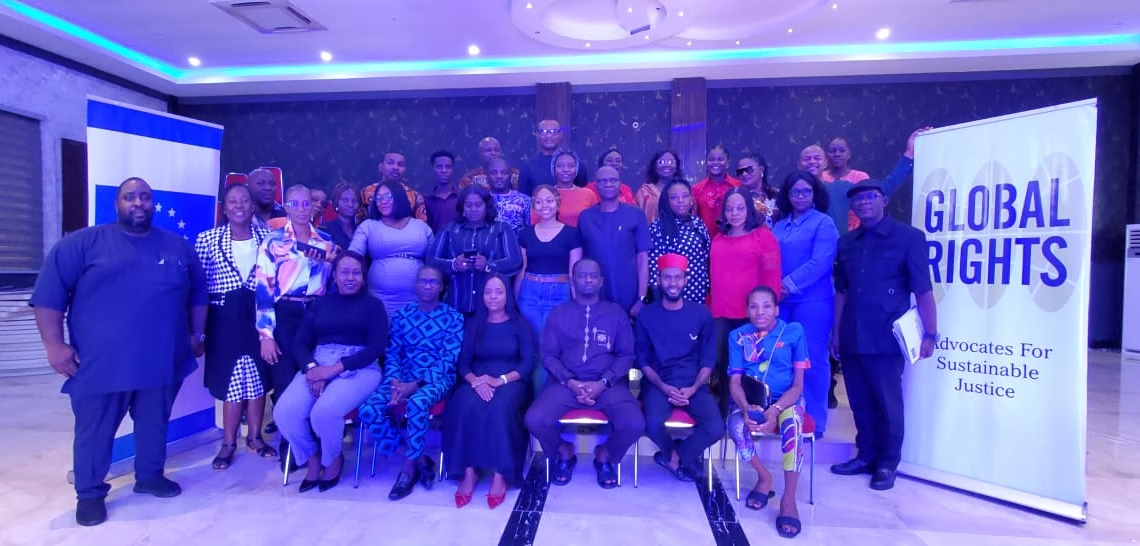
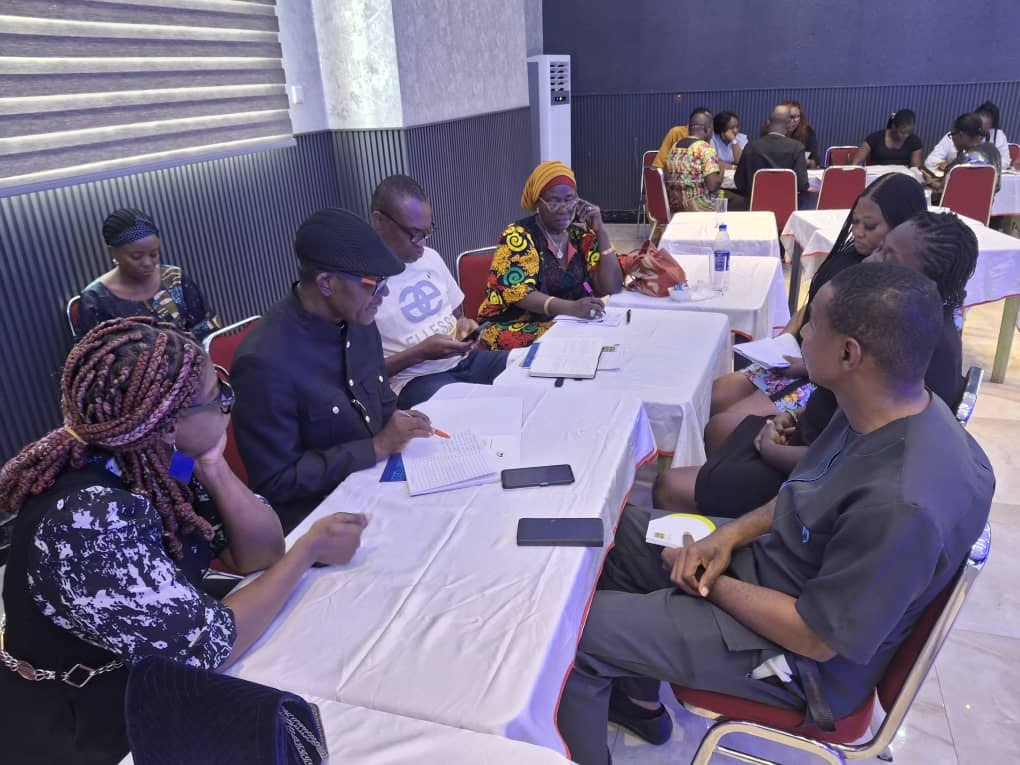
Global Rights, an international civil society group, has organised a two-day training on regulatory compliance and civic space strengthening for Civil Society Organisations (CSOs) in Anambra State.
The initiative aims to help CSOs in the state align their operations with their objectives while adhering to established regulatory procedures.
Speaking at the end of the training on Thursday in Awka, the Programme Officer for Civil Space Strengthening at Global Rights, Damilola Decker, emphasised the role of CSOs in democracy and protecting citizens’ rights, while highlighting the need for a more enabling regulatory environment to support their smooth operations.
“Civil space strengthening is about the protection of the citizen square, which mainly are the civil space rights around underpinning democracy – I am referring to the right of freedom of association, right to peaceful assembly, rights of freedom of expression and freedom of the press. These are key rights that are intrinsic to the enjoyment of a democracy and arm the citizens with the ability to participate as much as possible in governance, of which democracy at its core is participatory governance,” Decker said.
“As we have identified in this training, CSOs play a crucial role in governance, helping bridge the gap between government and the people. It is incumbent on policy actors in the state to make the state as friendly as possible for CSOs’ operations,” he added.
He further stressed the importance of compliance training while sharing success stories of similar training previously held by the organisation.
“We realised there is a lacuna in understanding CSOs’ operation and the regulatory requirement regimes – they have not complied (in the past), not because they are stubborn and do not want to, but the majority of them do not know, and that is what informed the need to carry out this training to bridge the knowledge gap that CSOs have about the legal requirements for operation.
“We are happy with the feedback we are getting, even from the training we had last year, from the first cohort, a lot of NGOs are saying their eyes have been opened and because of that, they are becoming more and more compliant,” he stated.
The two-day training drew principals of several non-profit organisations across the state who expressed their thoughts on areas where they have gained insights.
Rachel Yohanna, member of the National Steering Committee on Civic Space Strengthening and the focal person of Community of Practice in Anambra State, described the training as eye-opening and helpful to their cause, whilst appealing strongly to regulatory agencies to clear the backlog of penalties for defaulting CSOs due to non-compliance in the past.
“The benefit of the training is the knowledge that we have gained and knowing the right thing we are supposed to do. Our eyes have been opened to a lot of regulations and the way to go about them. For example, we know that EFCC is not chasing us for anything but just putting us on the right track, so we do not fall into financing terrorism unknowingly and not because they don’t want us to function.
“FIRS is telling us that NGOs are not supposed to pay tax, but just let us know what is coming into your account. The training is also helping us to see how they can assist us so that we can clear most of these things. The training is an eye-opener, helpful and puts us in the right direction.
“They (government) should understand that whatever we do is borne out of passion, we are not doing it because of what we stand to gain; they should allow us to start on a clean slate.”, she appealed.
Cross-section of participants at the training. Photocredit: Global Rights
On her part, Dr Uche Chimoko, Executive Director, Women Security and Child Abuse Initiative, an NGO which focuses on matters of marginalisation of women and children in Anambra State, shared light on areas she had gotten enlightenment.
“I was doing a lot of things without knowledge. There are a lot of things I didn’t know before I came here, which I know will help me in my organisation. Because it is a passion, with this training, my eyes have been opened; there are a lot of corrections I will make. For instance, in the area of registration, I was feeling it was a matter of passion; however, with this training, registration is a protection for me for what I am doing,” Chimoko said.
Founder and CEO of Alliance for Progressive and Sustainable Environment, an NGO focused on environmental sustainability, Prof Emmanual Chukwuma, expressed delight over the opportunity to network with other environmental activists.
“I have been in the civic space for about four years now in Anambra state, being able to realise that people are working with you in a similar space and there is a possibility of collaboration and partnerships, I think it is a big plus. Overall all this program is a big plus for my goal and passion for environmental space,” he said.
He further expressed willingness to work with existing legal frameworks in terms of taxation, registration and other regulatory procedures.
“The aspect of compliance has not been emphasised in the past. I have been able to see a lot to do to be compliant and become a voice in Anambra State and beyond. We need to go home to see how to put compliance with CAC, FIRS and the state’s internal. It is a worthwhile goal, and we will find a way to fix all these things,” he added.
The programme had in attendance representatives of regulatory agencies, including Corporate Affairs Commission (CAC), Economic and Financial Crime Commissions (EFCC), Federal Inland Revenue Service (FIRS) and Anambra State Internal Revenue Service (ASIRS), who took turns to train participants on various areas of compliance.
Author

Sign up for The Insight Newsletter
Get in-depth, research and data-based interpretative reports from around Nigeria.