
WTO Talks in Yaounde Collapse Over E-commerce Duties.
By Emmanuel Kwada
High-stakes negotiations at the World Trade Organization’s 14th Ministerial Conference (MC14) in Yaoundé ended without a breakthrough on extending the long-standing moratorium on customs duties for electronic transmissions, delivering a significant setback to efforts to safeguard global digital trade.
The moratorium, in place since 1998 and routinely renewed every two years, is now scheduled to lapse on Monday, March 31, 2026.
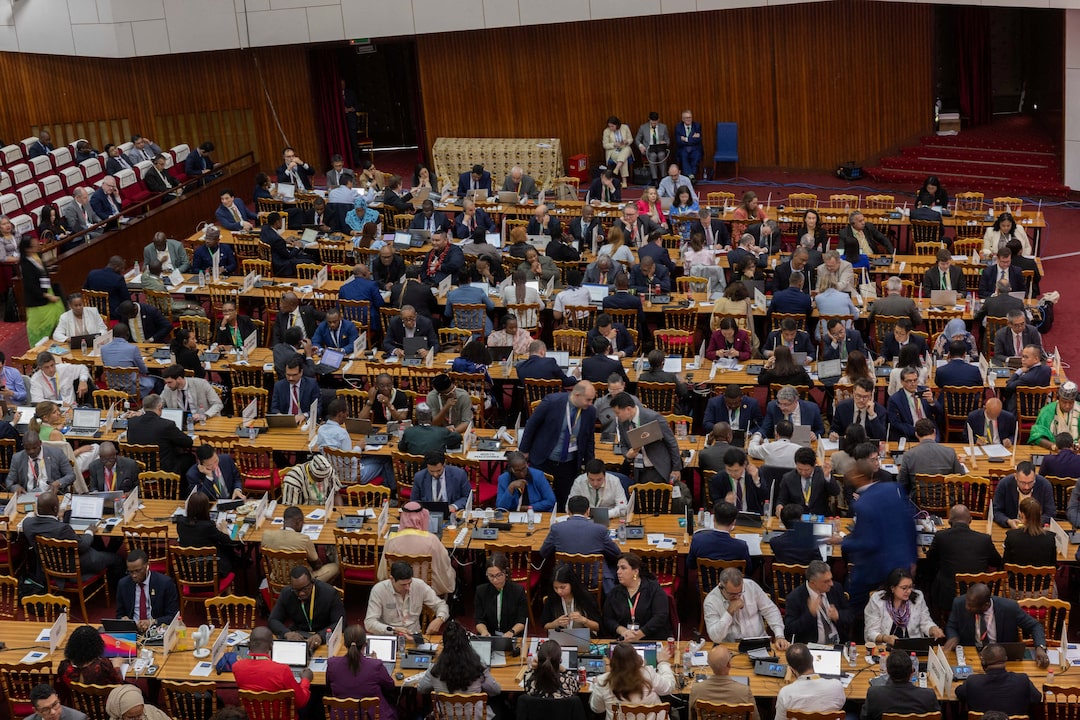
Delegates attend the World Trade Organisation (WTO) 14th ministerial meeting in Yaounde, Cameroon, March 28, 2026. WTO/Handout. Credit: Reuters
Its expiration means WTO members are no longer collectively bound to refrain from imposing tariffs on cross-border digital products and services including e-books, music streaming, software downloads, cloud computing services, and even telemedicine.
Delegates and ministers from around the world gathered in Cameroon’s capital from March 26, hoping to chart a new course for the multilateral trading system amid geopolitical tensions, including the ongoing Middle East conflict, and mounting pressures on global supply chains.
Over 200 business organizations had urged ministers ahead of MC14 to renew and ideally make the moratorium.
Instead, deep divisions, particularly between developed economies pushing for permanence or a long extension and several developing nations wary of lost fiscal revenue and policy space — prevented consensus.
WTO Director-General Ngozi Okonjo-Iweala had opened the conference with an urgent call for members to “launch the next chapter of the multilateral trading system.”
She highlighted the “tense” atmosphere in global trade and criticized the “unilateralism” and “collective failure” that have plagued the organization in recent years. Despite her appeals, the e-commerce file proved intractable.
Delegates attend the World Trade Organisation (WTO) 14th ministerial meeting in Yaounde, Cameroon, March 28, 2026. WTO/Handout. Credit: Reuters
The moratorium has shielded electronic transmissions from customs duties, fostering explosive growth in the digital economy.
Proponents, including the United States, the European Union, Japan, and major business groups representing hundreds of companies, argued that letting it lapse would introduce uncertainty, raise costs for consumers and businesses — especially micro, small, and medium-sized enterprises (MSMEs) — and potentially slow digital innovation and inclusion.
Over 200 business organizations had urged ministers ahead of MC14 to renew and ideally make the moratorium permanent, warning that its end could undermine cross-border e-commerce at a time when the digital economy is a key driver of growth worldwide.
The global trading system faces its worst disruption in 80 years.
Developing countries, including many in Africa and India, expressed concerns that the moratorium deprives governments of potential revenue from a rapidly expanding sector.
They pushed for clearer definitions of “electronic transmissions” and greater emphasis on bridging the digital divide, technology transfer, and special and differential treatment for poorer nations.
Some advocated only a short extension or conditional renewal tied to broader development outcomes.
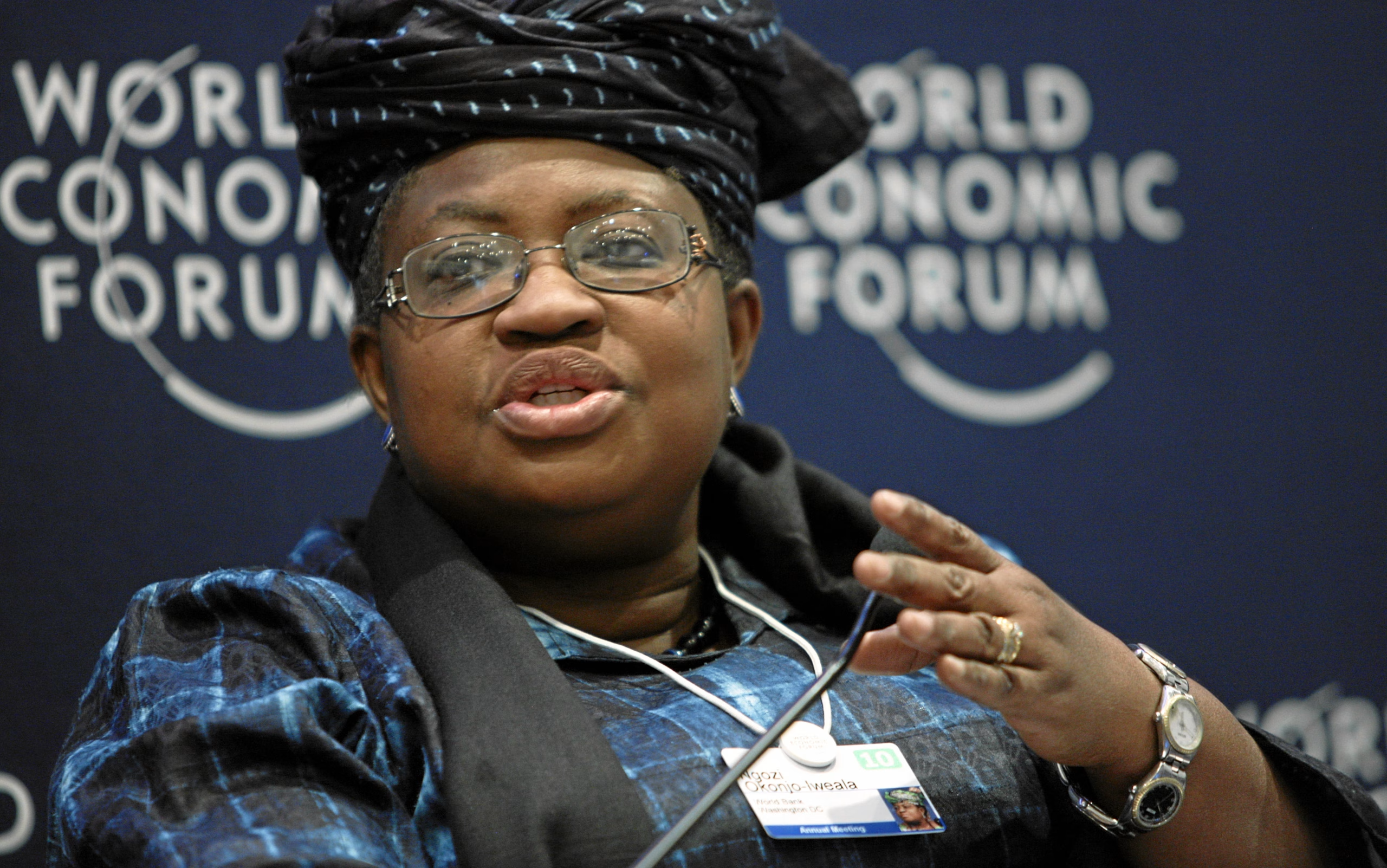
Ngozi Okonjo-Iweala, Managing Director, World Bank, Washington DC; Global Agenda Council on Corruption, is captured during the session ‘Zero Option for Corruption’ in the Congress Centre of the Annual Meeting 2010 of the World Economic Forum in Davos, Switzerland, January 30, 2010.
Copyright by World Economic Forum
swiss-image.ch/Photo by Remy Steinegger
Talks reportedly stalled in the final hours, with reports of disagreements involving positions from the United States, India, Brazil, and others preventing even a compromise extension.
While the lapse does not automatically impose duties — individual members can still choose not to apply them unilaterally — the absence of a collective WTO commitment creates new risks of fragmentation and tit-for-tat measures.
The failure on e-commerce comes against a backdrop of wider challenges for the WTO. Okonjo-Iweala has repeatedly warned that the global trading system faces its “worst disruption in 80 years,” exacerbated by geopolitical conflicts, supply chain vulnerabilities, and rising protectionism.
Progress was reportedly made on other fronts, including interim arrangements for the plurilateral Agreement on Electronic Commerce involving 66 members covering about 70% of global trade.
Many governments are expected to maintain the status quo.
However, the inability to resolve the high-profile moratorium issue is seen by many observers as a blow to the organization’s credibility and its ability to deliver meaningful outcomes through consensus.
Ministers had also been discussing WTO reform, agriculture, fisheries subsidies, and support for least developed countries (LDCs), but the e-commerce impasse overshadowed much of the narrative as the conference drew to a close.
With the moratorium expiring, attention now shifts to national capitals. Many governments are expected to maintain the status quo and continue refraining from new digital customs duties in the short term.
However, the door is now open for countries to reconsider their policies, potentially leading to a patchwork of tariffs that could complicate digital trade flows.
WTO members may attempt to revisit the issue at future meetings or through bilateral and plurilateral channels.
Director-General Okonjo-Iweala has indicated hope that the moratorium could eventually be restored, but the Yaoundé outcome underscores the deep fractures within the organization.
Read Also: Over 8,000 Migrants Died or Went Missing on Perilous Routes in 2025, Most from Africa – UN Agency
Author

Sign up for The Insight Newsletter
Get in-depth, research and data-based interpretative reports from around Nigeria.