
South African Xenophobic Crisis: The Overhyped Struggle for Crumbs
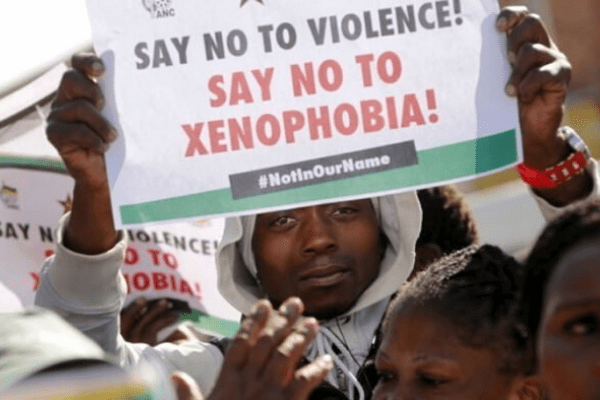
…Analysis Questions Focus on Migrants Amid Deep Economic Inequality
By The Insight
A new policy analysis has challenged prevailing narratives surrounding xenophobic attacks in South Africa, arguing that anti-immigrant sentiments may be diverting attention from deeper structural economic inequalities rooted in the country’s apartheid-era economic framework.
The report, titled “South African Xenophobic Crisis: The Overhyped Struggle for Crumbs,” was published by Policy House, a policy and governance think tank, which contends that much of the public anger directed at foreign nationals may be misplaced when viewed against the broader distribution of economic power and wealth in South Africa.

South Africans beat a Nigerian until he fainted.
According to the analysis, recurring xenophobic violence against migrants from countries such as Zimbabwe, Malawi, Mozambique, Nigeria and Ghana has largely been driven by competition for opportunities within the lower tiers of the economy, particularly in informal trade, retail activities and low-skilled employment.
Policy House stated that while emotions and nationalist sentiments often dominate public discourse during periods of social tension, a more data-driven assessment reveals that immigrants occupy only a relatively small segment of the country’s overall economic ecosystem.
The think tank cited data from international institutions, including the International Monetary Fund (IMF), the World Bank and the World Trade Organization (WTO), to support its argument that South Africa’s economic challenges are deeply linked to longstanding structural inequalities rather than immigration alone.
Immigrants occupy only a relatively small segment of the country’s overall economic ecosystem.
According to the report, South Africa’s economy was estimated at approximately $420 billion in 2025, with the services sector accounting for about 65 percent of Gross Domestic Product (GDP), manufacturing and industry contributing 25 percent, and mining and agriculture making up roughly 10 percent.
Policy House argued that the bulk of xenophobic tensions are concentrated within sectors representing a relatively small portion of the economy, particularly mining, agriculture and informal labour markets, where competition exists between South African workers and migrants from neighbouring countries.
The report further claimed that economic power remains heavily concentrated within the private sector, which accounts for more than 80 percent of economic activity, while government expenditure represents roughly 20 percent.

South Africans harassed Nigerians in the presence of a security officer despite having a complete document.
According to the analysis, white South Africans, despite constituting a minority of the economically active population, continue to hold a disproportionately large share of senior management positions and ownership stakes within the private sector. The report argued that this concentration of economic influence reflects enduring patterns established during apartheid and has contributed to persistent inequality decades after the country’s democratic transition.
Policy House noted that many foreign nationals, particularly migrants from other African countries, operate mainly within small-scale retail businesses, informal commerce and low-capital entrepreneurial ventures rather than occupying dominant positions within major sectors of the formal economy.
The report questioned whether anti-immigrant movements should continue focusing their efforts on sectors representing a relatively small share of national economic output while larger questions surrounding ownership, wealth concentration and economic transformation remain unresolved.
“Should the anti-immigrant movement spend so much energy and mobilisation capacity pursuing an estimated 10 or 15 percent share of the economy, or should it push for a total restructuring of the economic architecture that concentrates economic power and control in the hands of a small segment of the population?” the report asked.
Immigrants are not the principal beneficiaries of the economic structures that continue to generate inequality and social frustration.
Policy House concluded that xenophobic attacks risk obscuring broader debates about economic inclusion, unemployment, poverty and wealth distribution in South Africa. The think tank argued that immigrants are not the principal beneficiaries of the economic structures that continue to generate inequality and social frustration.
The analysis comes amid renewed concerns over xenophobic rhetoric and periodic attacks targeting foreign nationals across parts of South Africa. Human rights organisations, community leaders and regional bodies have repeatedly warned that violence against migrants threatens social cohesion and undermines efforts to promote African unity and regional integration.
While the findings and conclusions presented by Policy House remain subject to debate, the report has added a fresh dimension to discussions about the root causes of economic hardship and social unrest in South Africa, highlighting the need for broader conversations about economic reform, opportunity distribution and post-apartheid transformation.
Observers say the report is likely to reignite debate over whether immigration is the primary driver of unemployment and poverty in South Africa, or whether deeper structural economic issues remain the more significant challenge facing the country.
Source: Centre for Public Policy – a research and advocacy organization promoting evidence-based solutions to global policy challenges through dialogue, analysis, and critical thinking (Manchester, UK).
Read Also: Weekly Brief: Xenophobe-Returnees from South Africa tell plane-load of sad tales
Author

Sign up for The Insight Newsletter
Get in-depth, research and data-based interpretative reports from around Nigeria.