Tinubu: Subsidy Removal to Tax Burdens – Billions Borrowed, Limited Relief for Ordinary Nigerians
By Emmanuel Kwada
More than two years after President Bola Ahmed Tinubu’s administration removed fuel subsidies, secured billions in fresh loans from multilateral lenders, and aggressively widened the tax net, the promised economic turnaround remains elusive for millions of ordinary Nigerians.
Instead, a deepening cost-of-living crisis, persistent insecurity, and soaring prices of essentials have left many households unable to afford three square meals a day, while fear of banditry and kidnapping keeps families awake at night and restricts safe travel.
The administration’s flagship reforms – launched with the declaration “subsidy is gone” in May 2023 – were intended to free up funds for infrastructure, social investment, and fiscal discipline.
Sources: AFBD, World Bank,
Yet data from households, market surveys, and civil society groups paint a picture of limited relief. Food inflation has remained stubbornly high, transport fares have tripled in many cities, and the cost of basic commodities such as rice, beans, cooking oil, and bread has moved beyond the reach of the average worker earning the new minimum wage of ₦70,000 per month.
Across urban slums in Lagos, Kano, and Abuja, as well as rural communities in the North-East and South-East, the reality is stark. Families that once managed two meals are now skipping breakfast or dinner. “We eat once a day when we are lucky,” said Hajia Salamatu Mohammed, a mother of four in Nasarawa.
“You work for the month, but transportation eats up all the money. The government says prices of food have come down, but if you don’t have the money, how do you buy when the money you’re earning isn’t enough? How are we supposed to survive?
You work for the month, but transportation eats up all the money.
Insecurity compounds the economic pain. Despite repeated government assurances and increased security votes, banditry, kidnapping for ransom, and farmer-herder clashes continue to plague highways and farmlands.
Travelers on the Abuja-Kogi, Lagos-Benin, and Enugu-Port Harcourt routes routinely cancel trips. Residents in affected communities sleep in shifts or flee to safer urban centres, further straining family budgets.
Transportation costs have become another punishing burden. The removal of the petrol subsidy pushed pump prices from under ₦200 to over ₦1,000 per litre at peak periods. Even with occasional drops, the ripple effect on bus fares, motorcycle taxis (okada), and tricycles has made commuting unaffordable for low-income workers.

Fuel pump nozzle and Naira notes to demonstrate Subsidy removal.
Essential services – healthcare, education, and electricity – have also seen sharp increases, with many Nigerians now relying on unregulated herbal remedies or skipping medical care altogether.
The fuel subsidy removal was the first major shock. The government argued it would eliminate a bloated ₦4–6 trillion annual drain on the treasury, redirecting savings toward infrastructure and social programmes.
While some infrastructure projects have indeed commenced, critics point out that the immediate inflationary impact was underestimated. The naira’s floatation in June 2023 further accelerated price rises, wiping out whatever marginal gains came from saved subsidy funds.
To plug revenue gaps, the administration accelerated tax reforms aimed at “widening the tax net.” Measures include stricter enforcement by the tax authorities, new levies on digital transactions, higher VAT on certain goods, and proposed reforms to the Companies Income Tax and Personal Income Tax regimes.
While these have boosted non-oil revenue, they have also squeezed small businesses and salaried workers already reeling from inflation.
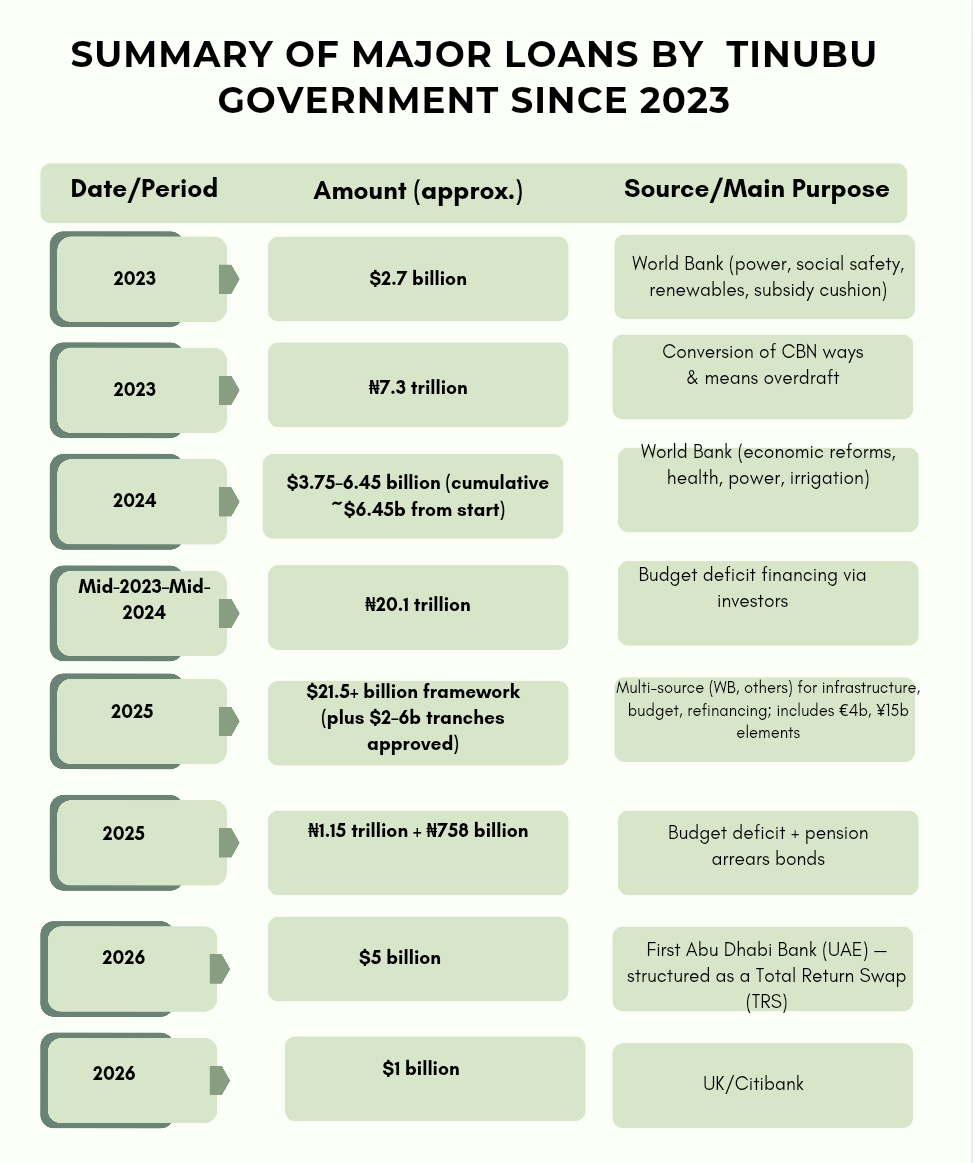
Despite the reforms, the administration has turned repeatedly to borrowing to finance budget deficits and reform programmes. Since President Tinubu assumed office in May 2023, the Nigerian government has secured multiple loan approvals and borrowing plans, primarily from multilateral institutions like the World Bank, as well as requests to the National Assembly for external and domestic borrowing.
The Tinubu administration secured 17 loan approvals from the World Bank.
One of the most documented aspects is borrowing from the World Bank (including its International Development Association arm). Reports indicate that in barely two years (May 2023 to around April 2025), the Tinubu administration secured 17 loan approvals from the World Bank with total disbursements or approvals reaching about $7.2 billion between May 2023 and May 2025.
The Tinubu government claims that these loans typically fund specific sectors such as education, power, health, agriculture, and economic reforms.
Additional multilateral support includes a $1 billion facility from the African Development Bank (AfDB) approved for disbursement between 2024 and 2025.
Beyond individual project loans, the government has submitted several large-scale borrowing requests to the National Assembly for approval. These are often “rolling plans” that cover multiple years and projects:
May 2025 Request (2025–2026 External Borrowing Plan): President Tinubu sought approval for approximately $21.5 billion (plus €2.2 billion, ¥15 billion, and a €65 million grant), along with about ₦758 billion in domestic bonds for pension arrears. The Senate approved the core plan in July 2025.
October 2025 Request: A fresh $2.35 billion external loan (including components to finance the 2025 budget deficit and refinance maturing Eurobonds) plus a $500 million debut sovereign Sukuk. The National Assembly approved this in late October 2025.
Additional Adjustments: In July 2025, an extra $347 million was approved as an amendment to the 2025–2026 plan.
These are difficult but necessary decisions. We are fixing decades of structural rot. Results will come.
Including around $6 billion from First Abu Dhabi Bank and UK Export Finance that received Senate approval in March, 2026. Domestic borrowing approvals, such as ₦1.15 trillion in late 2025 for the 2025 budget, also occurred.
In addition to external loans, the government regularly issues domestic bonds and other instruments through the Debt Management Office (DMO). These are approved separately and contribute significantly to the total public debt stock, which rose from about ₦87 trillion in mid-2023 to over ₦152 trillion by mid-to-late 2025.
The government defends these borrowings as essential for infrastructure, reforms, and closing budget deficits. However, with debt servicing consuming a large portion of revenue, concerns remain about sustainability and the tangible impact on ordinary Nigerians.
Economists and opposition voices argue that while the borrowings have funded some projects – notably in power, roads, and social safety nets like the Conditional Cash Transfer programme – the benefits have been slow to reach the grassroots. Debt servicing now eats up over 90% of federal revenue in some quarters, leaving little fiscal space for direct relief measures.
Debt servicing now eats up over 90% of federal revenue in some quarters, leaving little fiscal space for direct relief measures.
President Tinubu’s spokespersons maintain that the reforms are laying a foundation for long-term stability. “These are difficult but necessary decisions,” said a senior presidential aide. “We are fixing decades of structural rot. Results will come.”
Yet for millions of Nigerians struggling to put food on the table or sleep without fear of armed intruders, the “results” feel painfully distant.
As the administration enters its third year, the question echoing in homes, markets, and opposition rallies is whether the heavy lifting of subsidy removal, tax expansion, and record borrowing will eventually deliver the dividends of democracy – or whether ordinary citizens will continue to bear the heaviest burden while waiting for relief that has yet to arrive.
Author

Sign up for The Insight Newsletter
Get in-depth, research and data-based interpretative reports from around Nigeria.