
SON: Local Product Certification Hits 17,866 Products as MANCAP Marks Two Decades
By Emmanuel Kwada
The Standards Organisation of Nigeria (SON) has disclosed that the number of products certified under its Mandatory Conformity Assessment Programme (MANCAP) has increased to 17,866, covering 8,634 companies, as the scheme marks 20 years of promoting quality and safety in locally manufactured goods.
The Director-General and Chief Executive Officer of SON, Dr. Ifeanyi Okeke, disclosed this at the 2026 MANCAP Quality Award Ceremony held in Lagos on Wednesday.
MANCAP has served as SON’s flagship mandatory certification programme for locally manufactured products.
Okeke called on Nigerian manufacturers to sustain high product quality standards, stressing that consistent compliance with established requirements is essential to protecting consumers, strengthening confidence in Made-in-Nigeria products and improving the competitiveness of the country’s manufacturing sector.
According to a statement published on SON’s website on Thursday, the anniversary provided an opportunity to reflect on the programme’s achievements since its introduction in 2006 and its contribution to Nigeria’s industrial development.
The Mandatory Conformity Assessment Programme was introduced by SON and became operational on January 1, 2006. It was established to ensure that products manufactured in Nigeria conform to relevant Nigerian Industrial Standards before they are released into the market.
The scheme was designed to protect consumers against substandard and unsafe products, promote fair competition among manufacturers and encourage the production of goods that meet recognised quality requirements.
Since its introduction, MANCAP has served as SON’s flagship mandatory certification programme for locally manufactured products.

Dr. Ifeanyi Okeke, Director-General and Chief Executive Officer of The Standards Organisation of Nigeria (SON)
The scheme has recorded considerable growth over the past two decades. In its first year, it covered 1,930 products manufactured by 458 companies. By 2026, the figures had risen to 17,866 products and 8,634 companies, reflecting the programme’s expanding reach across Nigeria’s manufacturing sector.
Okeke said the growth demonstrated the importance of product certification in building consumer confidence and supporting businesses committed to maintaining established standards.
He urged manufacturers to view quality assurance as a continuous responsibility rather than simply a regulatory requirement, noting that consistent product quality helps businesses protect their reputation, retain customers and create long-term value.
The SON chief also congratulated manufacturers recognised for maintaining their certifications for 10, 15 and 20 years, describing their achievements as evidence of sustained commitment to quality.
Certification process involves factory inspections, product sampling, laboratory testing, compliance reviews.
Okeke explained that the certification process involves factory inspections, product sampling, laboratory testing, compliance reviews and certification to establish whether products meet the applicable standards.
Certificates are renewed every three years, while annual surveillance inspections and testing are conducted to ensure that manufacturers continue to comply with the requirements.
He stressed that manufacturers, regulators and consumers must work together to strengthen product quality in Nigeria.
According to him, manufacturers must maintain compliance, regulators must enforce standards fairly and consistently, while consumers should demand quality and make informed purchasing decisions.
To improve the effectiveness of the scheme, SON has continued to strengthen stakeholder engagement, public awareness, laboratory infrastructure and measurement capabilities through the National Metrology Institute.
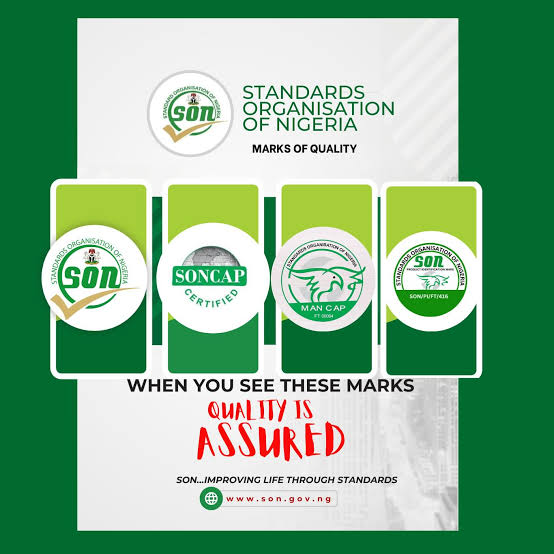
The organisation introduced a new MANCAP logo in March 2025 to improve public recognition of certified products and help consumers identify goods that have undergone the required conformity assessment.
SON has also expanded the promotion of certified products through its website and Digital Standards Platform.
Other initiatives supporting manufacturers include the SON Export Conformity Assessment Programme (SONEXCAP), the Special Economic Zones Conformity Assessment Programme (SEZCAP) and the Product Identification Scheme (PIS).
These programmes are intended to support product identification, conformity assessment and manufacturers’ access to domestic and international markets.
The government and regulatory institutions had a responsibility to protect consumers while supporting industrial development.
Also speaking at the ceremony, the Permanent Secretary of the Federal Ministry of Industry, Trade and Investment, Dr. Chris Isokpunwu, called for sustained commitment to quality and conformity across Nigeria’s manufacturing sector.
He described MANCAP’s 20th anniversary as an important milestone in the development of the country’s quality infrastructure.
Isokpunwu said standardisation and certification had helped strengthen confidence in products manufactured and sold in Nigeria, adding that consumers deserved safe and reliable goods while manufacturers needed an environment in which quality could improve their competitiveness.
He noted that the government and regulatory institutions had a responsibility to protect consumers while supporting industrial development.
The permanent secretary stressed that all stakeholders in the quality assurance system must ensure that established standards are respected and that product safety and performance are not compromised.
As MANCAP enters its third decade, SON has reaffirmed its commitment to strengthening product certification and conformity assessment to help Nigerian manufacturers build consumer trust, reduce the circulation of substandard goods and compete more effectively in local and international markets.
Read Also: Nigeria’s Debt Interest Soars 124% Above Revenue as Capital Spending Drops to N700bn
Author

Sign up for The Insight Newsletter
Get in-depth, research and data-based interpretative reports from around Nigeria.


