African Referee Denied U.S. Entry Over Alleged Terror Links, Ruled Out of 2026 World Cup
By Emmanuel Kwada
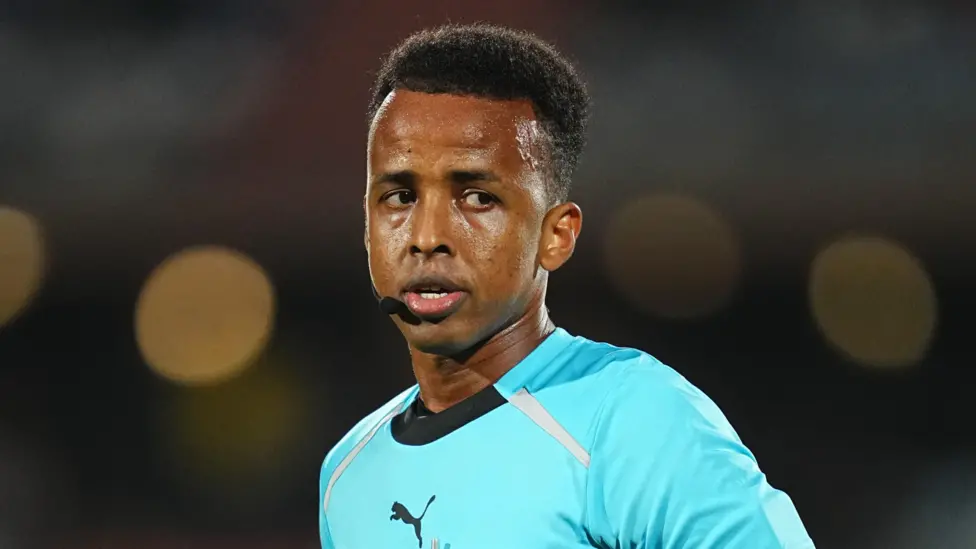
The United States government has denied entry to acclaimed Somali referee Omar Abdulkadir Artan, citing national security concerns and alleged associations with suspected members of terrorist organizations, a move that has sparked controversy just days before the start of the 2026 FIFA World Cup.
Artan, who was named Africa’s Referee of the Year in 2025 and was set to become the first Somali official to referee at a FIFA World Cup, was stopped by U.S. Customs and Border Protection (CBP) upon arrival at Miami International Airport from Istanbul over the weekend.
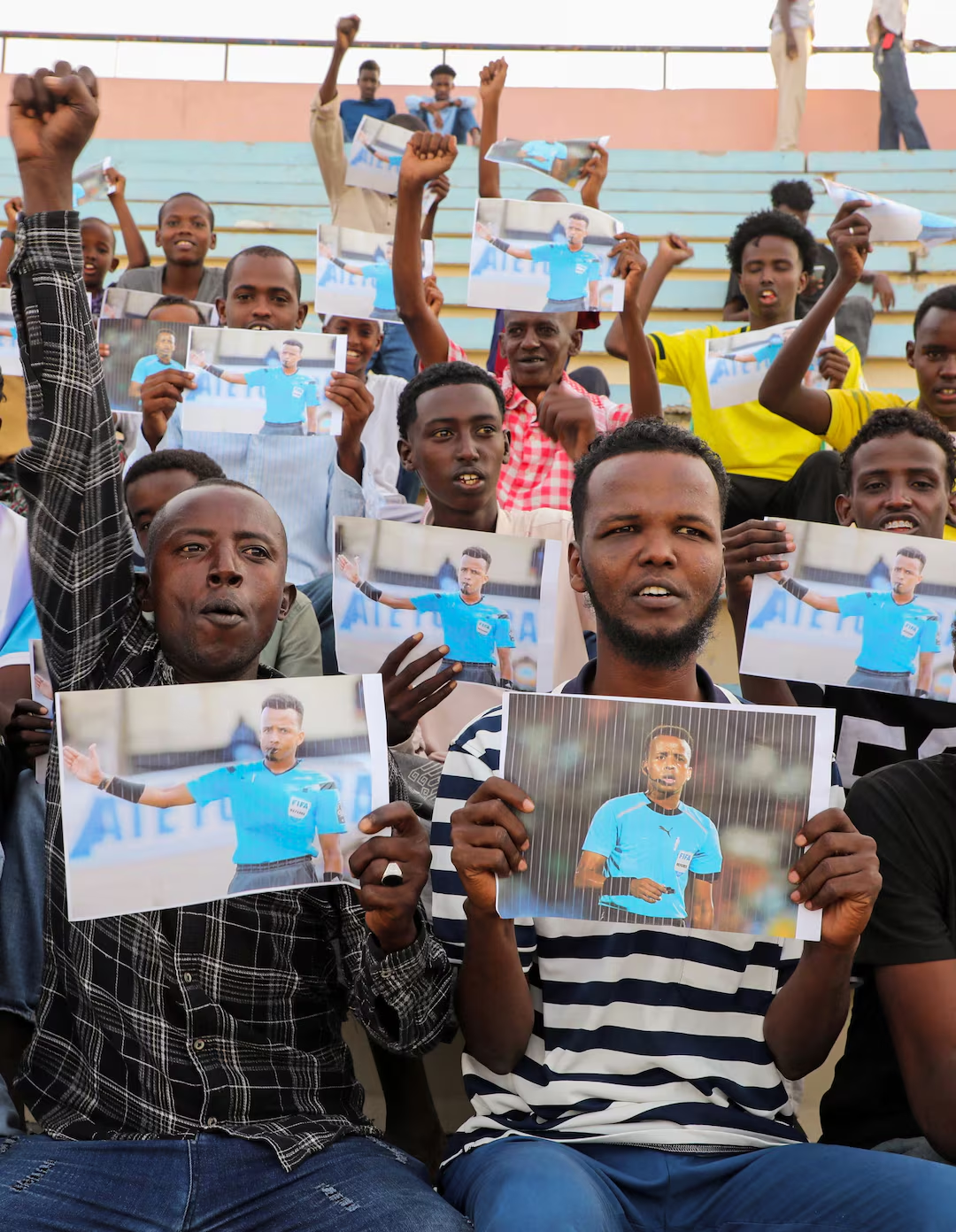
Somalis hold pictures of referee Omar Abdulkadir Artan, who had been expected to officiate matches at the 2026 FIFA World Cup but was refused entry to the United States, during a match between Gaadiidka and Juba at Mogadishu Stadium, in Mogadishu. Credit: Reuters.
The decision effectively ends his participation in the historic 2026 World Cup, which is being jointly hosted by the United States, Mexico, and Canada. FIFA has confirmed that Artan will neither take part in pre-tournament training activities nor officiate matches during the competition.
According to U.S. authorities, the referee was denied admission following additional screening procedures that allegedly uncovered information linking him to individuals suspected of involvement with terrorist organizations.
A senior Trump administration official stated that Artan was found inadmissible under provisions of the U.S. Immigration and Nationality Act after CBP officers identified what was described as “derogatory information” during a secondary inspection process.
“President Trump’s administration will not allow any security threat to enter our country, full stop,” the official said, emphasizing that national security considerations took precedence over Artan’s professional status and role in the tournament.
President Trump’s administration will not allow any security threat to enter our country, full stop.
The case has drawn international attention amid ongoing scrutiny of the United States’ immigration policies ahead of the World Cup. The Trump administration’s stringent border measures have been a source of concern for sports officials and participating nations, particularly following the implementation of a travel ban affecting citizens from 12 countries, including Somalia.
Somalia’s government expressed disappointment over the development, revealing that diplomatic efforts had been made to secure Artan’s entry into the United States. However, those negotiations reportedly failed to produce a breakthrough.
In a statement, Somalia’s Ministry of Sports described Artan as a source of national pride whose achievements had inspired many across the country.
“His international achievements are a source of honour and pride for the Somali people,” the ministry said, lamenting the setback for both the referee and Somali football.
The Somali Football Federation also voiced its sadness over the incident, describing Artan’s World Cup appointment as a historic milestone earned through years of dedication, professionalism, and integrity.
The federation noted that it had not received a formal explanation regarding the exact reasons for the entry denial and said it was working closely with FIFA and relevant authorities to obtain further clarification.
His international achievements are a source of honour and pride for the Somali people.
Reports indicated that Artan was travelling with a valid U.S. visa at the time of his journey, adding another layer of complexity to the controversy.
FIFA, meanwhile, distanced itself from the immigration dispute, stressing that decisions regarding visas and entry permissions fall entirely within the jurisdiction of host countries.
A spokesperson for the world football governing body said FIFA had been informed by U.S. authorities that Artan’s immigration status would not be changed and reiterated that the organization does not participate in visa adjudication or border enforcement processes.
Despite the setback, Artan appeared composed when speaking to journalists at Istanbul Airport before returning to Somalia.
“I feel very good now,” he said, expressing gratitude to FIFA, the Confederation of African Football (CAF), and the Somali people for their support throughout the ordeal.
I feel very good now.
Diplomatic efforts to reverse the decision were reportedly continuing as of Tuesday, although Somali officials declined to provide details regarding ongoing discussions.
The incident has renewed debate about the potential impact of immigration and security policies on international sporting events, particularly as the United States prepares to host millions of visitors during what is expected to be the largest World Cup in history.
CBP Commissioner Rodney Scott defended the decision, stating that U.S. authorities routinely deny entry to individuals who fail to meet legal requirements or are considered security risks, regardless of their profession or international status.
“I don’t really care what you do for a living. The law is still the law,” Scott said during an event in Washington, adding that exceptions would not be made simply because an individual was scheduled to officiate at a major sporting competition.
With the opening matches of the 2026 FIFA World Cup just days away, Artan’s exclusion marks one of the tournament’s first major controversies, overshadowing what would have been a landmark moment for Somali football and African refereeing on the global stage.
Read Also: Top African Referee Barred From 2026 World Cup Over U.S. Entry Denial
Author

Sign up for The Insight Newsletter
Get in-depth, research and data-based interpretative reports from around Nigeria.