AfDB Forecasts Nigeria’s Inflation to Decline to 24.7% in 2025, 17.3% in 2026 Amid Economic Reforms

By Emmanuel Kwada
The African Development Bank (AfDB) has projected Nigeria’s inflation to ease from 33.2% in 2024 to an average of 24.7% in 2025, with a further decline to 17.3% by 2026, according to its 2025 African Economic Outlook released during the AfDB’s Annual Meetings which is holding at the Sofitel Abidjan Hotel Ivoire in Abidjan, Côte d’Ivoire.
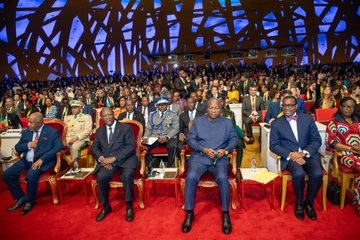
Participants at the 51st Meeting of the African Development Fund
AfDB President Dr. Akinwumi Adesina, addressing the 60th Annual Meeting of the African Development Bank and the 51st Meeting of the African Development Fund, highlighted global economic pressures, stating, “When those currencies weaken, you’re going to find that high inflation becomes a problem… and the cost of servicing foreign currency debt is going to get worse.”
Nigeria’s projected inflation decline reflects ongoing structural reforms, tighter monetary policies, and improved agricultural productivity. Despite these positive signals, the country faces significant challenges, including widespread poverty, high unemployment, and infrastructure deficits, which could threaten the trajectory unless addressed through sustained policy efforts.
When those currencies weaken, you’re going to find that high inflation becomes a problem… and the cost of servicing foreign currency debt is going to get worse
Nigeria’s inflation surged from 24.7% in 2023 to 33.2% in 2024, driven by a 77% spike in petrol prices following the removal of fuel subsidies and a 42% naira depreciation.
The Central Bank of Nigeria responded by raising its policy rate to 27.5% in 2024, a measure expected to stabilize prices through 2026. Government initiatives to boost food production are set to ease food inflation, which accounted for over 40% of the consumer price index in 2024, while reforms like an integrated unique identification system and infrastructure investments aim to strengthen fiscal resilience. Although the 24.7% inflation forecast for 2025 remains high, these efforts pave the way for the projected 17.3% rate in 2026, signaling growing economic stability if reforms persist.
Economic growth, however, remains subdued, with real GDP growth projected at 3.2% in 2025 and 3.1% in 2026, down 0.3 and 0.5 percentage points from earlier estimates due to reduced demand from key trading partners like the United States and China, global financial market volatility, and supply chain disruptions.
In 2024, the services sector drove 75% of GDP growth, with industry up 13% due to a 2.8% increase in oil production to 1.56 million barrels per day and agriculture contributing 9%. Nigeria’s growth lags behind West Africa’s average of over 5%, with countries like Ethiopia and Senegal surpassing 7%. Oil production, still below the OPEC quota of 1.8 million barrels per day, highlights structural constraints limiting economic potential.
Real GDP growth projected at 3.2% in 2025 and 3.1% in 2026
With over 63% of Nigeria’s 230 million population living in multidimensional poverty and 18 states exceeding the national poverty average, economic pressures are intensified by a projected 33% unemployment rate in 2025.
Infrastructure deficits, such as unreliable power and poor roads, drove a 25% rise in food prices in 2024 due to high transportation costs. Insecurity in northern states like Borno and climate risks like flooding threaten agricultural gains critical for food security and inflation control. Governance inefficiencies, with budget execution rates below 50% in some states, further risk undermining reform benefits.
The anticipated inflation decline could bolster Nigeria’s development priorities. A drop to 17.3% by 2026 could ease living costs for the 133 million multidimensionally poor Nigerians, improving access to essentials like food and healthcare, where challenges like a maternal mortality rate of 814 per 100,000 live births and 68 million malaria cases in 2023 persist.
Increased fiscal space could fund health infrastructure in underserved states like Jigawa and Bauchi, while improved roads and power supply could reduce business costs and foster growth. Initiatives like the Livestock Productivity and Resilience Support Project could strengthen rural economies, supporting food security and poverty reduction.

Participants at the 51st Meeting of the African Development Fund
Risks remain significant, with the naira’s 42% depreciation in 2024 threatening inflation if foreign exchange reserves, estimated at $35 billion in 2025, are not bolstered. Insecurity and climate challenges could disrupt agricultural productivity, a key driver of the inflation decline.
Dr. Muda Yusuf of the Centre for the Promotion of Private Enterprise warns that 24.7% inflation in 2025 remains burdensome, urging targeted subsidies for low-income families. Private sector leaders, however, see the 17.3% projection for 2026 as a positive signal for investor confidence, bolstered by reforms enhancing revenue collection. Adesina’s remarks underscore the broader context, as currency weaknesses and rising debt costs could exacerbate economic pressures across Africa.
The AfDB’s projections offer a cautiously optimistic outlook for Nigeria, with the decline from 24.7% inflation in 2025 to 17.3% in 2026 contingent on sustained reforms, monetary discipline, and agricultural gains. While growth lags behind regional peers, easing inflation could alleviate pressures on households and businesses, enabling investments in healthcare, infrastructure, and poverty reduction.
Challenges like currency volatility, insecurity, and inefficient budget execution demand urgent attention. As Nigeria navigates this critical period, the AfDB’s forecast, presented at its 2025 Annual Meetings, emphasizes resilience and strategic policy execution to transform the nation’s economic landscape and improve citizens’ lives.
Read Also: NBS Reports 76.73% Fuel Price Hike
Author

Sign up for The Insight Newsletter
Get in-depth, research and data-based interpretative reports from around Nigeria.