
Electoral Act Now Law: What You Should Know

Key points:
- Election funds released 6 months before general election.
- Birth certificate, passport, NIN are key voter IDs.
- Voters can download PVCs from INEC’s website now.
- Parties submit candidates 120 days before election day.
- Electronic transmission of results is compulsory, with manual fallback.
- Direct primaries and consensus methods now recognized only.
By Emmanuel Kwada
President Bola Tinubu signed the Electoral Act, 2022 (Repeal and Re-Enactment) Bill 2026 commonly known as the Electoral Act 2026 into law on Wednesday, February 18, 2026, at the Presidential Villa in Abuja.
The brief ceremony, held around 5:00 p.m., was attended by Senate President Godswill Akpabio, Speaker of the House of Representatives Tajudeen Abbas, Chief of Staff Femi Gbajabiamila, and other principal officers of the National Assembly.
The National Assembly passed the harmonized version of the bill on Tuesday, February 17, 2026, following months of intense deliberations, public hearings, committee reviews, heated debates, protests (including instances of police using tear gas outside the Assembly complex), walkouts by opposition lawmakers, and divisions—particularly over electronic transmission of results and party primaries.
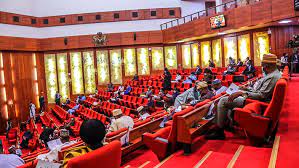
The Nigerian Senate in session
This law repeals and re-enacts the 2022 Electoral Act, introducing targeted updates to address logistical, technological, operational, and internal party challenges observed in recent elections.
It establishes the primary legal framework for the 2027 general elections, with presidential and National Assembly polls scheduled for February 20, 2027, as announced by INEC.
The reforms emphasize efficiency, inclusivity, and resilience, adapting to practical issues like inconsistent internet coverage in rural areas, funding delays, and the complexities of large-scale party processes.

President Bola Ahmed Tinubu, Senator Godswill Akpabio, Femi Gbajabiamila, Tajudeen Abbas, and others during the Signing of Electoral Act Ceremony at State House
The key summary of the core amendments below for clarity:
1. Funds must now be released to INEC at least 6 months before the general election (reduced from the previous 12 months).
This change streamlines budgeting to avoid last-minute scrambles and enables faster preparations.
While it accelerates resource allocation, the shorter window could compromise INEC’s financial independence, constrain detailed long-term planning, and lead to rushed procurement of sensitive materials or security setups, potentially requiring politically influenced supplementary funding that affects overall election credibility and readiness.
2. Acceptable identification documents for voter registration are narrowed primarily to birth certificate, Nigerian passport, and National Identification Number (NIN).
The national ID card and driver’s licence have been removed from the list. This provision standardizes verification by linking to national databases, aiming to reduce fraud, multiple registrations, and identity mismatches.
It bolsters anti-fraud safeguards and aligns voter rolls with secure national records, but it risks disenfranchising eligible citizens—particularly in rural, low-income, or underserved areas—who lack these specific documents and have relied on previously accepted alternatives, unless INEC implements aggressive, widespread NIN enrollment campaigns to mitigate exclusion.
3.Voters are now permitted to download their Permanent Voter Cards (PVCs) directly from INEC’s official website. This digital innovation enhances accessibility for those facing physical collection delays, reduces logistical burdens and costs for INEC, and has the potential to increase voter participation by lowering barriers to obtaining accreditation.
It modernizes voter engagement and could boost turnout through convenience, but challenges persist due to the digital divide (limited internet or smartphone access in many communities), cybersecurity vulnerabilities (risk of fake or altered downloads), and the need for robust polling unit protocols to verify digital versions without disputes or rejections.
4. Political parties must submit candidates’ lists 120 days before election day (shortened from 180 days), and INEC must publish the final list 60 days before the election (down from 150 days).
These compressed timelines aim to expedite preparations, minimize prolonged uncertainty, and allow INEC greater flexibility in adjusting schedules.
It speeds up the electoral calendar overall, but places significant pressure on parties for accelerated internal processes, candidate screening, dispute resolution, and legal compliance—potentially increasing nomination errors, incomplete vetting, rushed decisions, and post-submission challenges that could disrupt planning or lead to more litigation.
5. Electronic transmission of polling unit results to the INEC Result Viewing (IReV) portal is compulsory as the primary method: presiding officers must upload after Form EC8A (the physical result sheet) is signed, stamped, and countersigned by agents where available.
However, in cases of communication failure, network issues, glitches, or other technical problems, the physical Form EC8A becomes the primary source for collation and results declaration.
This creates a contingency mechanism without a strict real-time upload requirement while witnesses are present. Supporters, including President Tinubu (who emphasized safeguards against “glitches [and] unnecessary hacking” and noted that humans, not computers, ultimately announce results), view it as pragmatic to avoid disenfranchisement in low-connectivity areas and prevent over-reliance on vulnerable technology.
Critics contend it dilutes the transparency gains of the 2022 Act, potentially enables manipulation during manual collation stages, erodes public trust, and could recreate past controversies or invite extensive legal challenges.
The hybrid approach balances tech ambition with infrastructure realities but has fueled sharp debate, with opposition parties and CSOs arguing it weakens safeguards against rigging.
6. Only direct primaries (where all registered party members vote) and consensus methods are permitted for candidate nomination; indirect primaries via delegates have been eliminated.
Political party guidelines can regulate direct primaries but cannot override the Act. This shifts toward broader grassroots participation, reduces elite control through delegate manipulation, and aligns with calls for genuine internal party democracy—potentially making nominations more inclusive and altering power dynamics.
It empowers ordinary members but imposes massive logistical demands on major parties (nationwide polling units, accreditation, security, and INEC monitoring for millions of voters), dramatically increases funding requirements (venues, transport, materials, mobilization), and heightens infiltration risks (vote-buying, ballot stuffing, fake members, thug disruptions, or external interference)—issues more difficult to contain than in controlled delegate systems.
Smaller or resource-limited parties may face disadvantages, favoring wealthier candidates or incumbents, while opposition groups criticize it as undue interference that could trigger legal battles or flawed outcomes.
Overall, the Electoral Act 2026 seeks a more adaptive, resilient electoral system—retaining innovations like the Bimodal Voter Accreditation System (BVAS) while incorporating practical fallbacks for funding, technology, and party processes ahead of 2027.
The law remains deeply controversial: Provisions on transmission and primaries provoked protests, opposition walkouts, accusations of “treachery” from parties like the PDP, and warnings from CSOs and figures such as Peter Obi about rigging loopholes, diminished transparency, and shaken public confidence—potentially leading to court challenges or calls for further review.
President Tinubu defended the signing by stressing built-in protections against technical failures and the essential role of human oversight to safeguard voters.
INEC will now implement these changes, with close stakeholder monitoring expected in upcoming by-elections and throughout the 2027 preparatory period. The Act reflects Nigeria’s continuing efforts to refine electoral integrity in a complex landscape of technological, logistical, and political realities.
Author

Sign up for The Insight Newsletter
Get in-depth, research and data-based interpretative reports from around Nigeria.


