
2027 in Focus: Atiku Reveals His Next Move

By Emmanuel Kwada
In an exclusive Arise News primetime special, former Vice President Atiku Abubakar has confirmed that the 2027 presidential election will be his final bid for Nigeria’s highest office, describing it as his last outing at the age of 80.
The veteran politician, a fixture in Nigerian public life since the return to civilian rule, sat down with host Charles Enyegulu for a wide-ranging interview that touched on age, experience, coalition-building, and the shifting expectations of a younger, more impatient electorate.

Former Vice President Atiku Abubakar
Atiku, who turns 80 around the time of the 2027 polls (born November 25, 1946), has contested the presidency multiple times against MKO Abiola in the aborted Third Republic, and later in 2007, 2011, 2019, and 2023 — making 2027 potentially his seventh attempt.
He has served as Vice President under Olusegun Obasanjo (1999–2007) and held senior roles across parties including the SDP, PDP, AC, APC, and now the African Democratic Congress (ADC), where he has positioned himself as a key architect of a broad opposition coalition.
When pressed on whether his advanced age and long political résumé make him a symbol of continuity rather than change, Atiku pushed back firmly.
I represent both the past and the future.
He argued that Nigeria has tested both young and older leaders, but many younger governors and officials have “failed woefully” due to a lack of experience and proper tutelage.
“I represent both the past and the future,” he said, insisting that effective leadership at the apex requires seasoned guidance.
He cited his own learning curve as Vice President under the experienced Obasanjo and contrasted it with what he described as the shortcomings of relatively inexperienced leaders like former President Goodluck Jonathan.
Critics, however, continue to question whether another bid from a familiar face can resonate in a country facing acute economic hardship, widespread insecurity, and a demographic bulge of young voters demanding disruption of the old order.
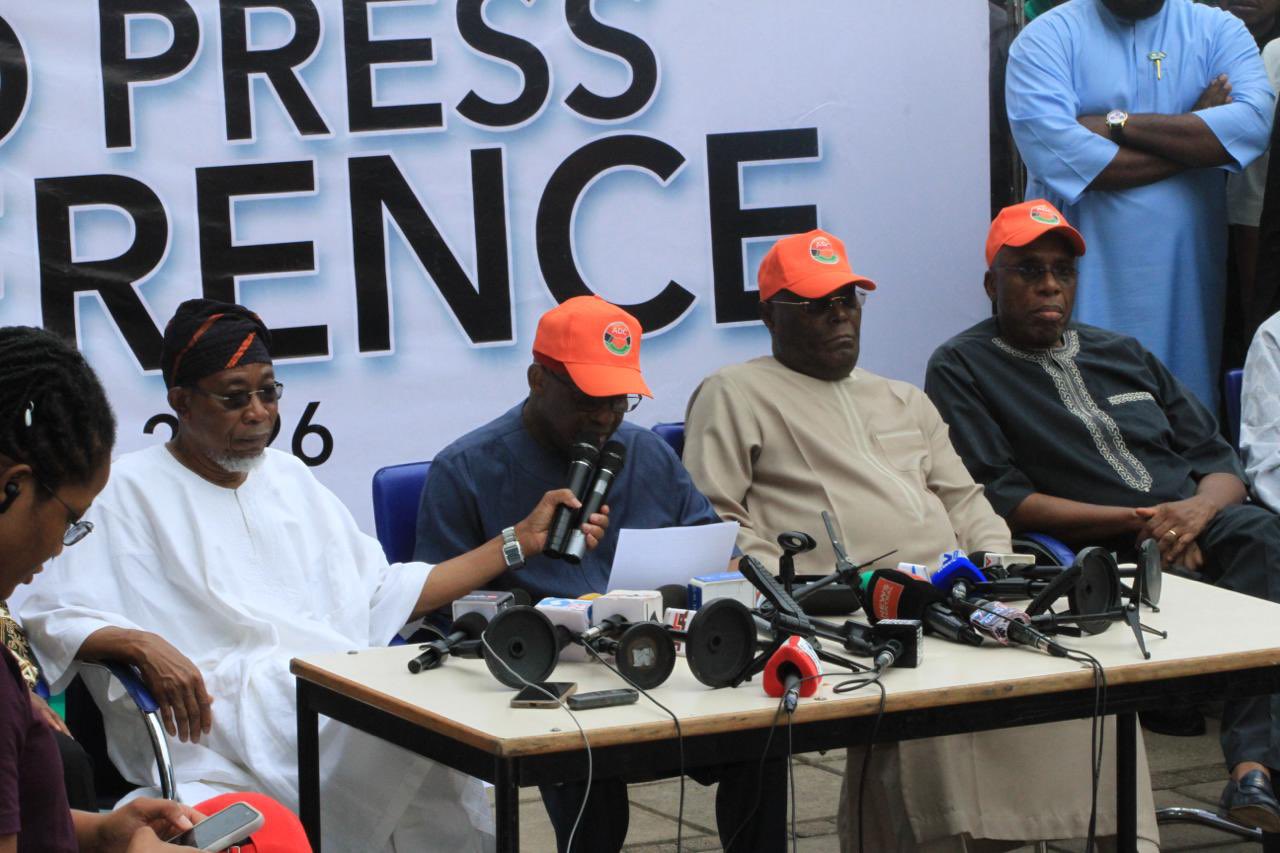
From left: Peter Obi, Atiku Abubakar, during a world press conference in Abuja
Atiku revealed he was among the earliest advocates for a grand opposition alliance after the PDP’s 2023 defeat, urging the party to pursue a broad coalition rather than going it alone.
He claimed party leaders rejected the idea largely due to personal animosity toward him rather than the merits of the proposal.
Now aligned with the ADC, he described the emerging platform as more expansive than previous efforts, drawing elements from the APC, PDP, NNPP, and Labour Party.
He listed fellow heavyweights in the coalition space, including Peter Obi (his 2023 running mate in some contexts), Rabiu Kwankwaso, Rotimi Amaechi, Nasir El-Rufai, and Aminu Tambuwal.
On whether the coalition is driven purely by anti-Tinubu sentiment or a shared vision, Atiku said “both.”
Effective leadership at the apex requires seasoned guidance.
He expressed disappointment in President Bola Tinubu’s governance, particularly on economic management, and highlighted concerns over the erosion of democratic institutions and the separation of powers.
He pledged to support whoever emerges as the ADC’s presidential candidate — whether through consensus (the preferred first option) or direct primaries — emphasizing that the group comprises “mature and experienced politicians” capable of managing ambitions for the sake of saving democracy.
North is more united now than ever.
Atiku maintained that the North remains his strongest political base and rejected suggestions of fragmentation, arguing it appears “more united now than ever.”
He claimed no other current Northern leader commands comparable bloc support, though he acknowledged strategic influence held by figures like Kwankwaso in Kano.
On the sensitive issue of power rotation, Atiku challenged the notion of a rigid North-South zoning consensus beyond the PDP’s internal constitution.
He noted that only the PDP formally entrenches zoning, while pointing to the cumulative years of Southern versus Northern presidencies since 1999 to argue that equity considerations could still favor a Northern candidate in 2027.
The coalition is driven purely by anti-Tinubu sentiment or a shared vision.
Critics from the ruling APC and elsewhere maintain that informal rotation norms and the current Southern presidency make another Northern bid contentious.
The interview underscored the high stakes: Atiku’s vast network, business success, and philanthropic record (including investments in education via the American University of Nigeria) stand against questions of repeated defeats, party-hopping, and whether 2027 represents resilience or one last roll of the dice in a transformed Nigeria.
As the opposition coalesces under the ADC banner amid reported internal and legal challenges, Atiku’s insistence that this broader alliance, combined with his experience, offers a genuine alternative will face its ultimate test at the polls.

ADC logo
Analysts on the Arise program later debated whether his blend of endurance and coalition-building can overcome voter fatigue with “recycled” leadership, or if the younger generation’s restlessness will once again tilt the scales.
For now, the former Vice President has drawn a clear line: 2027 is his final chapter in the presidential arena, and he intends to enter it not as a relic of the past, but as a bridge between experience and the future Nigeria needs.
Read Also: Atiku Abubakar: Nigeria’s most resilient politician still banks on the North for 2027
Author

Sign up for The Insight Newsletter
Get in-depth, research and data-based interpretative reports from around Nigeria.


