
Nigerians Fume as Senate Ducks E-Transmission:’No Network in 9 States, Nat’l Grid May Crash’- Akpabio’s Explosive Defence

Key points:
- Senate rejects mandatory real-time transmission of election results amendment clause.
- Akpabio defends decision, cites infrastructure and security concerns prevailing.
- Experts warn of constitutional crisis and transparency erosion risks rising.
- SERAP petitions CCB to investigate Senate’s amendment removal process.
- Professional bodies demand reversal, citing transparency and credibility needs.
By Emmanuel Kwada
The Nigerian Senate’s recent decision to reject mandatory real-time electronic transmission of election results has ignited intense national controversy, drawing sharp criticism from legal experts, civil society organizations, political figures, and professional bodies.
The move, seen by many as a setback for electoral transparency, has raised fears of deepened public distrust, potential fraud revival, and threats to democratic stability ahead of the 2027 general elections.
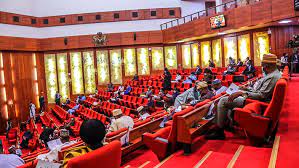
The Nigerian Senate in session
On February 4, 2026, during the clause-by-clause consideration and third reading of the Electoral Act 2022 (Repeal and Reenactment) Amendment Bill 2026, the Senate declined to approve a proposed amendment to Clause 60(3).
The rejected provision would have required presiding officers of the Independent National Electoral Commission (INEC) to electronically transmit polling unit results in real time to the INEC Result Viewing (IReV) portal immediately after Form EC8A was signed, stamped, and countersigned by party agents.
The presiding officer shall transfer the results, including the total number of accredited voters and the results of the ballot.
The chamber instead retained the existing provision from the 2022 Electoral Act, stating that “the presiding officer shall transfer the results, including the total number of accredited voters and the results of the ballot, in a manner as prescribed by the Commission.”
This discretionary wording allows INEC flexibility but leaves room for ambiguity, critics argue, potentially enabling manipulation or disputes.
Senate President Godswill Akpabio defended the decision, insisting the Senate did not scrap electronic transmission entirely but removed the mandatory “real-time” requirement to avoid practical and legal pitfalls.
We can’t mandate real time transmission, there is no network in nine states due to insecurity.
In public statements, Akpabio argued that real-time transmission could invalidate results in areas with poor infrastructure.
He stated: “We can’t mandate real time transmission, there is no network in nine states due to insecurity. The national grid may crash anytime. It’s unfortunate we don’t have the spirit of patriotism.”
Akpabio elaborated that mandating real-time uploads could lead to no valid results in insecure regions or during national grid failures, potentially disenfranchising voters and triggering court challenges.
He emphasized that electronic transmission remains permissible—via phone, iPad, or other devices—but should not be compulsory in a way that ignores Nigeria’s realities.
It’s unfortunate we don’t have the spirit of patriotism.
The remarks triggered immediate backlash, with many Nigerians and commentators labeling them as excuses to weaken transparency. Social media erupted with criticism, accusing the Senate of prioritizing self-interest over democratic integrity.
Prominent governance expert Dr. Sam Amadi, Director of the Abuja School of Social and Political Thought, warned that the Senate’s approach risks plunging Nigeria into a constitutional crisis.
He argued the proposal could deepen public distrust, revive electoral fraud, and destabilize democracy ahead of future elections. Amadi described it as a “déjà vu” moment, referencing the 2022 debates, and stressed that weakening electronic transmission provisions undermines credibility.

INEC official uploads election results during the 2023 elections.
Senator Victor Umeh (Anambra Central) expressed concern that failing to entrench real-time electronic transmission in law would undermine transparency, erode public trust, and invite future election disputes.
Umeh clarified that the Senate had largely agreed to electronic transmission during consultations but noted procedural issues during final readings led to the discretionary wording, disappointing many stakeholders.
The Socio-Economic Rights and Accountability Project (SERAP) petitioned the Code of Conduct Bureau (CCB) to investigate senators allegedly involved in removing electronic transmission provisions without due process or debate.
The petition, dated February 7, 2026, claims the alterations occurred after a majority had voted for inclusion, constituting potential abuse of office. SERAP also urged scrutiny of discrepancies in the Tax Reform Bills, alleging improper changes between passed versions and those signed into law.
If you don’t make electronic transmission of results possible, it means you want an end to this democracy and we will give it to you.
Prince Adewole Adebayo, the Social Democratic Party (SDP) presidential candidate in the 2023 election, delivered a stern rebuke to the National Assembly leadership and President Bola Tinubu. He insisted that blocking mandatory electronic transmission signals an intent to undermine democracy.
“If you don’t make electronic transmission of results possible, it means you want an end to this democracy and we will give it to you,” Adebayo warned.
“If that amendment doesn’t hold, then there will be no elections, and at the termination of your tenure, you will leave the office. This is because it is what the people want.”
The Nigerian Society of Engineers (NSE) endorsed real-time transmission, dismissing the Senate’s objections as “technically flawed and professionally indefensible.”

OccupyNass protesters are protesting at the National Assembly.
In a statement, NSE President Ali Rabiu argued that none of the lawmakers’ concerns; network issues, cybersecurity, or infrastructure had endorsement from competent technical bodies like the NSE.
The group highlighted successful implementations in countries like Estonia and India, asserting that real-time transmission could enhance integrity, efficiency, and credibility while addressing Nigeria’s history of electoral disputes.
The Nigerian Bar Association (NBA) went further, with its National Executive Council (NEC) adopting a report by President Max Afam Osigwe, SAN, at its February 5, 2026, meeting in Maiduguri, Borno State.
The NEC urged the National Assembly to reverse the Senate’s position and pass the amendment to Clause 60(3), making electronic transmission mandatory.
The NBA emphasized that discretionary language weakens transparency, leaves room for manipulation, and erodes public confidence. It described credible elections as the bedrock of constitutional democracy and stressed that technology-backed processes are essential in modern governance.
The Council called on lawmakers to show “legislative responsibility and statesmanship” by supporting the change.
Public anger has manifested online criticizing the Senate for “ducking” reforms with threats of mass action, including protests by labor unions like the Nigeria Labour Congress (NLC), and calls for emergency sessions or boycotts.
The controversy prompted the Senate to schedule an emergency plenary on February February 10, 2026, amid growing pressure.
Read Also: Lives of Rural Villagers Hold Little Value to Authorities in Nigeria – American Missionary
Author

Sign up for The Insight Newsletter
Get in-depth, research and data-based interpretative reports from around Nigeria.