
WEEKLY ROUNDUP: Ceasefire in Iran, Bloodshed in Nigeria
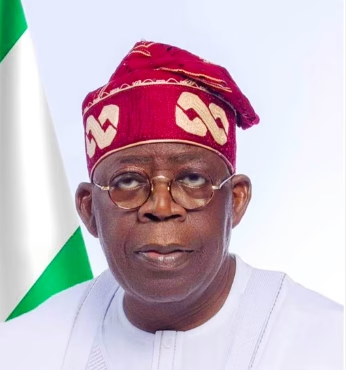
By Emmanuel Kwada
This week, Nigeria witnessed another wave of heartbreaking insecurity as Boko Haram released a disturbing video showing 416 abducted women and children in Borno, with victims desperately begging President Tinubu for rescue. In a shocking development, terrorists killed Brig-Gen. Braimoh, the fifth senior military officer lost in 2026 alone.
Meanwhile, the African Democratic Congress (ADC) descended into deeper crisis as rival factions accused each other of hijacking the party and stormed INEC headquarters in Abuja.
Internationally, the US issued a strong warning by ordering embassy staff departures and placing 23 Nigerian states under “Do Not Travel.” On a lighter global note, easing US-Israel-Iran tensions caused oil prices to drop sharply.
These stories paint a troubling picture of the security, political, and economic challenges facing the nation. Read the full reports for deeper insight into what truly happened this week in Nigeria and beyond.

416 Abducted Women and Children in Borno
Boko Haram Releases Disturbing Video of 416 Abducted Women and Children in Borno as Victims Beg Tinubu for Help
In a shocking propaganda move, a faction of Boko Haram, identified as Jama’atu Ahlis-Sunna Lidda’Awati Wal-Jihad (JAS), has released a video displaying 416 abducted residents from Ngoshe community in Gwoza Local Government Area of Borno State.
The six-minute footage, which surfaced on Thursday, shows mostly women and children, alongside a few men, paraded before the camera. The insurgents claim the captives are alive, healthy, and have not been subjected to torture or sexual harassment.
A group member stated the video was produced at the request of the Borno South Youth Alliance (BOSYA), which has been mediating.
Distressed victims are seen appealing directly to President Bola Tinubu, Vice President Kashim Shettima, and even international figures including U.S. President Donald Trump for urgent intervention and rescue. Many appeared visibly traumatized as they begged for their freedom after more than a month in captivity.
The vehicle failed to start, leaving him stranded.
The Borno South Youth Alliance confirmed the exact figure of 416 abductees and called on the federal government and global partners to engage immediately for their safe return. The abduction from Ngoshe has drawn widespread condemnation, highlighting the persistent threat of insurgency in the Northeast despite ongoing military operations.
Terrorists Kill Fifth Military Senior Officer in 2026: Brig-Gen. Braimoh
In a devastating blow to Nigeria’s counter-terrorism efforts, Brigadier-General Oseni Omoh Braimoh, Brigade Commander in Borno State, was killed on April 9, 2026, during a fierce assault by suspected ISWAP/Boko Haram terrorists on a military base in Benisheikh, Kaga Local Government Area of Borno State.
Military and intelligence sources confirmed that the insurgents overran the position, killing at least 18 troops including the senior officer. Eyewitness and military accounts revealed a harrowing scene: “as the attack intensified with heavy gunfire and explosives, Brig-Gen. Braimoh attempted to manoeuvre out in a bulletproof armoured vehicle for safety and to regroup forces.

Brigadier Gen Braimah
“Tragically, the vehicle failed to start, leaving him stranded. The insurgents captured and executed him on the spot, along with the brigade’s second-in-command, its Imam, and several other officers”.
This incident marks the fifth senior military officer killed by terrorists in 2026 alone, coming barely five months after the November 2025 ambush that claimed Brigadier-General Musa Uba, the highest-ranking officer lost since 2021.
The previous losses include Lieutenant Colonel Umar Farouq, Commanding Officer in Kukawa, Borno State, who was shot during a multi-directional assault on a military camp around March 9, 2026. He sustained critical injuries but died while being evacuated to Maiduguri for treatment.
Are armoured vehicles properly maintained?
In the same period, Lieutenant Colonel S.I. Iliyasu, Commanding Officer of 222 Battalion in Konduga, was killed when terrorists overran positions in a coordinated night attack that hit multiple bases between late March 6 and early March 7.
On March 1, 2026, Major Umar Ibrahim Mairiga, commander of a Forward Operations Base in Mayenti, Bama LGA, was killed along with three soldiers and a local hunter when Boko Haram struck the exposed position.
Earlier, on January 27, 2026, a newly promoted Lieutenant Colonel Mohammed and six soldiers were ambushed and killed by ISWAP near Damasak in Mobbar LGA while on patrol along the Maiduguri-Damasak route.
For ordinary Nigerians, this tragedy exposes the terrible reality of the ongoing insurgency. A one-star general – a highly trained strategist responsible for commanding hundreds of troops and securing vast territories – could not escape due to basic mechanical failure in critical equipment.
It raises serious questions about the state of military logistics: Are armoured vehicles properly maintained? Are supply chains for spare parts and fuel reliable in active combat zones? Low troop morale, reported leadership gaps, and repeated successful overruns of “well-defended” bases suggest deeper systemic issues that go beyond individual bravery.
President Bola Tinubu described the attack as a sign of “desperation” by insurgents suffering losses elsewhere and vowed to crush terrorism. Yet for families of fallen soldiers and millions of citizens in Borno, Yobe, and Adamawa who live under constant threat, such assurances ring hollow amid recurring headlines of ambushes, base attacks, and mounting casualties.

Lieutenant Colonel Mohammed
The death of Brig-Gen. Braimoh is not just the loss of one gallant officer; it symbolises how insecurity continues to erode national defence from the top. Without urgent fixes in equipment readiness, intelligence, and welfare of fighting troops, the cycle of sacrifice without decisive victory risks further demoralising the military and endangering civilian lives.
Nigerians deserve a security architecture that protects those who protect us – before more senior officers and ordinary soldiers pay the ultimate price.
ADC Leadership Crisis Deepens: Rival Factions Trade Accusations of Hijack, Storm INEC in Abuja
The African Democratic Congress (ADC), once touted as a potential platform for a formidable opposition coalition ahead of future elections, is plunging deeper into chaos as rival factions openly accuse each other of hijacking the party in defiance of its constitution.

Hon Leke Abejide and Nafiu Bala Gombe
On Thursday, April 9, 2026, a faction led by Nafiu Bala Gombe accompanied by Kogi State lawmaker Hon. Leke Abejide and hundreds of supporters, stormed the headquarters of the Independent National Electoral Commission (INEC) in Abuja.
The protesters demanded formal recognition of Gombe as the authentic National Chairman, insisting that the rival group led by former Senate President Senator David Mark is attempting to seize control of the party without following due process or internal democratic procedures.
They described the Mark-led faction as “hijackers” and urged INEC to revert to the status quo ante bellum as ordered by the Court of Appeal. “How do you come into a party and attempt to hijack its leadership on the same day?” Gombe’s camp queried, warning that such actions undermine democracy.
The protest came barely 24 hours after the Mark-led faction, which includes prominent opposition figures like Atiku Abubakar, Peter Obi, Rotimi Amaechi, Rauf Aregbesola, and Rabiu Kwankwaso, staged its own high-profile demonstration tagged #OccupyINEC.
That group accused INEC of bias and undermining the party’s internal leadership following the commission’s decision to delist the Mark-led National Working Committee.
A third faction, comprising several state chairmen and backed by 2023 presidential candidate Dumebi Kachikwu, has also emerged. It rejects both camps, accuses them of hijacking the party from original members, and has announced an interim leadership while endorsing INEC’s stance.
Embassy in Abuja will remain open but with significantly limited capacity to provide consular services.
For ordinary Nigerians, this unfolding drama is deeply concerning. With less than a month to critical deadlines for party registration and primaries, the ADC’s inability to resolve its leadership tussle risks weakening the opposition voice at a time when many citizens yearn for a credible alternative to the ruling party.
The repeated scenes of politicians and supporters besieging INEC not only erode public confidence in opposition politics but also raise questions about the maturity of Nigeria’s democratic institutions.
As factions continue to battle in the streets and courts, the big loser remains the Nigerian electorate, who deserve a stable, united opposition capable of holding power to account rather than endless internal power struggles.
Meanwhile, the Nigerian Bar Association (NBA) has warned lawyers against misusing the courts to truncate Nigeria’s democracy. In a strongly worded press release signed by its National President, Mazi Afam Osigwe, SAN, on Friday, the NBA cautioned legal practitioners to uphold the integrity of the judiciary and avoid filing frivolous cases aimed at undermining democratic processes.
US Orders Embassy Staff to Leave Nigeria, Flags 23 States as ‘Do Not Travel’ Amid Soaring Insecurity
The United States has escalated its security concerns over Nigeria, authorising the voluntary departure of non-emergency US government employees and their families from the Embassy in Abuja due to the rapidly deteriorating security situation.
The Consulate in Lagos will continue routine operations.
In an updated travel advisory issued on April 8, 2026, the US Department of State maintained Nigeria at Level 3: Reconsider Travel, citing widespread risks of terrorism, kidnapping, violent crime, civil unrest, and limited healthcare services. However, it expanded the strictest Level 4: Do Not Travel category to 23 states, adding Plateau, Jigawa, Kwara, Niger, and Taraba to the list.
These states join others including Borno, Yobe, Kaduna, Kano, Zamfara, Sokoto, Abia, Anambra, Imo, and parts of Adamawa and Rivers (excluding Port Harcourt), where threats of banditry, insurgency, and armed attacks remain severe.
The Embassy in Abuja will remain open but with significantly limited capacity to provide consular services. The Consulate in Lagos will continue routine operations.
This development is a sobering international verdict for millions of Nigerians on the nation’s worsening insecurity, which has now spilled into previously calmer states.
While the Federal Government described the move as a routine precaution, the advisory underscores how safety concerns are forcing even diplomatic missions to scale down operations, sending a clear signal that no part of the country is entirely immune from the escalating threats.
US-Israel-Iran Tensions Ease as Oil Prices Drop Sharply
Global markets breathed a sigh of relief this week as tensions between the United States, Israel, and Iran began to lessen following a fragile two-week ceasefire agreement.
The strait had been largely blocked during the conflict, triggering sharp spikes in energy costs worldwide.
The deal, announced on April 7-8, 2026, by President Donald Trump and confirmed by Iranian officials, includes safe passage for oil tankers through the Strait of Hormuz; a vital waterway that carries about 20% of the world’s oil supply. The strait had been largely blocked during the conflict, triggering sharp spikes in energy costs worldwide.
In response, oil prices plunged dramatically. Brent crude, the global benchmark, fell by over 13% to around $94.75 per barrel, while US West Texas Intermediate (WTI) dropped more than 16% to about $94.41 – marking one of the biggest single-day declines in years.
For ordinary Nigerians and consumers globally, this drop offers hope for lower fuel prices at the pump in the coming weeks, provided the ceasefire holds. However, analysts warn that full normalisation could take months, as shipping resumes slowly and a “risk premium” remains due to ongoing uncertainties, including Israeli actions in Lebanon that have strained the agreement.

The temporary de-escalation comes after weeks of intense fighting that began in late February with US and Israeli strikes on Iranian targets. While the ceasefire brings short-term calm, experts say lasting peace depends on further negotiations to address deeper issues like Iran’s nuclear programme and regional security.
As markets rally on hopes of restored oil flows, Nigerians watching petrol and diesel costs will be closely monitoring whether this fragile truce translates into real relief at filling stations. The situation remains delicate, but the falling oil prices signal that even limited peace in the Middle East can quickly ease pressure on global energy markets.
Read Also: Over 100 killed During 2026 Easter
Author

Sign up for The Insight Newsletter
Get in-depth, research and data-based interpretative reports from around Nigeria.