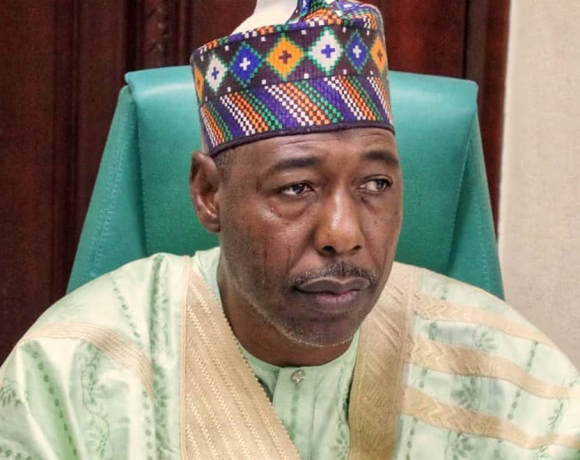
Sultan Abubakar’s Burden and the Herdsmen Crisis

Key Points:
- Former President Muhammadu Buhari, a Fulani cattle owner, was expected to address the farmer-herder conflict but failed to do so effectively
- Other influential Fulani leaders, including General Aliyu Gusau and NSA Nuhu Ribadu, have not taken decisive action to curb violence associated with Fulani militias.
- Groups like Miyetti Allah Cattle Breeders Association of Nigeria (MACBAN) often contextualize rather than outright condemn violence.
- His Eminence, Alhaji Sa’ad Abubakar, has focused on criticizing social media rather than addressing Fulani-associated violence.
- Over the past 20 years, Fulani militias have been implicated in acts of violence, including kidnappings, killings, and attacks on various communities across Nigeria.
By Abubakar Adam Ibrahim
After my column a fortnight ago, in which I partly decried the status of the Fulani in today’s Nigeria—having regressed from the friendly herders we remembered in the not-too-distant past to whatever they have become now—I thought it appropriate to write about the complicity of Fulani leaders in this decline.

An Illustration of a Fulani herder
In today’s Nigeria, individuals of Fulani descent have held key positions in the country. Most notably, Muhammadu Buhari, a Fulani cattle owner himself, was expected to address the farmer-herder conflict and the increased brigandry attributed to herders decisively during his presidency from 2015 to 2023. It is safe to say those expectations were massively deflated.
His RUGA scheme was poorly conceived and lacked the political will to follow through. It got so bad that on May 25, 2023, as Buhari was packing to leave the villa, Baba Usman Ngelzarma, the president of the Miyetti Allah Cattle Breeders Association, MACBAN, proclaimed that even the cattle breeders “never had it so bad like when Buhari was in government.”
His RUGA scheme was poorly conceived and lacked the political will to follow through
Auwal Gonga, the Vice President of the Nigerian chapter of the Tabital Puulaku International at the same event, proclaimed that “Buhari has never called us as pastoralists, and we are here; we have intellectuals including professors, ministers, and he has never contacted us, and that is why they have failed.”
For most Nigerians, it was a missed opportunity to address the problem through the leadership of someone who could, to borrow his own words, “speak a language they could understand.”

An Illustration of Former President Muhammadu Buhari in his farm
Buhari is not the only prominent Fulani leader to pass up the chance to address the problem. Nigerians like General Aliyu Gusau, a former National Security Adviser and now a prominent political kingpin in the bandits-ridden Northwest, have remained silent while the region burns from this conflict with the Fulani at its heart.
To his credit, the current NSA, Nuhu Ribadu, himself a Fulani man, attended a 2018 conflict resolution summit on the farmers/herders conflict. However, at the event, he made an impassioned speech decrying the marginalisation of the nomadic population of the country, saying that they benefit nothing from Nigeria. That statement is also true of most ethnic nationalities in the country who have gained nothing from Nigeria.
Never had it so bad like when Buhari was in government.
Since he was appointed NSA, though, Ribadu has not publicly deviated from those claims and has not challenged the herders and their militias in a manner that would compel them to rein in the killings attributed to these groups. The Minister of Defence, Mohammed Badaru Abubakar had in 2021 made similar claims, blaming the herdsmen violence on injustices done to them, while he was still governor of Jigawa. As minister though, he has so far failed to address this injustice and end the violence.

An Illustration of Mallam Nuhu Ribadu, NSA
Political appointment or otherwise, no single Fulani leader holds greater religious, cultural, and symbolic significance than His Eminence, the Sultan of Sokoto, Alhaji Sa’ad Abubakar. Therefore, none of their silences and deflections have resonated more than his.
Recently, while speaking at a public event, His Eminence branded social media as “terrorist organisations” that security agencies need to address. He strongly condemned the dangers of social media and the urgency to curtail it. These comments by His Eminence, the Sultan, came in the same week that Fulani militias have been accused of genocidal crimes in Plateau and Benue.
“Social media is a terrorist organisation that we must deal with. Security agencies must deal with this terrorist organisation called social media.”
Alhaji Muhammadu Sa’adu Abubakar III, Sultan of Sokoto, says security agencies must treat social media as a serious threat. pic.twitter.com/kPn6NxGmoX
— News Central TV (@NewsCentralTV) April 16, 2025
The irony is that the leader of Nigeria’s Muslims, who also happens to be the head of the Fulani clan, chooses to point fingers at social media as a terrorist organisation, overlooking the armed Fulani militias and gangs that have allegedly been terrorising much of the country.
Over the last 20 years, Fulani ethnic militias have engaged farmers and the general population of Nigeria in a war of attrition—most often with genocidal acts being perpetrated by these militias, as we witnessed recently in Plateau and Benue. This is not to mention the heinous crimes the herdsmen have been accused of committing in the Northwest, where hundreds of farmers, villagers, and travellers have been abducted for ransom, abused, tortured, dehumanised, and murdered. Thousands of women in the region have been violated by these men.
Each time the identities of these criminals are revealed to be Fulani.
Each time the identities of these criminals are revealed to be Fulani, we see the pan-Fulani group, Miyetti Allah Cattle Breeders Association of Nigeria (MACBAN), defending its members while reminding everyone of the injustices done to their clansmen, for which they would be justified in seeking retaliation. MACBAN’s priority seems to be to contextualise the violence the herdsmen are accused of, rather than sincerely denounce it.
It just so happens that the chairman of the board of trustees of Miyetti Allah is none other than His Eminence, the Sultan himself. While as a Fulani man he seeks to advance the interests of his tribesmen, his position as their leader and as the leader of Nigeria’s Muslim population places upon him a greater responsibility to foster peaceful co-existence between the people and rein in the excesses of the ethnic militias. His position obliges him to call his clansmen to order to stop the bloodshed, terror, and fear that have become associated with the Fulani tribe.
Stop blaming Fulani for every attack or “stop stereotyping Fulani. Nothing about stop killing Nigerians.
While Nigerians have always had a penchant for exaggeration and stereotyping, it is no exaggeration to say that the majority of the bandits in the wild—those killing Muslims in the Northwest, in Kebbi, Zamfara, Katsina, and other states; the militias killing Christians in Benue, Plateau, and other areas; and those kidnapping anyone in sight across the country—are mostly Fulani. If in doubt, ask any survivors of these murderous gangs or look at the hundreds of videos the bandits themselves post on social media or the many interviews the gang leaders grant, in which their identities are not only obvious but are presented by them as justification for their crimes.
If we were to tally the casualties of Boko Haram, the internationally recognised terror group, over the last 15 years, I doubt the numbers would compare to the casualties attributed to herdsmen in the same period.

An Illustration of Muhammadu Sa’ad Abubakar III, Sultan of Sokoto
Yet, I am not aware of what the Sultan has done in private, away from the flashing lights of the cameras, to call his tribesmen to order and address these murderous rampages. What is available in the public domain are his repeated calls at various functions for people to “stop blaming Fulani for every attack” or “stop stereotyping Fulani.” Nothing about “stop killing Nigerians.”
His Eminence could have exercised the influence of his position to organise outreach programmes and sensitisation campaigns to address the herders, steer them away from crime and genocidal violence, and encourage the establishment and attendance of nomadic and religious schools. Most crucially, they need to be educated on the realities and dynamics of life in Nigeria today in relation to the herders’ way of life.
The tree that will not bend to the wind will not last the storm.
The times are changing, and it is increasingly clear that not only the herders but everyone must adapt to live a fulfilled life in which tolerance and respect for all are paramount, one in which the sanctity of life is upheld. The Sultan’s duty, and that of MACBAN, is not to attempt to compel the times to devolve into a period that has long passed, but to help them transition. To insist on retaining that way of life, at such enormous cost to all, is suicidal. As the Chinese say, the tree that will not bend to the wind will not last the storm.
Deflecting blame is not a strategy that will serve the Fulani interest. To focus on social media and not on the Fulani militia and bandits is a gross misapplication of the term. It has unequivocally drawn attention to the Sultan’s lack of chastisement of his murderous clansmen. Above all, it calls into question, in ways that are even more apparent now, what legacy the Sultan wants to leave behind. Does he want to be remembered as the Sultan who stopped the bloodletting of the bandits, or the Sultan under whose reign his kinsmen went completely berserk while he watched from his throne?
What legacy the Sultan wants to leave behind?
Read Also: 3 Killed, 8 Injured in Adamawa State Farmers-Herders Clash
There is nothing golden about the Sultan’s silence on this bloodletting, nor is there wisdom in trying to deflect attention to something else. The activities of these bandits and militias are tarnishing the reputation not only of the Fulani tribe but of Muslims as a whole, considering the religious dimensions of the situation. In his position, the Sultan should be concerned about the damage being done to the victims, both Muslims and non-Muslims, and the harm being inflicted on the tribe and religion he leads.
Does he want to be remembered as the Sultan who stopped the bloodletting of the bandits?
His Eminence the Sultan needs to decide if he wants his legacy to be as the Sultan who called for order and worked to end this bloodshed, or as the Sultan of the pariah clan? Will his be a song for the Sultan who quelled the madness, or will it be an elegy for the quiet king who watched as his kinsmen burned and ravaged?
Read Also: Data: Now, herdsmen shed more blood than bandits and terrorists
Author

Sign up for The Insight Newsletter
Get in-depth, research and data-based interpretative reports from around Nigeria.