Why the North Falls Behind Southern States in UTME Performance
…Scoring 350+ in UTME Isn’t Luck: Why the North Trails in Nigeria’s Regional Gaps
By Emmanuel Kwada
Every year, the release of the Joint Admissions and Matriculation Board (JAMB) Unified Tertiary Matriculation Examination (UTME) results sparks national conversation about academic excellence, access, and equity in Nigeria’s education system. An analysis of the official top performers from 2023 to 2026 reveals a clear and persistent regional pattern: Southern states, particularly from the South-East, South-West, and South-South, continue to dominate the highest score brackets, while Northern representation remains limited to a few notable outliers.
The Geography of High Performance
A review of the top scorers across the four years shows heavy concentration in a handful of Southern states. Below is the breakdown by state of origin:
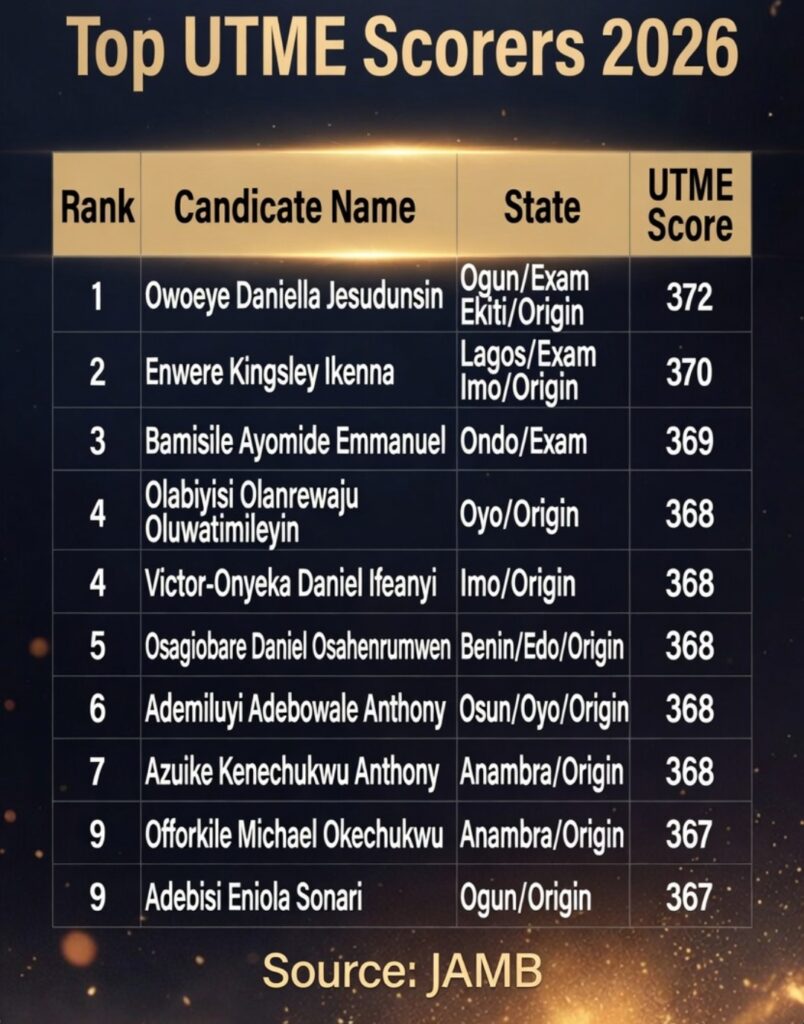
In 2026, Owoeye Daniella Jesudunsin from Ekiti State, based in Ogun State, topped the table with 372, as seen in the table above, and was immediately followed by Enwere Kingsley Ikenna from Imo State with 370, with no northern states in the top ten.
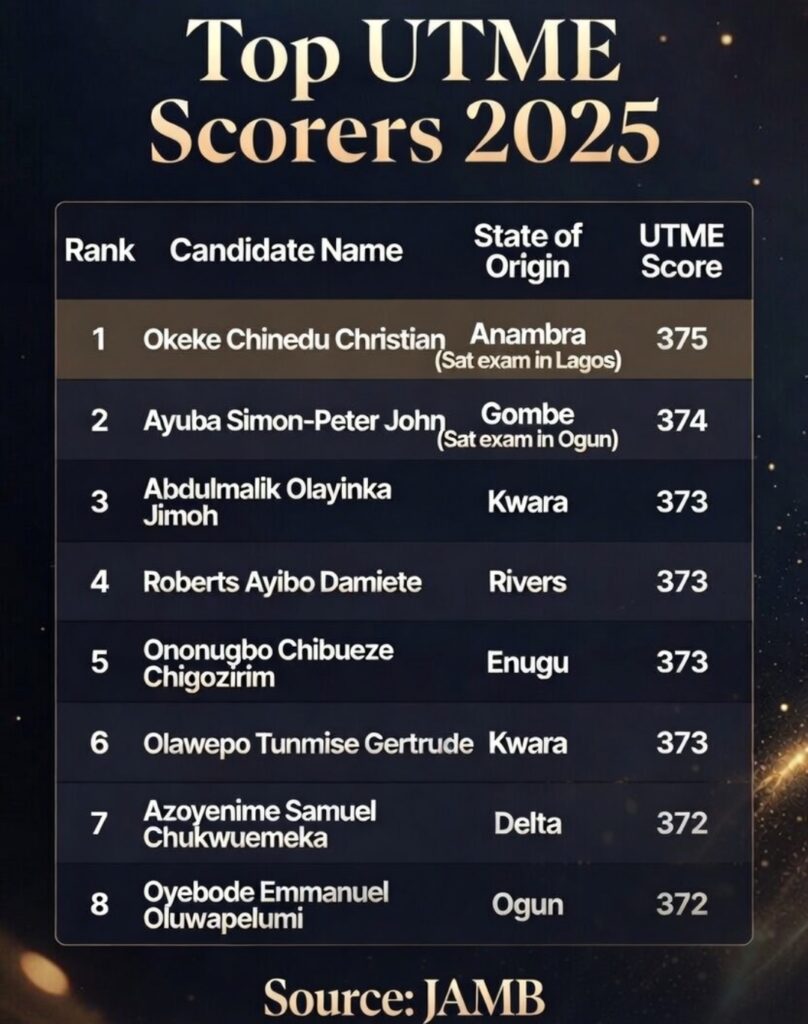
In 2025, Anambra State emerged at the top of the rankings, with Okeke Chinedu Christian scoring an impressive 375. Interestingly, the only northern state to break into the top positions was Gombe State, where Ayuba Simon-Peter John scored 374 to place second, while the dominance of southern states continued across the rankings.
This development comes as Tunji Alausa, the Minister of Education, revealed that the North-East and North-West regions still record the lowest literacy and numeracy rates in the country despite receiving 80 per cent of Nigeria’s education donor funding over the past decade.
Alausa, who spoke through his Special Adviser on Media and Communication, Ikharo Attah, made the disclosure on Monday at the Education World Forum in London, where he engaged education ministers and global stakeholders on Nigeria’s foundational learning reforms.
North-East and North-West regions still record the lowest literacy and numeracy rates in the country despite receiving 80 per cent of Nigeria’s education donor funding.
According to the minister, the federal government now has credible data to guide the more effective allocation of educational resources. He explained that findings from NEDI showed that although 80 per cent of donor funding in the last decade was channelled to the North-West and North-East, the regions still posted the weakest literacy and numeracy outcomes nationwide.
He added that the government would now focus on redirecting resources to areas where they can deliver measurable results. Alausa also disclosed plans to increase the Universal Basic Education Commission (UBEC) share of the consolidated revenue fund from two per cent to four per cent as part of efforts to strengthen basic education across the country.
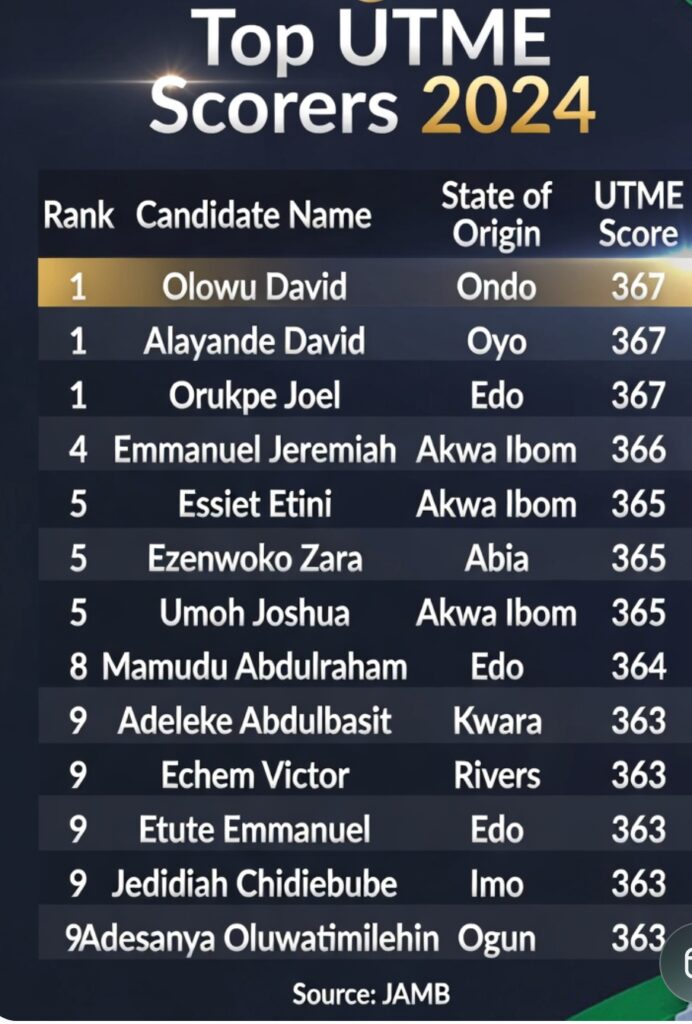
In 2024, Ondo State topped the chart, with Olowu David scoring 367, while its South-West counterpart, Oyo State, came second as Alayande David also recorded 367. The trend continued with other southern states dominating the rankings, with no northern state appearing in the top ten, as shown in the table above.
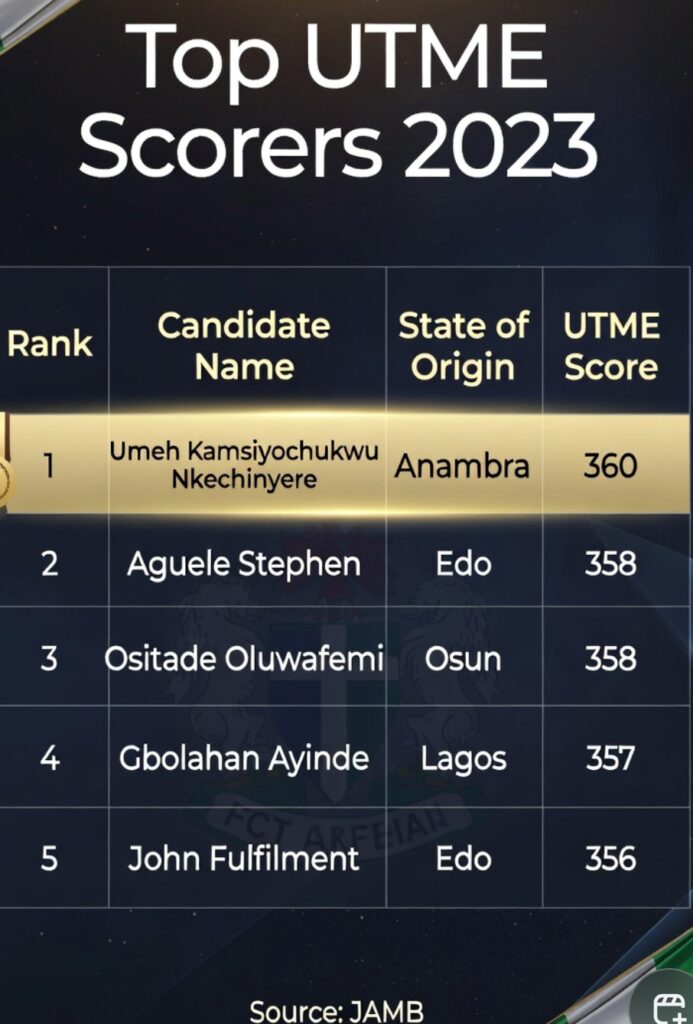
In 2023, Anambra State came first, with Umeh Kamsiyochukwu Nkechinyere scoring 360, while Edo State followed closely in second place through Aguele Stephen, who scored 358, as shown in the table above.
Across the four years, states such as Anambra State, Imo State, Edo State, Ogun State, Oyo State, and Ondo State consistently produced candidates who scored 365 and above, with Anambra and Edo frequently occupying the top positions. In contrast, northern states appeared only occasionally, with notable performances from Gombe State, which recorded a score of 374 in 2025, and Kwara State, which produced multiple high scores of 373 and 363.
Why the North Trails: Experts Speak
Educationists and academics attribute the regional disparities not to inherent differences in student ability but to deep-rooted systemic and socio-cultural factors.
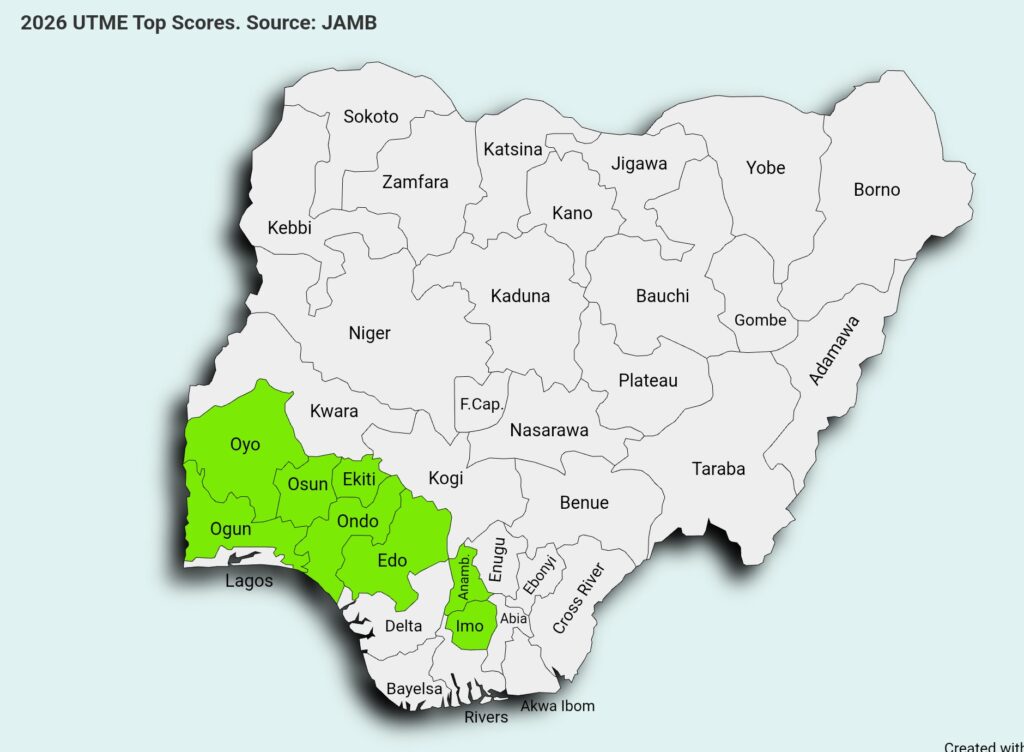
The southern states, highlighted in green on the Nigerian map, dominated the list of top-performing states in the UTME rankings.
Ataka Elisha, Head of the Science Department at Crest International Schools, Mararaba, said many brilliant students exist in Northern Nigeria, poor monitoring, inadequate infrastructure and limited exposure to technology often hinder their performance in computer-based examinations. She stressed that a solid foundation and deliberate preparation remain the real drivers of success.
“There are many brilliant students in the North, but they lack proper monitoring, infrastructure and equipment. Students cannot learn everything in class; they must be monitored at home,” she said.
Elisha noted that Northern students are naturally brilliant but often become intimidated when faced with digital tools.
“When you compare their performance in WAEC, which is still written manually, you will see they do very well,” she added.
She explained that scoring above 350 in JAMB is rarely by chance. According to her, top performers succeed through strategy: they master the CBT environment early, stick strictly to the JAMB syllabus and prescribed novel, analyse past questions deeply, and follow rigorous, timed revision schedules.
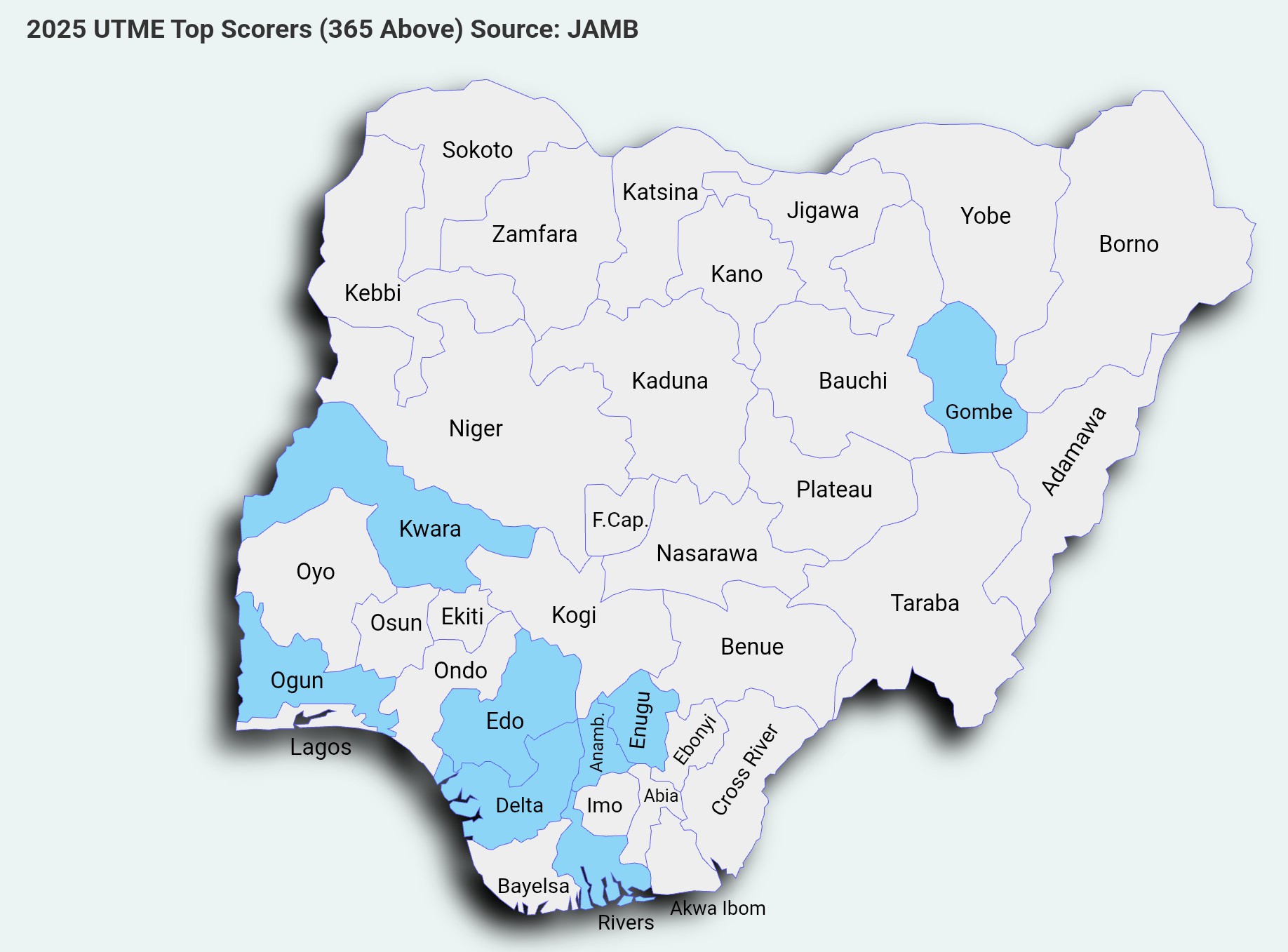
The southern states, highlighted in blue on the Nigerian map, dominated the list of top-performing states in the UTME rankings, with Gombe State managing to come second in 2025.
Dr. Aliyu Ahmed Tanko, Senior Lecturer in the Department of Business Administration and Entrepreneurship at Baba-Ahmed University, Kano, stated: “The disparity is largely due to differences in educational access, quality of teaching, and socio-cultural factors. Southern states tend to have stronger educational traditions, better school infrastructure and higher parental expectations regarding tertiary education. In parts of Northern Nigeria, challenges such as poverty, insecurity, early marriage, and lower school enrollment rates can negatively affect students’ academic performance.”
On the interplay between school quality and family attitudes, Dr. Tanko added: “Both factors are important and closely linked. School quality — qualified teachers, learning materials, and effective supervision — directly influences student achievement. At the same time, family and community attitudes toward education shape students’ motivation and commitment. Where parents and communities strongly value education, students are more likely to perform better.”
He emphasised funding challenges: “Inadequate funding and poor infrastructure are major contributors. Many schools lack classrooms, laboratories, libraries, ICT facilities and qualified teachers.”
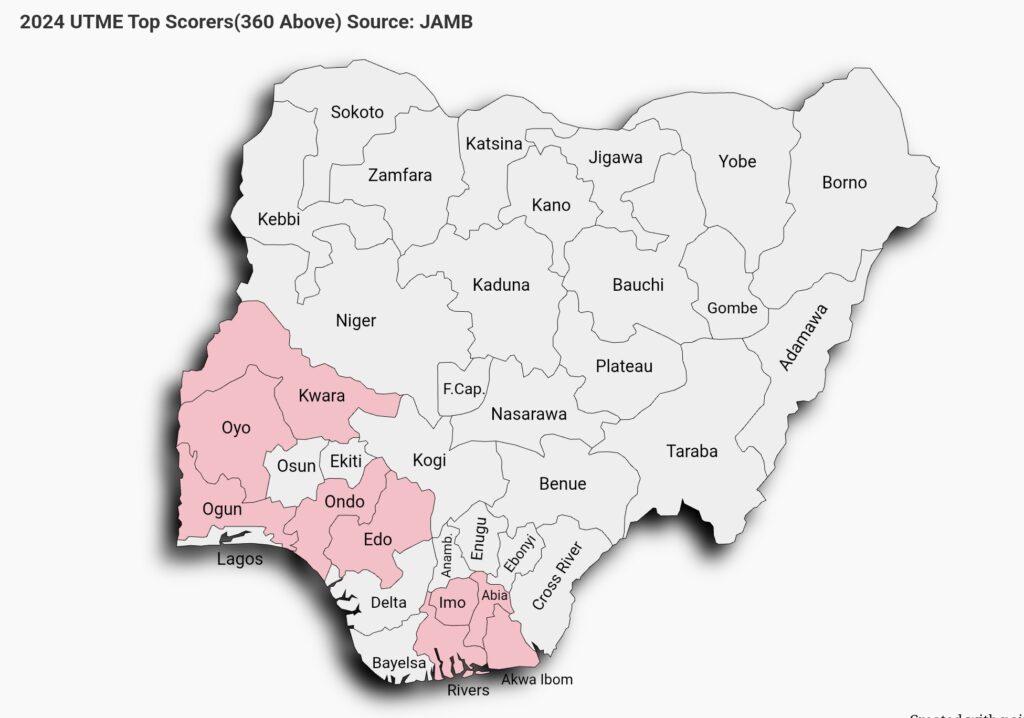
The southern states, highlighted in pink on the Nigerian map, dominated the list of top-performing states in the UTME rankings.
Mr. Ojonimi Ameh, academic staff, Nasarawa State polytechnic, attributed the consistent emergence of top scorers from the South-East and South-West “to a stronger educational culture, the presence of quality schools and teachers, generations of educated families, better-resourced private schools predominantly located in the South, higher literacy rates, strong household support for exam preparation, and minimal disruptions to schooling from poverty, conflict, early marriage, or displacement.”
He noted that Southern schools typically have “qualified teachers, equipped classrooms and laboratories, quality textbooks, better student-teacher ratios, and more stable calendars,” while many Northern schools, especially rural ones, face “higher ratios, unqualified or poorly motivated teachers, inadequate infrastructure, and unstable calendars.” Family and community attitudes further reinforce this, as Southern parents “closely monitor their children’s progress, encourage serious study for university degrees, and communities celebrate academic achievements.”
Mr. Ajino Mathew Kehinde, Principal of Samvic Royal Schools in Igwuruta, Rivers State, explained that higher scores from the South “stem mainly from better access to functional CBT centers, stable electricity, fewer exam disruptions, consistent schooling without frequent closures due to insecurity, and early student exposure to English and digital tools.”
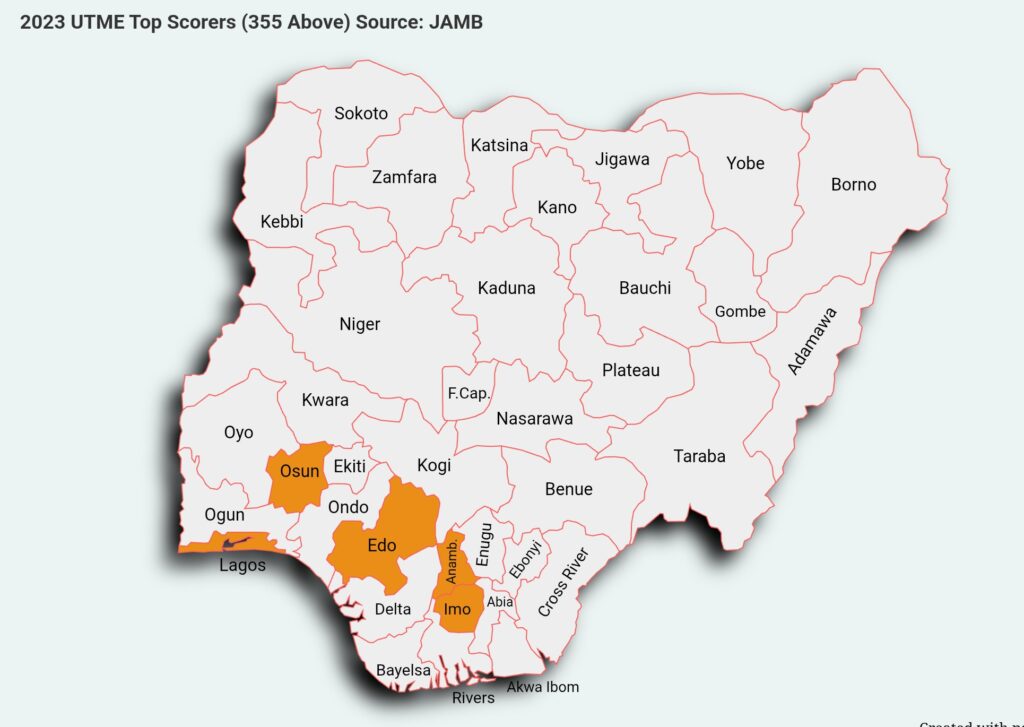
The southern states, highlighted in yellow on the Nigerian map, dominated the list of top-performing states in the UTME rankings.
He estimated that “school factors like qualified teachers, syllabus coverage, textbooks, labs, and CBT practice account for about 60 percent of the performance gap while family and community attitudes toward attendance, homework, and the value of education make up the remaining 40 percent.”
Isaac Ochoche Godwin, a lecturer based in Nasarawa acknowledged the existence of quality schools in parts of the North but attributed the performance gap as follows: school factors contribute only 5 percent, teachers 20 percent, learning materials 20 percent, family attitudes 25 percent, and community factors the highest at 30 percent.
Read Also: Five colours of UTME candidates
An anonymous professor from the University of Abuja attributed the relatively poor performance of many Northern students in the UTME primarily to weak foundational education at the primary and secondary levels, which forms the bedrock of effective learning.
He identified four key contributing factors. First, the shortage of quality teachers remains a major challenge. In many Northern schools, teaching has become an unattractive profession, often taken up by individuals who could not secure other employment. These teachers are generally poorly remunerated, leading to low morale and limited commitment. Consequently, a significant number lack depth in their subject knowledge and struggle with basic competencies, such as clear communication and sentence construction.
Second, inadequate infrastructure hampers effective teaching and learning. Many schools in the North lack essential facilities, including functional computer laboratories and well-equipped science practical labs. Where such facilities exist, they are frequently outdated or staffed by unqualified personnel. The professor noted that Northern elites often prioritize political spending over investments in education. In contrast, the South benefits from better-resourced government schools and a competitive private school system that helps drive higher standards.
Poverty, insecurity, early marriage, and lower school enrollment rates can negatively affect students’ academic performance.
Third, there is a generally weak culture of learning in several parts of the North. Many students attend school with minimal engagement or aspiration for academic excellence. It is not uncommon to encounter senior secondary students who lack basic digital skills, such as operating a computer, partly because parents do not prioritize such tools or additional learning opportunities. In the South, even young pupils in nursery classes are typically computer-literate. Given that the UTME is computer-based, students without these foundational digital skills often lose valuable time navigating the examination interface, even when familiar with the subject matter.
Fourth, persistent insecurity has significantly disrupted education across the North. Recurrent attacks by bandits, insurgents, and other criminal elements have resulted in prolonged school closures. This environment of fear affects both students and teachers, leading to irregular academic calendars, reduced attendance, and psychological trauma that impairs concentration and overall learning outcomes.
Northern elites often prioritize political spending over investments in education.
While Southern states currently lead in producing top UTME performers, educationists agree that targeted interventions can narrow the gap. Recommendations include increased and accountable funding, teacher recruitment and training, infrastructure development (especially ICT and labs), improved security for schools, expanded CBT centers, and community sensitization by traditional and religious leaders to promote education, particularly for girls.
Closing Nigeria’s educational regional divides will require sustained collaboration among governments, communities, private sector, and NGOs. As the data from 2023–2026 shows, excellence is achievable where the right systems, support, and mindsets align. The challenge now is replicating those conditions more equitably across the country.
Read Also: Nigeria This Week: 2027 Elections: Governors impose candidates and call it ‘consensus’
Author

Sign up for The Insight Newsletter
Get in-depth, research and data-based interpretative reports from around Nigeria.