
56 YEARS LATER : Lassa Fever Continues to Haunt Nigeria, with Ondo State Topping the Chart
By Emmanuel Kwada
It has been 56 years since Lassa fever was first identified in Nigeria, in the town of Lassa, in the former North-Eastern State, now known as Borno State. The disease was discovered by a missionary nurse, Laura Wine, who reported a mysterious illness that was affecting people in the area, with the first cases reported in January 1969. The disease was later confirmed by laboratory tests in March 1969, and the initial outbreak resulted in 12 reported cases, with 6 deaths.

Laura Wine, the missionary nurse posted to the town of Lassa in Borno State. Photo Credit: Brethren Historical Library & Archives
Nigeria’s trend with the disease has been fluctuating, and Ondo state has consistently been at the top of the country’s chart. The state government has reported that the disease has resulted in 12 deaths, with 112 confirmed cases and 353 reported infections.
Additionally, Dr. Adeniran Ikuomola, the Permanent Secretary of the Ministry of Health, has disclosed that nearly , 400 suspected cases have been recorded. According to the Nigeria Centre for Disease Control (NCDC), Ondo state has the highest number of cases, with 1,444 suspected cases, 634 confirmed cases, and 114 deaths, making up 37% of all confirmed cases. Edo state is second, with 1,243 suspected cases, 543 confirmed cases, and 94 deaths, accounting for 21% of all confirmed cases, while Bauchi state is third, with 644 suspected cases, 274 confirmed cases, and 49 deaths, accounting for 17% of all confirmed cases.
There has been a decline in confirmed Lassa fever cases, with 76 confirmed cases reported between January 20 and January 26, 2025
The NCDC report shows that, there has been a decline in confirmed Lassa fever cases, with 76 confirmed cases reported between January 20 and January 26, 2025. The cumulative data for 2025 indicates 290 confirmed cases and 1,171 suspected cases across 10 states, with a case fatality rate of 18.3%. The top three states affected are Ondo, Edo, and Bauchi, accounting for 75% of all confirmed cases.
Epidemiological Data
In week 4 of 2025, the number of new confirmed cases decreased from 71 in the previous week to 76, with cases reported in Ondo, Taraba, Edo, Bauchi, Ebonyi, Kogi, Nasarawa, and Gombe States. Cumulatively, 53 deaths have been reported, with a case fatality rate of 18.3%, which is lower than the 18.6% reported for the same period in 2024.
Ondo state has consistently been at the top of the country’s chart with 12 deaths, 112 confirmed cases in 2025
The disease has affected 54 local government areas across the country, with the predominant age group being 21-30 years. The male-to-female ratio for confirmed cases is nearly equal, at 1:0.9. The NCDC has activated a national Lassa fever multi-partner, multi-sectoral Incident Management System (IMS) to coordinate response activities at all levels.

Training of NCDC National Reference Lab Team on diagnosis for Lassa in 2016. PHOTO Credit: NCDC
The NCDC has deployed National Rapid Response Teams to support the response efforts in affected states. The agency has also conducted risk communication and community engagement in affected areas, and enhanced surveillance and contact tracing efforts. Healthcare workers have been trained in case management in high-burden states, and Lassa fever treatment centers have been equipped with essential response commodities.
Despite the decline in new cases, the death toll continues to rise, and the NCDC is concerned about the rising number of fatalities. The agency attributes this increase to late presentations of cases, poor health-seeking behavior, and inadequate environmental sanitation in high-burden communities.
The NCDC outlines significant challenges, including a lack of awareness in high-risk communities and delayed case reporting, which continue to hinder effective outbreak control. The agency urges Nigerians to remain vigilant and adopt preventive measures, such as maintaining proper hygiene, storing food correctly to avoid contamination by rodents, and seeking medical attention promptly if symptoms occur.
According to the World Health Organisation, prevention of Lassa fever relies on promoting good “community hygiene” to discourage rodents from entering homes.
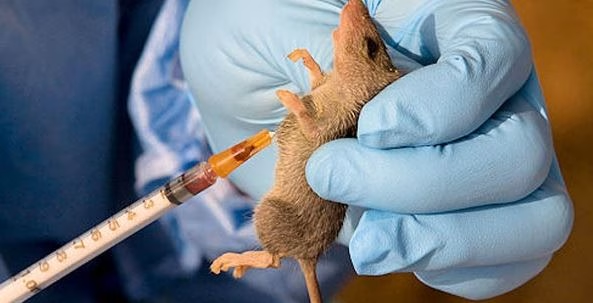
Mastomys rats are so abundant in endemic areas, it is not possible to eliminate them from the environment
“Effective measures include storing foodstuffs in rodent-proof containers, disposing of garbage far from the home, maintaining clean households, and keeping cats.
“Because Mastomys rats are so abundant in endemic areas, it is not possible to eliminate them from the environment. Family members should always be careful to avoid contact with blood and body fluids while caring for sick persons.
“In health-care settings, staff should also always apply standard infection prevention and control precautions when caring for patients, regardless of their presumed diagnosis.
“These include basic hand hygiene, respiratory hygiene, use of personal protective equipment (to block splashes or other contacts with infected materials), safe injection practices, and safe burial practices.
Health-care workers should wear face protection
“Health-care workers caring for patients with suspected or confirmed Lassa fever should apply extra infection control measures to prevent contact with the patient’s blood and body fluids and contaminated surfaces or materials such as clothing and bedding.
“When in close contact (within 1 metre) of patients with Lassa fever, health-care workers should wear face protection (a face shield or a medical mask and goggles), a clean, non-sterile long-sleeved gown, and gloves (sterile gloves for some procedures),” WHO said.
Lassa fever remains a persistent public health concern in Nigeria, with a significant impact on the health and wellbeing of Nigerians. The NCDC and other stakeholders must continue to work together to strengthen surveillance, improve case management, and enhance community awareness to reduce the risk of transmission. With the support of all Nigerians, it is possible to control the spread of Lassa fever and reduce the number of deaths associated with the disease.
Read Also:Kidnapping Epidemic: NYSC Corps Members Bearing the Brunt
Author

Sign up for The Insight Newsletter
Get in-depth, research and data-based interpretative reports from around Nigeria.


