
Muhammadu Buhari (1942-2025): Exit of a Fortunate Nigerian Leader

Theophilus Abbah
Former President Muhammadu Buhari, a retired Major General of the Nigerian Army, who died in London on Sunday, July 13, 2025, may be described as one Nigerian leader who survived and ruled on the wave of good fortune. No doubt, he recognized that his ‘chi’ was alive and well, and cracked several difficult nuts for him – from birth to death. After he won the 2015 presidential election, Buhari admitted to a crew of journalists that went to his country home Daura in Katsina State to interview him, that his victory was less of his making and more as a result of good fortune.
“I think my election was a revolution; an event that must be studied by historians,” Buhari remarked. His reference to revolution was a deliberate description of how the masses in the North voted for him in the 2015 elections though he did not buy their ballot papers, unlike other politicians. Taken to be a man of integrity; a man with a mission to salvage the country; a man who would curb the shameless corruption that drained resources for social services, millions among peasants voted for the late Head of State.
The support Buhari enjoyed was comparable to that of Mr Peter Obi in the 2023 presidential elections. Without the enormous funds available to other political parties, Peter Obi’s image won the hearts of over five million Nigerians who voted him for Nigeria’s presidency. In 2015, though the northern elite, not comfortable with Buhari’s principles, described by the Peoples Democratic Party (PDP) as ‘fossilized ideas’, shunned the former military general.
The elite campaigned and voted against Buhari. Yet he won. However, as at the time Buhari completed a two-term presidency in 2023, it was doubtful if, over a period of eight years, he lived up to the expectations of the people as a man of integrity and the country’s messiah.
I think my election was a revolution; an event that must be studied by historians
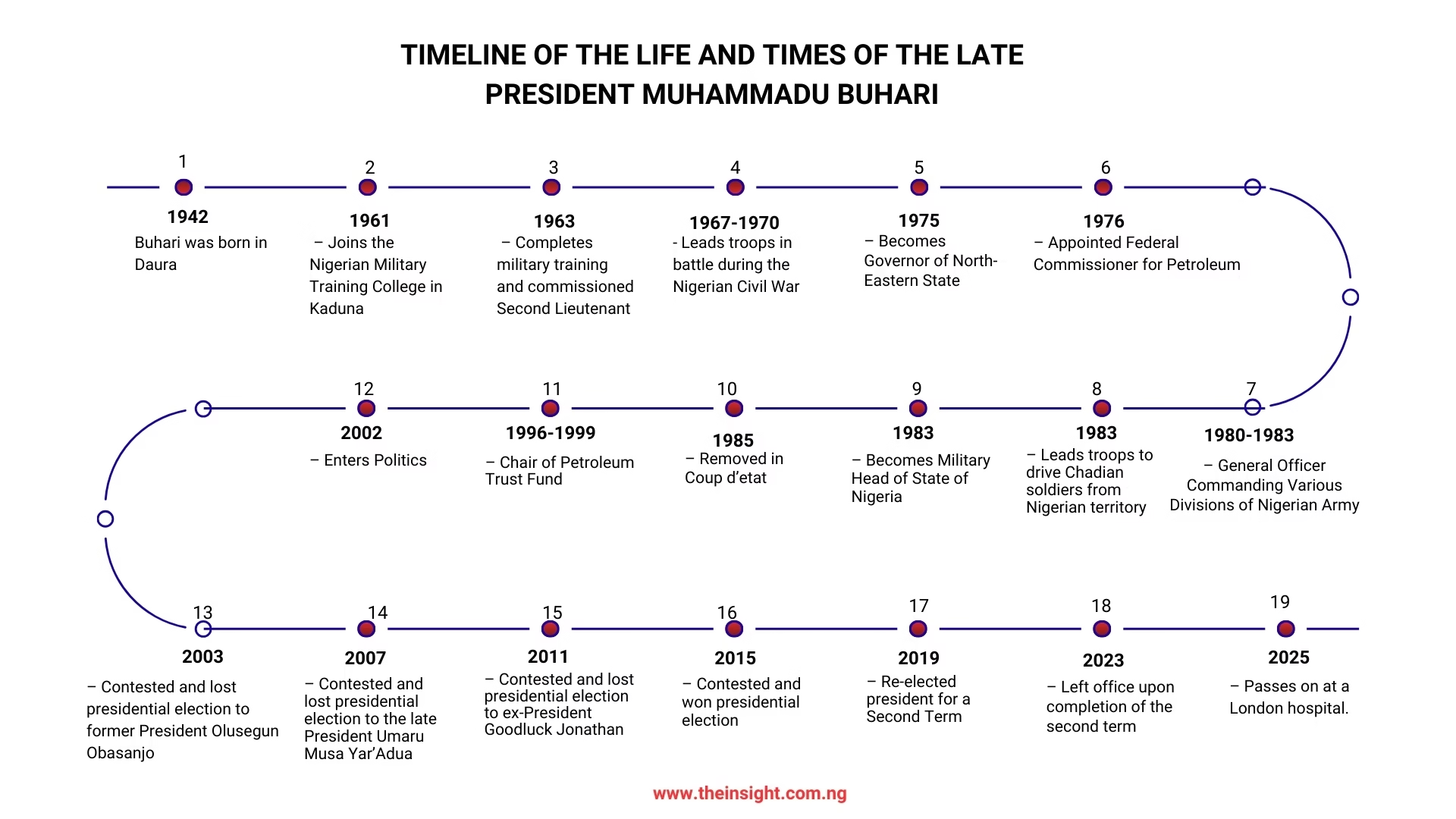
Born in 1942, the late Buhari joined the Nigerian Army in 1961, at the age of 19. He was one of the country’s military officers who took over the enormous burden of leading the country at a relatively young age. Barely four years after Buhari completed his military training in 1963, the Nigerian Civil War broke out. At the age of 27, Buhari commanded troops until the end of the war in 1970.
For a war that consumed millions of Nigerians, Buhari was lucky to have survived the brutal conflict. He was among the new crop of military leaders that emerged after the war; Buhari was assigned to important positions, first as Acting Director of Transport (1974-1975); Military Governor of the North Eastern State (1975-1976); Federal Commissioner for Petroleum (1976) and General Officer Commanding 1st and 2nd Division of the Army.
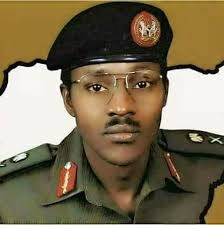
General Muhamadu Buhari
It was while he served as Commander of the Nigerian Army in Jos that Buhari carried out a daring operation against Chadian soldiers, in defiance of the orders of then President Shehu Shagari. An account of this is found in biography, Muhammadu Buhari: The Challenge of Leadership in Nigeria, by John N. Paden. It says, “In 1983, the Chad crisis emerged in the Lake Chad area. Several Nigerian areas had been occupied by Chadian soldiers. President Shagari was reluctant to use armed force. Despite Shagari’s orders to avoid military action, Buhari led his troops to the contested zone and reclaimed the lost territory for Nigeria. He was dedicated to the preservation of Nigeria at all cost, even if it might jeopardize his own career.” (P.22-23).
That defiance paid off. That same year, on December 31, 1983 when the military sacked Shagari as president, Buhari was appointed as Military Head of State, a role he played for 20 months.
The period between December 31, 1983 and August 27, 1985 when Buhari was overthrown in another military coup, was difficult for Nigerians. The military government’s austerity policy, closure of borders, anti-corruption drive, and the famous War Against Indiscipline (WAI), created scarcity of essential goods, restricted importation of goods, and saw to the implementation of Draconian laws, including death penalty, especially to drug traffickers.
Despite Shagari’s orders to avoid military action, Buhari led his troops to the contested zone and reclaimed the lost territory for Nigeria
What Nigerians would remember vividly, years after the regime had been sacked in successive coups, were the WAI and the fight against corruption, seen to be short-lived. It was this image of Buhari as an anti-corruption ideologue that sustained his political career.
Though he served as the Chairman of the Petroleum Trust Fund (PTF) under the infamous military government of the late General Sani Abacha, Buhari was not stained by the brutality and human rights abuses that characterized that regime. Rather, the projects executed under PTF contributed to his image as a man of integrity – PTF projects across the country spoke well about the Abacha government.
Between 1999 and 2023, Nigerian politics in the North was more about Buhari. The impression that he was the Messiah spread across the country at the return to democratic rule, but it was not until 2003 that he stepped out to contest for the presidency on the platform of the All Peoples Party (APP) against former President Olusegun Obasanjo.
It was this image of Buhari as an anti-corruption ideologue that sustained his political career
In spite of the massive support Buhari received from a section of the North, he lost the election to Obasanjo in 2003. He would go on to contest for the presidency against the late President Umaru Musa Yar’Adua in 2007. The result of that election was mired in controversy. The Independent National Electoral Commission (INEC) declared Yar’Adua winner, but Buhari believed he won that election.
Furthermore, he lost the 2011 election to former President Goodluck Jonathan who became the PDP’s standard bearer after the death of Yar’Adua in office in 2010. Over this period, Buhari was seen as the solution to the country’s problems – corruption, indiscipline and insecurity.
The rise of Boko Haram in the North-East and emergence of bandits in the North-West further enhanced Buhari’s chances of becoming president in the 2015 election. A former Major-General in the Army; an officer that led Nigerian troops to chase away Chadian soldiers from the country’s territory; a commander in the Nigerian Civil War, and a man who was believed to have quelled the Maitatsine Riots in Kano in 1982 in a period of 48 hours, was seen as the ideal president to redeem the country from the throes of terrorists and bandits’ attacks.
Buhari was seen as the solution to the country’s problems – corruption, indiscipline and insecurity
Though it was not exactly a thoroughfare, Buhari won the 2015 presidential elections. Remarkably, former President Jonathan congratulated him shortly before INEC declared the final results and pronounced Buhari as winner. It was not long before he would realize that yearning for the presidential shoes may be sweet dreams, but wearing them may not be as palatable at it seemed during the electioneering campaign.
Buhari would confess during his first anniversary as president in 2016 that he nearly threw in the towel to run away from power when confronted with the enormity of the problems facing the country.
One of the tunnels that civil servants used to drain the country’s resources was the so-called subsidy on petroleum products. Though Buhari had claimed during his campaign that subsidy was fraud, he could not stop it when he became president. Civil servants helped him to coin a new name for it – under-recovery. Yet, petroleum marketers connived with civil servants to steal public funds, not minding the new terminology used to repaint the fraud.
I’m not the only person running this country
Secondly, Buhari did not halt the devaluation of the Naira. When he took over, a US dollar exchanged for about N150, but a year into his government, it had been devalued to N300 to $1. This writer, at a media interview with Buhari in 2016 asked why the president allowed the devaluation of the Naira. His response was: “I’m not the only person running this country. All sorts of economists and experts come here to tell me why the currency must be devalued. They say my own position was not realistic. What should I do?”
But things became worse, as forex scams involving government officials and the Central Bank of Nigeria (CBN) became talks on the streets of Abuja. Towards the end of his tenure in 2023, it became clear that Buhari had lost control of the fight against corruption; it became so worse that the only defense Buhari had for those who accused the regime of corruption was: ‘I’m not a thief. Nobody can say I stole any money.’ But it was not enough that Buhari did not steal; some of his close aides were caught pants down in the field of corruption.

Late President Muhammadu Buhari
Perhaps, the greater disappointment Nigerians suffered under Buhari was his failure to persuade his Fulani stock to drop their arms against the Nigerian people and the Nigerian State. Attacks by Fulani herdsmen, now called bandits, began in 2011 as farmers-herders conflict. But it degenerated to cattle rustling, kidnapping for ransom, senseless killings, burning down of villages, illegal tax of farmers, and land grabbing.
As president, Buhari, who was once the patron of the Fulani worldwide, failed to rein them in. Killings by these bandits overtook the bloodshed by Boko Haram terrorists. Though Buhari claimed the killings by his kinsmen were caused by neglect by previous Nigerian governments, Nigerians did not buy that argument from him. It would be on record that as president, Buhari failed to call his own people, who caused insecurity, to order.
If Buhari had not been president, he would have died as a saint, a man who was not given the opportunity to redeem Nigeria from its woes
In the early days of his administration, Buhari had a running battle with his health. At some point in 2016 he was away to the United Kingdom on medical treatment for over 100 days. It was believed he underwent several surgeries. To many Nigerians, his survival in the first term of four years, and then for the next four-year period, from 2019 to 2023, was an act of God.
Buhari’s health condition improved in the later years, as he campaigned for his re-election with the vigour of a youth, not an 80-year-old man who had been under the surgeon’s knife severally. It, therefore, came as a surprise to many Nigerians when, in the early days of July 2025 news about his deteriorating health condition filtered into public space. Being taken to a London hospital for medical attention spoke loudly about the severity of the health crisis. His death on Sunday, July 13, 2025 after his former media aide, Alhaji Garba Shehu, told Nigerians that his health condition had improved tremendously in London, was a shock to Nigerians.
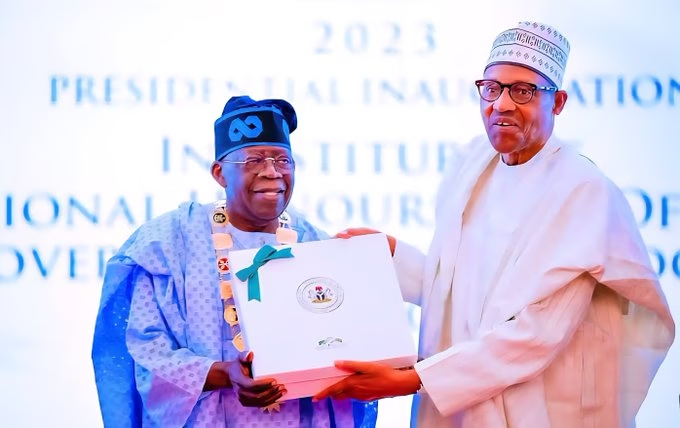
Muhammadu Buhari Handover to Presdeent Bola Ahmed Tinubu
For the Nigerian polity, it was good that Buhari was president for as long as eight years. It was enough time for him to implement all the theories he had propounded outside the parlance of power. But what Nigerians expected did not happen. As a man, he was fulfilled, having been Head of State and President of Nigeria for a cumulative period of approximately 10 years.
If Buhari had not been president, he would have died as a saint, a man who was not given the opportunity to redeem Nigeria from its woes. He enjoyed a lot of luck in Nigeria, always in the corridors of power. Buhari will be remembered as a remarkable Nigerian leader who tried his best to salvage the country.
Read Also: How Nigerians are working against God
Author

Sign up for The Insight Newsletter
Get in-depth, research and data-based interpretative reports from around Nigeria.


